

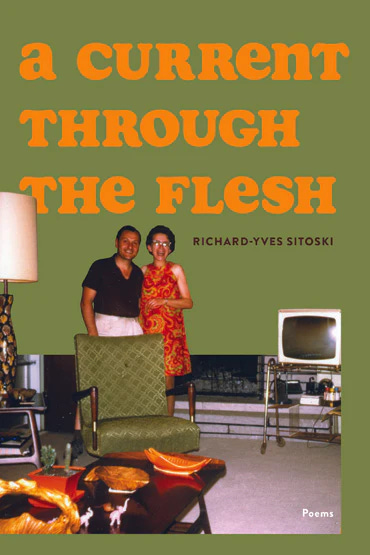
A Current Through the Flesh by Richard-Yves Sitoski
Reviewed by Bryn Robinson

In his last hours he was a derelict house,
the handle dissolving when I tried the door.
In hers she was empty as a cathedral
if everything holy within
had risen and flown away.
This contrast - between immediate grace and distant force - serves as refrain throughout Richard-Yves Sitoski’s latest poetry collection (and dissection of his immediate family and parenting), A Current Through the Flesh.
And aren’t families ripe for dissection? We have the most intimate knowledge yet there are still gaps in knowledge - why people did or said certain things. In these liminal spaces, our desire to make meaning blooms, and Sitoski’s collection effloresces electric.
What makes the poems compelling and evocative, though, is that they move beyond the compulsion to which we all easily submit - that the people in our lives who impacted us the most, and then who we impact, can be easily distilled into primary colours. As one reads on through the collection, what was known begins to take on new hues, which isn’t always a spoonful of sugar. It’s hard to acknowledge two truths at once. How someone can be a revered mother (his grandmother) but wondering why her apron is “bleached clean”, because “you’ll know a mother’s love by the stains/on her apron…” How his father continues to share the lasting residue of this trauma with his son like generation-defining radiation (“no man is an island, but your son’s Bikini Atoll”). It elevates the observations made beyond bitterness with empathy for the events that shaped those who then shape us.
Personal favourites from the collection include:
Limitations of Art, as Sitoski asks one of his dead parents whether their passing was “soft rain” or “hailstones on the hood of a car” - but more importantly, whether the heart he was “bequeathed” was “defective or full of love”. I felt the play back and forth between two opposing forces created evocative tension, especially as I reflect back on how the collection uncovered layers that eschewed the idea that reality is ever that simple to begin with.
Things My Mother Learned Too Late, in which he lists several things that his mom learned about his dad, including that “a honeymoon is a round trip” and that he was “the rain you run through…as if running/will keep you dry” and when she tried to leave, he “will be everywhere, like the sound of a single cricket”. How much of these phrases were reflecting difficulties? How much could they also reflect love?
A Guide to Canine Behaviour, in which he talks about a childhood golden retriever by initially extolling its virtues, but how these virtues depend on the individual. For his dad, it’s a good dog because it does what it’s told (noting that he, too, behaved but didn’t get treats); for his mom, the dog could take a beating and still come back (like her). He concludes by stating a preference for cats because “if a thing I love is going to kill me, I don’t want to see it coming”. To me, it was the perfect example of how grief also found its way into the crevices in our knowledge about our families and their behaviours - that bittersweet acknowledgement that some people can never be reached, even though we want desperately for them to be places of comfort and worship. The grief in the inability to find connection, or, as he remarks in another section, that “having a pulse is sufficient provocation.”
what I have cannot be cured by collagen.
I’ve got that thing where you grow up
with a father who hates everyone
including the people he loves.
While other reviews have remarked on the quirky, humorous nature of his descriptions (and I’m not entirely sure about the extent of the humour), what struck me more was their earnestness and pursuit of painful truths (“sun pokes horizon gingerly, a tongue probing a sore tooth”), laced with the element of surprise. A Current Through the Flesh is like having drink after drink laid down on the coaster in front of you, but not knowing whether the first sip will warm and comfort, or punch you in the face.
Ain’t that family for you?

About the Author
Richard-Yves Sitoski is a poet, songwriter and performer. He was the 2019–2023 Poet Laureate of Owen Sound, Ontario, on the lands of the Saugeen Ojibway Nation (treaty territory 45 ½). He is co-editor, with Penn Kemp, of Poems in Response to Peril: An Anthology in Support of Ukraine, profits from which went to displaced Ukrainian cultural workers, and is the author of the chapbook How to Be Human and the full-length collection Wait, What?. His one-person musical theatre piece, Butterfly Tongue, has played to sold-out houses. He is the Artistic Director of the Words Aloud Poetry Series and serves as Marketing and Publication Coordinator at Kegedonce Press. He lives in Owen Sound with his wife, Mary, and a thoroughly impossible cat, and uses guitars to make sounds unheard since the Cretaceous.
About the Reviewer
Bryn Robinson (she/her) lives in New Brunswick, Canada, where she uses her PhD in experimental psychology to help her support mental health research in the province. She prefers contemporary fiction, narrative non-fiction, graphic novels and poetry that is emotional, reflective, and if it can do it with humour, all the better. Bryn also writes on Campfire Notebook, where she regularly features original poetry. When not reading, she’s searching for birds in the New Brunswick forests and seascapes, camera in hand.
Book Details
Publisher : Ronsdale Press (September 2025)
Language : English
Paperback : 84 pages
ISBN : 9781553807360