

A Vacation for Victory by Kelsey M. Lonie
An Illustrated History of the Women's Land Army in Canada

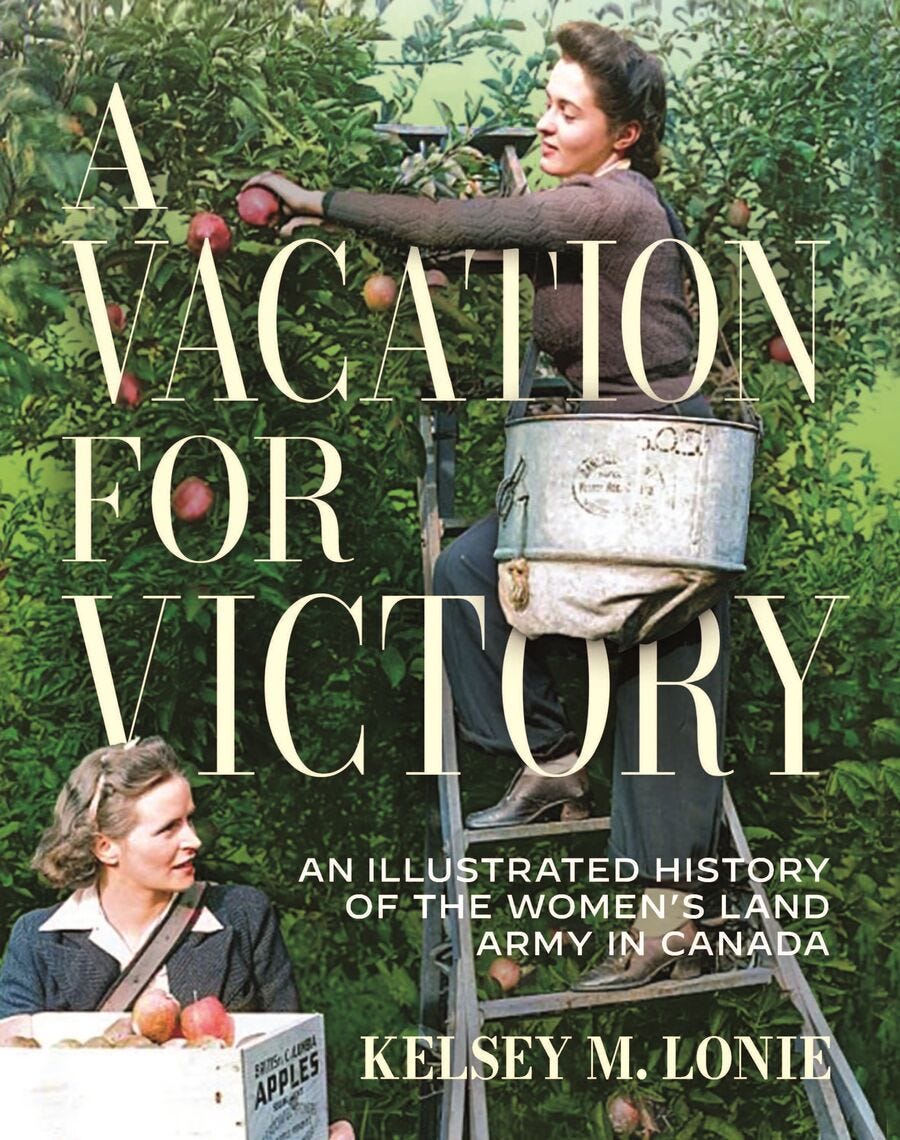
Maybe it’s just me, but I find that nonfiction books have the most resonance when you can sense the author’s passion for the topic. Sometimes the reason for that passion might be hidden, and sometimes it’s overt. When it comes to A Vacation for Victory: An Illustrated History of the Women’s Land Army in Canada, written by Kelsey M. Lonie, the source of the author’s interest is stated in the Preface.
It was stories told by Lonie’s grandmother Irene about her experiences with the Women’s Land Army that ignited Lonie’s interest in the topic. In the Epilogue, Lonie notes, “The project was sparked by my questions about Irene, simply because I wanted to know her better.”
But A Vacation for Victory does far more than tell us the history of one particular program. Lonie’s book offers a comprehensive look at the historical context and the interconnected factors of geography and culture that influenced the timing and structure of the Women’s Land Army and similar initiatives in Canada.
Though Canada’s Women’s Land Army was launched during World War II, it had its forerunners in World War I. In both cases, farmers needed help to bring in the crops as many men had left the country to enlist, and many women had moved to urban areas to work in factories supporting the war effort.
One solution implemented successfully in Ontario during World War I was the “Farmerette Brigade,” which saw women aged 16 and up supporting farm work from May to October. Lonie describes the housing, supervision, and work performed by these girls, and the efforts to keep them entertained in their off hours. As a sign of how much things have changed, “On days off, the girls were encouraged to hitchhike to Toronto, Niagara Falls, or even Buffalo, New York, for shopping and sightseeing.”
With the outbreak of World War II, the same problems with farm labour arose, and Canada wasn’t the only country to experience them. While Britain established a national Women’s Land Army in 1939, “Canada’s federal government left the organization of farm labourers in the hands of each province.” Ontario was quick to start a Farmerettes program similar to the one previously enacted, and once again, this program was highly successful.
British Columbia was unable to generate the same momentum. For example, the province initiated a Volunteer Field Fighters (VFF) program for boys, girls, men and women. This program saw some successes, but didn’t get the same enthusiastic reception as Ontario had experienced. Lonie notes, “For women living in urban areas, the VFF was viewed as a step down, and for women living in rural areas who wanted to move up in class, opportunities were too great elsewhere to remain working as a farm labourer.”
Worried about crop harvests, British Columbia approached the National Selective Service (NSS), created to help fill labour shortages, for assistance. Unable to garner enough interest within the province, they decided to recruit women aged 18 to 45 from Alberta and Saskatchewan. Lonie notes that “within two days, NSS offices in Alberta and Saskatchewan were flooded with more applications than they could place.”
These women proved to be “reliable, hardworking, experienced agricultural labourers,” and even after the war concluded, some Prairie women continued to support the British Columbia harvests. Lonie’s grandmother was one of the Prairie women who traveled to BC as part of the Women’s Land Army initiative.
A Vacation for Victory includes over one hundred photos, and given the book’s oversized dimensions (7 ½ inches by 9 ½ inches), the combination of illustrations and text makes for an appealing layout. Photos of numerous posters and ads about the programs encouraging Canadians to volunteer to support farm labour are included among the illustrations.
A Vacation for Victory also briefly discusses Women’s Land Army programs in Britain, Australia, and the United States, noting how other countries have done a better job of acknowledging and commemorating participants’ contributions. Canada, on the other hand, “has made minimal effort to highlight the contributions of our Women’s Land Army.” Yet, as Lonie states, “Canadian women were just as essential to the food front as women in other countries.”
At the same time, she acknowledges that “perhaps it is difficult to create national tone and memory for a program that was used in various ways based on different provincial needs.” Lonie adds that there have been some localized efforts in Ontario to celebrate women’s contributions to farm work during World War I and II. However, “very little has been written about the movement of prairie women into B.C.”
A Vacation for Victory helps to fill the knowledge gap, doing a thorough job of unearthing information about the Women’s Land Army. Lonie’s efforts to include the voices of those involved, and to make visible a part of history that has to date been somewhat obscured, make A Vacation for Victory well worth checking out for those interested in women’s history, and what happened on the home front during World War I and II.

About the Author
Kelsey M. Lonie (BEd, MA History) was raised on a cattle ranch in Southern Saskatchewan, a setting that fostered her passion for the history of this province and the women who helped shape it. After nearly a decade as a classroom educator, she is now the Regimental Historian for the Royal Regina Rifles and the Executive Director and Chief Historian of Royal United Services Institute Regina. Kelsey sits on the board of directors for the Organization of Military Museums Canada (OMMC) and acts as editor of its quarterly Bulletin.
About the Reviewer
Ontario resident Lisa Timpf writes poetry, book reviews, short stories, and creative nonfiction. Her speculative poetry collections Cats and Dogs in Space (2025) and In Days to Come (2022) are available from Hiraeth Publishing in print and electronic formats. You can find out more about Lisa’s writing projects at http://lisatimpf.blogspot.com/. Lisa is also on Bluesky, @lisatimpf.bsky.social, and her author Facebook page is @lisa.timpf.author.
Book Details
Publisher: McGill-Queen’s University Press
Language: English
Release date (Paperback): May 19, 2026
Pages: 304 pages,
Format: 7.5 x 9.5 inches, 110 illustrations, colour throughout
ISBN-10: 0228027616
ISBN-13: 978-0228027614