


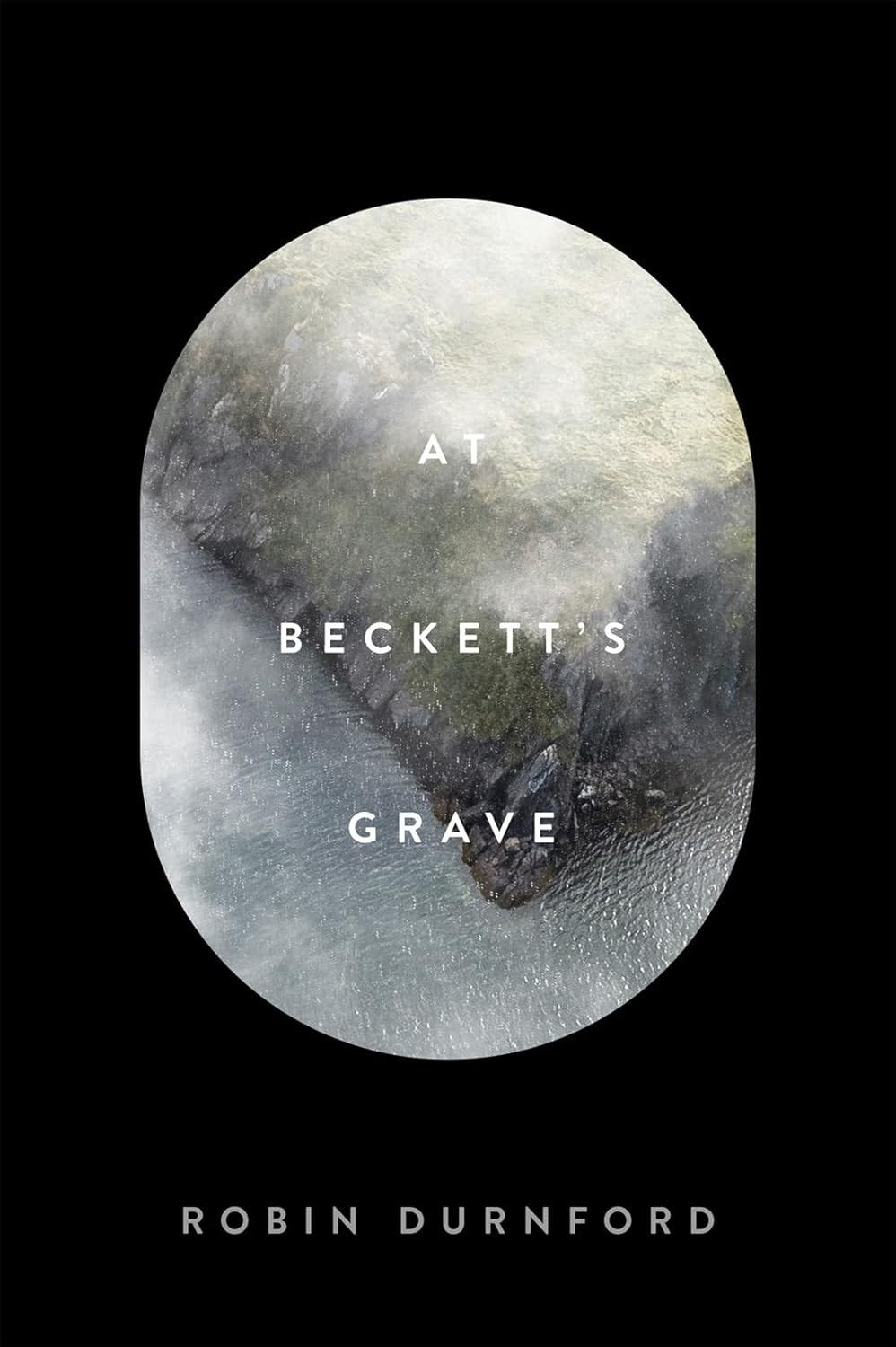
Robin Durnford’s fourth poetry collection is titled At Beckett’s Grave, but it isn’t really about the 20th-century existentialist writer Samuel Beckett. It’s a quietly articulated personal journey through the landscapes of loss, culminating in a visit to the Parisian cemetery where Beckett is buried. The book starts with a baby, conceived as a work of abstract art: “… the baby’s eyes / hidden under lids and we / want to see what colour // of dark marble that expanse / of sea-blown wonder will give / us …”.
“The poems in this collection deal in grief, not only for the dead but also the premonitory grieving that arises from loving and knowing it isn’t forever.”
The poems in this collection deal in grief, not only for the dead but also the premonitory grieving that arises from loving and knowing it isn’t forever. “I // want joy, to return to / joy but it’s another miracle that doesn’t live up / to scrutiny,” she muses, “people want it too much, conjure it, then it slips / from their faltering hands // then they remember each moment is ordinary / as any black-eyed human’s death // eyes emptied of the twinkliest stars / staring you through the / night’s clearness / light, resplendent”.
Durnford’s style is measured, calm, and contemplative. She puts distance between thought and object, between object and perception, between perception and emotion. The description is largely of thoughts, even of thoughts about thoughts, as in the above passage where the desire to feel joy is subjected to scrutiny and found unsatisfactory. This reserve allows Durnford to address mortality philosophically, and allows the reader to savour the formal qualities of the writing without being pummelled by emotion.
These formal qualities are interesting. Durnford uses enjambment strategically to fashion a fulcrum between two potentialities, as in the opening lines of “Sour Apples” where she writes, “enough poems about my son / can’t exist without me / blurting out the beginning”. She achieves verbal flourishes with the invention of words like “tomfoolhardy”, which appears in the last lines of the poem “Against Seasons”, reading “that green bird flying already / squirrels chitter at my cantankerousness / how tomfoolhardy we are”.
Durnford invokes and expects a baseline level of cultural literacy in the Western Romantic-modernist tradition. Poems in this collection sport epigraphs from e.e. cummings, T.S. Eliot, John Keats, Franz Kafka, Friedrich Nietzsche, Ezra Pound, William Wordsworth, Virginia Woolf, and surrealist painter/poet Dorothea Tanning, as well as Dante, Shakespeare, and the Magna Carta. The work is divided into two sections labeled “Act I” and “Act II” each introduced by a quotation from Samuel Beckett. Other poems are tagged geographically in manner that implies membership in a class for whom travel is normalized, ranging from Puget Sound to St. John’s to Montréal to Paris to somewhere in the Arctic. Readers who are less widely read or less far-reaching in their movements may find their imposter syndrome triggered, even as those who feel at home with these names and places will enjoy the resonances at play.
The last stanza of the final poem in the collection uses a term of art, “proem,” which my Concise Oxford defines as “preface or preamble to book or speech; beginning; prelude.” Having to run off to the dictionary at the very end of the book did rather pull me out of the flow and diminish the emotional force of the conclusion. On the other hand, the physical act of consulting another book to understand this one does highlight the intertextuality of the work (and of course, a more academic reader than myself would not have been brought up short by this bit of technical vocabulary). At Beckett’s Grave is a smooth, sophisticated collection for literary insiders, a sparkling game with deeply human concerns at its core.

About the Author
Robin Durnford teaches English literature at John Abbott College and is the author of A Lovely Gutting.
About the Reviewer
Dawn Macdonald lives in Whitehorse, Yukon, where she grew up without electricity or running water. She won the 2025 Canadian First Book Prize for her poetry collection Northerny. She posts weekly at Reviews of Books I Got for Free or Cheap (on Substack), as well as reviewing for journals and for The Seaboard Review of Books.
Book Details
Publisher : McGill-Queen’s University Press
Publication date : Sept. 16 2025
Language : English
Print length : 120 pages
ISBN-10 : 0228025648
ISBN-13 : 978-0228025641
