


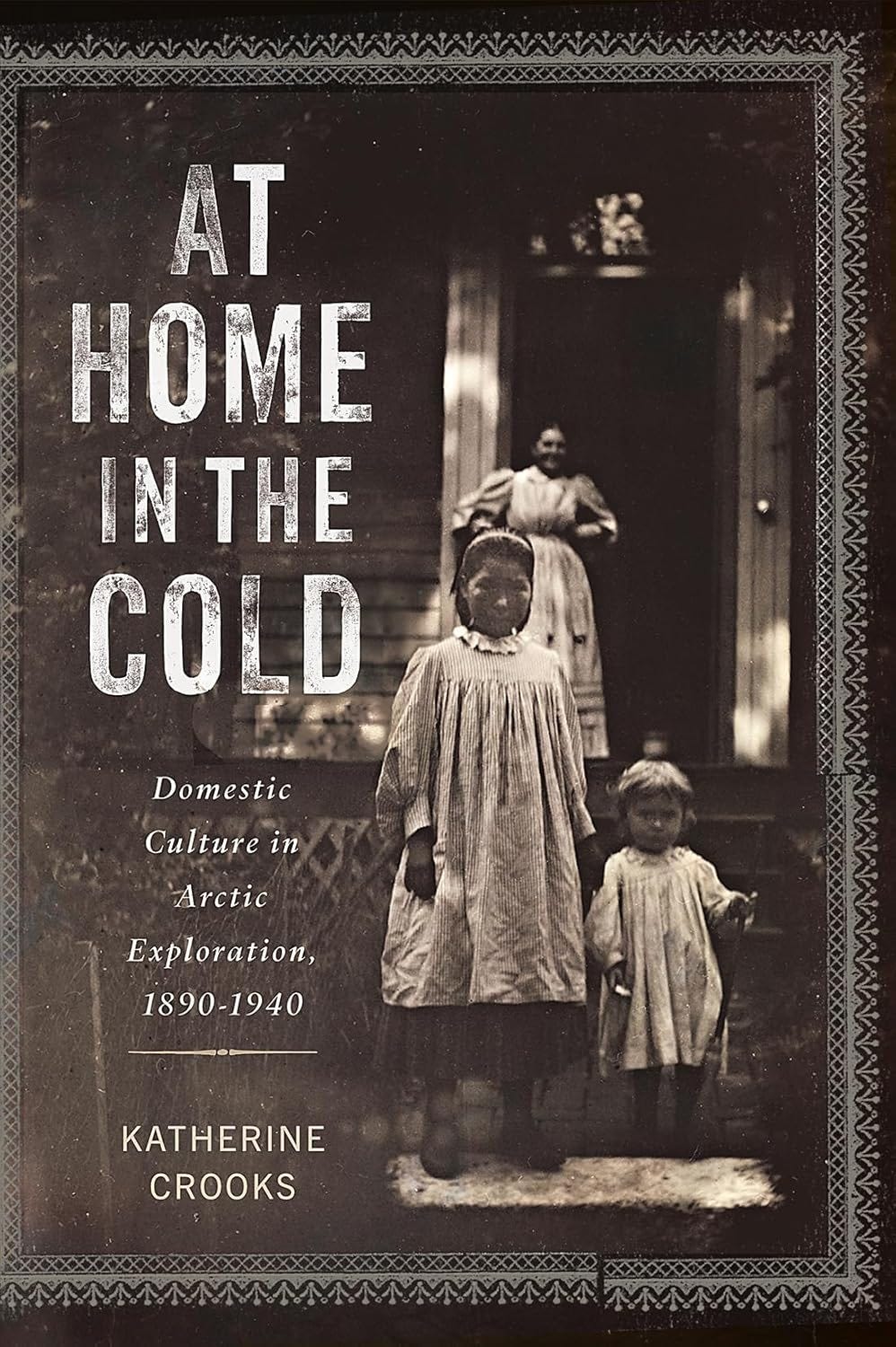
At Home in the Cold is an academic examination of the idea of “home” as seen and documented by five women who experienced cross-cultural life in the Arctic. In many ways, travel to and from the Arctic was the only thing these five women had in common. Still, Crooks examines their experiences in order to understand their concepts of “home” and how that understanding was challenged or supported by underlying beliefs that the culture of white America was inherently superior to that of the Inuit of Ellesmere Island and Greenland.
The first two women Crooks considers had some elements in common. Mina Hubbard and Josephine Peary both travelled to the Arctic willingly, Hubbard because her explorer husband had starved to death there, and she wished to defend his posthumous reputation. Josephine Peary went north with her husband to support his attempt to reach the Pole, to show her faith in his exploits, and to reinforce his belief that the Arctic could be successfully settled by white people who learned to live, travel, and thrive from the resident Inuit.
As Crooks argues, Hubbard, having lost her beloved husband, was fairly quick to abandon her attachment to her southern home once he was no longer there. Travelling with some of the same companions who had accompanied her husband, she accommodated herself to the bush, developed an affectionate relationship with her Cree and Settler guides, and completed the journey of exploration and mapping that her husband had attempted. Crooks writes that by “developing close relationships with her guides,” the Cree Elson in particular, Mina Hubbard was nevertheless “able to recapture some of his sense of home as a collection of caring relationships, even in the Arctic context.” However, once she and her companions had reached the Hudson’s Bay post at George River, she reentered the world of European female domestication with the Ford family, while her male companions made themselves a camp nearby.
While Mina Hubbard could legitimately claim to be an explorer, Josephine Peary did not and apparently did not wish to. Josephine was her explorer husband’s support and comfort. What made Josephine’s Arctic experience stand out was that she gave birth to their baby in Greenland. She lived on the expedition’s ship and was accompanied by an experienced midwife, so she wasn’t actually living with the Inuit at any point. Josephine went north several times and spent one winter frozen into the ice while her husband was away travelling, but she was in no sense living like an Inuk. During her time in the north, she kept diaries and wrote about her experiences so that she became quite a celebrity in America. Furthermore, her writings about her daughter Marie, the “Snowbaby,” made the child almost as famous as the parents.
Crooks’ third Arctic woman was a different kettle of fish. Born in the north into a Settler family, Elizabeth Ford was secure as part of an established Hudson’s Bay Company trading family. She spoke fluent Inuktitut, was familiar with most aspects of Inuit life at George River and Nachvak, and was happily married to another member of the Ford family, a half-cousin with whom she had two daughters. While Ford travelled in the north, and was familiar with Inuit culture and language, and had some Inuit heritage through her mother, she was not and never claimed to be an “explorer,” or even particularly associated with geographical exploration. In 1923, Ford’s husband, William Ford, and his co-worker, Scotsman C. G. T. Shepherd, drowned in a boating accident, leaving both Elizabeth Ford and Sarah Shepherd widowed and pregnant. Sarah did not recover from childbirth, although Elizabeth cared for her and for Sarah’s baby along with her own two girls.
Elizabeth, at this point, was prepared to raise the Shepherd baby with her own children, but Ralph Parsons, the district manager of the HBC, intervened at this point. Sarah’s parents wanted the child, so Parsons arranged for Elizabeth and all the children to go by ship to St. John’s, where the grandparents were to meet them and take the baby back to Scotland. Some accounts report that the ship had delayed departure waiting for Ford to arrive, and when she did, they took the baby and immediately cast off for Scotland, leaving Elizabeth and her children abandoned on the waterfront. In fact, Ralph Parsons had ensured that she had a small allowance from the HBC, and some savings inherited from William, but once her own daughter was born in St. John’s. Elizabeth had to find some way to support herself and her family. Her older brother owned a small hotel and photographic studio in Twillingate, so Elizabeth went there to work for him.
At Twillingate, Elizabeth lived next door to an older woman, Isabella Blackmore, who became a friend. Blackmore’s son Harry, a sheet metal worker, eventually. moved for employment to Indianapolis in 1916, and his mother joined him in 1919. Elizabeth and her children followed in 1920, when she and Harry married and had another daughter. Without denying her Inuit heritage, Elizabeth, up to this time identified as Settler, but Indiana’s miscegenation laws “prohibited interracial marriages between white and non-white citizens,” so both Elizabeth and her children were officially identified as white. In total, Harry and Elizabeth had three daughters, two of whom died in infancy, and according to Crooks, their surviving daughter, Mary Buckner, speculated that the stress of these losses was what led the couple to divorce.
The lives of the last two Arctic women Crooks examines are entangled with one another, not least because, unlike the other three, their travels took place when they were children and impacted them for the rest of their lives. One of these girls was Marie Peary, the “Snowbaby,” born in Greenland in 1893, the other Eqariusaq, born around 1881 in Smith Sound. The travels of Hubbard, Josephine Peary and Ford were of their own volition. Those of Marie and Eqariusaq were wished on them by their families.
Marie Peary’s claim to Arctic fame was that she was born there and spent time there as a toddler. She went back there with her parents on a summer trip in 1900, then again when Peary’s relief ship became frozen into the ice at Ellesmere Island, and finally in the summer of 1902. Between the ages of 7 and 40, Marie Peary did not venture into the Arctic, returning only to oversee the dedication of a monument to her father in 1932.
The other girl, Eqariusaq, went south rather than north, travelling to America in 1894 as a companion and nursemaid to Marie for a year. From the moment the ship crossed the Arctic Circle, Eqariusaq was required to dress in European clothing, bathe regularly, have her hair cut, and adopt American manners and habits. She also had to sleep alone, probably for the first time in her life. She was addressed as Miss Bill, was not allowed to eat raw meat, and upon return to her homeland rejected all the changes she had been required to make while living with the Pearys.
What is clear is that the lives of both girls were used to publicize the Peary expeditions, to sell Josephine’s books and lectures, and to convince the public of the superiority of the American way of domestic life. While Marie made her “Snowbaby” childhood the basis of a lifetime of celebrity and income, Eqariusaq’s American sojourn seems to have brought her nothing but complete rejection of the European way of life. According to Crooks, “Eqariusaq’s trip to America had proven to be a successful publicity stunt and fundraising venture for promoting the Peary family’s Arctic mythology and ambitions.” Crooks concludes that Eqariusaq’s contacts with the Peary family “embody the disruptive and at times tragic Inughiut experience of intercultural collaboration and exchange.” At least she arrived back home alive and in good health, which is more than can be said of some of her relatives who followed her south.
Crooks’ suggestion that the northerners “found urban America to be a difficult place to live compared to the northern places in which they felt at home” is not an easy argument to disagree with. Still, it would seem that her long examination of the five women she focuses on suggests that this had less to do with a harsh environment or a different culture than it had to do with simple out-and-out racism. The Americans who went north with Peary, and those the Inuit encountered when they went south, had a deeply embedded conviction that white people were inherently superior to any other race, including Inuit. Given the economic advantages white people had, with access to trade goods, it is not surprising that Inuit were easily dominated in domestic spaces, both at home and abroad. It stands to reason that only Elizabeth Ford, with her dual heritage and her more balanced exposure to both cultures, was the only one of the five women who was comfortable in the domestic spaces of both cultures.

About the Author
Katherine Crooks is a postdoctoral research fellow in northern history at Mount Saint Vincent University.
About the Reviewer
Robin McGrath was born in Newfoundland. She earned a doctorate from the University of Western Ontario, taught at the University of Alberta, and for 25 years did research in the Canadian Arctic on Inuit Literature and culture before returning home to Newfoundland and Labrador. She now lives in Harbour Main and is a full-time writer. Robin has published 26 books and over 700 articles, reviews, introductions, prefaces, teaching aids, essays, conference proceedings and chapbooks. Her most recent book is Labrador, A Reader’s Guide. (2023). She is a columnist for the Northeast Avalon Times and does freelance editing.
Book Details
Publisher : McGill-Queen’s University Press
Publication date : Nov. 18 2025
Language : English
Print length : 336 pages
ISBN-10 : 0228025613
ISBN-13 : 978-0228025610