

Bad Advice by Susan Carpenter
Reviewed by Ezra Anderson

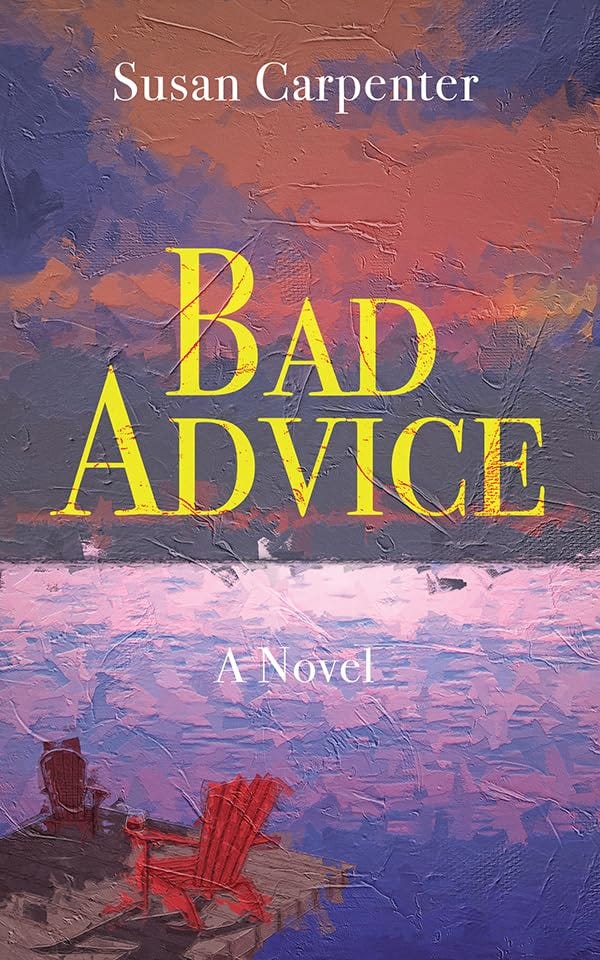
When Empathy Turns Risky
A female therapist sets a boundary. A male patient crosses it. In Bad Advice, Susan Carpenter transforms this unsettling scenario into a taut psychological thriller, posing urgent and uncomfortable questions: when a woman identifies danger, why is she still so often asked to prove it? When does empathy tip into liability? And what drives groups to turn on women who insist on protecting themselves?
The novel follows Tess, a Toronto psychologist who excels at the disciplined containment of other people’s pain. At thirty-nine, she is professionally successful, well respected and privately unravelling. Tess constructs her life around discretion, control, and emotional distance. Carpenter vividly conveys the emotional vigilance required to sustain such a posture: how self-command can harden into isolation, and how empathy, carefully cultivated as a clinical skill, can be pernicious.
That risk arrives in the form of Hal, a troubled patient who straddles the line between therapeutic dependence and personal threat. Bad Advice underscores the double-sided nature of empathy. Tess has learned to resist easy judgments, embrace contradictions, and listen for injury within aggression. Her psychological distancing skills trigger Hal, who feels thwarted and threatened when women assert boundaries. Their tension highlights how empathy is a gendered expectation, demanding women to show generosity even when faced with physical danger.
“In its concerns and execution, Bad Advice aligns with a recent wave of Canadian fiction that pairs literary style with narrative urgency to explore women’s interior lives.”
When Hal follows Tess to her hometown of Midland, the situation turns deadly. What began as a private conflict culminates in a chilling act of random violence. Tess’s fear for her personal safety is misread by the townspeople as evasion and moral ambiguity. In their eyes, her past professional relationship with Hal is grounds for suspicion. After taking brave steps to defend herself, Tess is treated as if her motives demand explanation.
Midland adds to the novel’s foreboding atmosphere. The lush green landscape of Ontario cottage country is littered with dark memories, incessant gossip, and unfinished business. The town watches, interprets, and remembers selectively. Carpenter ably captures the claustrophobia of intimate communities, where surveillance masquerades as care and judgment is delivered as concern. Tess is pursued not only by a dangerous man but by a social world primed to misread her.
Carpenter’s prose is one of the book’s main pleasures—crisp, stylish, and psychologically precise without sacrificing momentum. She has a clear sense of structure and a sharp ear for the moral evasions hidden in everyday speech. The novel is also darkly humorous, offering a pointed critique of how social cruelty often comes disguised as truth, fairness, and compassion. Through wit and wordplay, Carpenter reveals the disconnect between genuine danger and the platitudes used to mask it.
In its concerns and execution, Bad Advice aligns with a recent wave of Canadian fiction that pairs literary style with narrative urgency to explore women’s interior lives. Readers of Mona Awad, for instance, will admire Carpenter’s piercing social insights; fans of Ashley Audrain will prize her command of suspense grounded in psychological distress. However, Carpenter’s voice remains her own, particularly in its attention to the moral theatre of empathy and the penalties imposed on women who stand up for themselves.
Bad Advice derives suspense less from overt menace than from the pressures that shape how threats are understood. Carpenter frames the novel around pursuit and interpretation, tracing the shift from belief to suspicion and, ultimately, demonization. Darkly entertaining and sharply observed, Bad Advice offers the satisfactions of a propulsive literary thriller while leaving a quiet, persistent unease about the social pressures shaping women’s lives.

About the Author
SUSAN CARPENTER is a writer, actor, and teacher whose short fiction has appeared in numerous publications. A graduate of Western University and the Humber School for Writers, she has taught memoir, short fiction, and crafting stories rooted in real life with a sharp, humorous edge. She lives in Calgary with her husband and their pony-sized rescue dog. Bad Advice is her debut novel.
About the Reviewer
EZRA ANDERSON is a writer and bookseller living in Toronto.
Book Details
Publisher: Now or Never Publishing
Publication Date: April 15, 2026
Format: Trade Paperback
ISBN: 9781989689974