

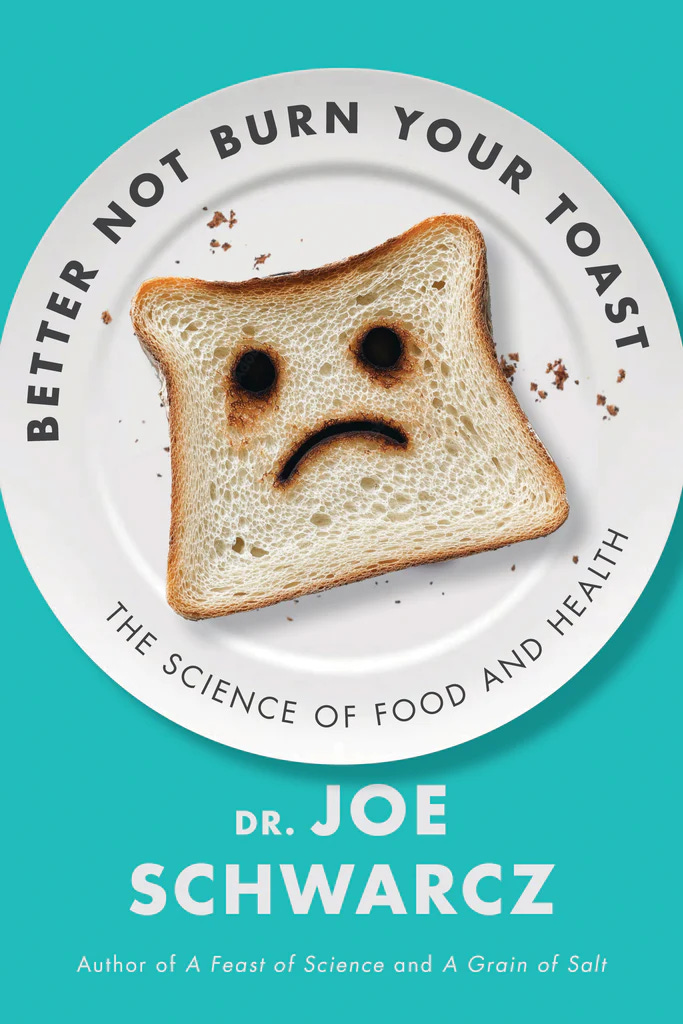
Do mushrooms and tomatoes have health benefits? What happens to foods cooked at high heat? Should you be concerned about food dyes? What about highly processed foods? These are some of the questions Dr. Joe Schwarcz examines in Better Not Burn Your Toast: The Science of Food and Health.
In Better Not Burn Your Toast, Schwarcz debunks myths, questions effectiveness claims, and offers cautionary notes about the foods we eat and the medicines we use. The book consists of short sections, each dealing with specific issues or questions. Because of its nature, Better Not Burn Your Toast offers a number of convenient stopping places, making it the sort of book you can pick up and put down without losing the narrative.
“Schwarcz’s writing is easy to follow, and the use of humour, often in the form of irony or light sarcasm, makes the book entertaining.”
Schwarcz’s inquiries are wide-ranging, and often include the history of particular items (like, for example, the use of opioids). Where research is available, he offers his view on whether that research is reliable or suspect, providing reasons. Sometimes, the science isn’t definitive, and he states when this is the case.
Among the chapters I found particularly interesting were those on weight loss drugs. Here, Schwarcz examined the development of various popular weight loss drugs, discussing the pros and cons, how they work, and future areas of research. Chapters on counterfeit drugs, acetaminophen, food dyes, and the chemical changes that take place when foods are cooked at high temperatures were also of particular interest.
Schwarcz’s writing is easy to follow, and the use of humour, often in the form of irony or light sarcasm, makes the book entertaining.
In some cases, Better Not Burn Your Toast reinforced things I already knew or suspected. In other cases, Schwarcz provided new information that I found immediately useful. One example came in the chapter on garlic. Schwarcz explained how garlic’s health benefits are in part due to the actions of an enzyme that becomes effective once the garlic has been crushed. But Schwarcz notes that the enzyme takes time to do its work, so crushing garlic and immediately exposing it to heat will interfere with that process.
Schwarcz’s writing conveys the sense that he knows what he is talking about. Perhaps this is not surprising, given that he holds a Ph.D. in Chemistry. Better Not Burn Your Toast comes off as being well-researched and believable.
Interesting, informative, and entertainingly written, Better Not Burn Your Toast takes the form of a wide-ranging science-based inquiry, and the inclusion of historical background should appeal to those with curious minds. Readers who want to learn more about the health effects of the foods we eat, the methods we use to prepare them, and the medicines we use should enjoy this book.

About the Author
Joe Schwarcz holds a Ph.D. in chemistry and is the director of McGill University’s Office for Science and Society, which aims to separate sense from nonsense. He is the recipient of numerous awards for teaching chemistry and interpreting science for the public. Dr. Joe has hosted a radio show on science for 43 years, appeared hundreds of times on television, writes The Right Chemistry column for the Montreal Gazette, and is the author of 19 books. He lives in Montreal, QC.
About the Reviewer
Ontario resident Lisa Timpf writes poetry, book reviews, short stories, and creative nonfiction. Her speculative poetry collections Cats and Dogs in Space (2025) and In Days to Come (2022) are available from Hiraeth Publishing in print and electronic formats. You can find out more about Lisa’s writing projects at http://lisatimpf.blogspot.com/. Lisa is also on Bluesky, @lisatimpf.bsky.social, and her author Facebook page is @lisa.timpf.author.
Book Details
Publisher: ECW Press
Publication date: Nov. 4 2025
Language: English
Print length: 240 pages
ISBN-10: 1770417915
ISBN-13: 978-1770417915