

Bluenose Bluebirds by Brian Douglas Tennyson
Nova Scotia's Military Nurses in the Great War

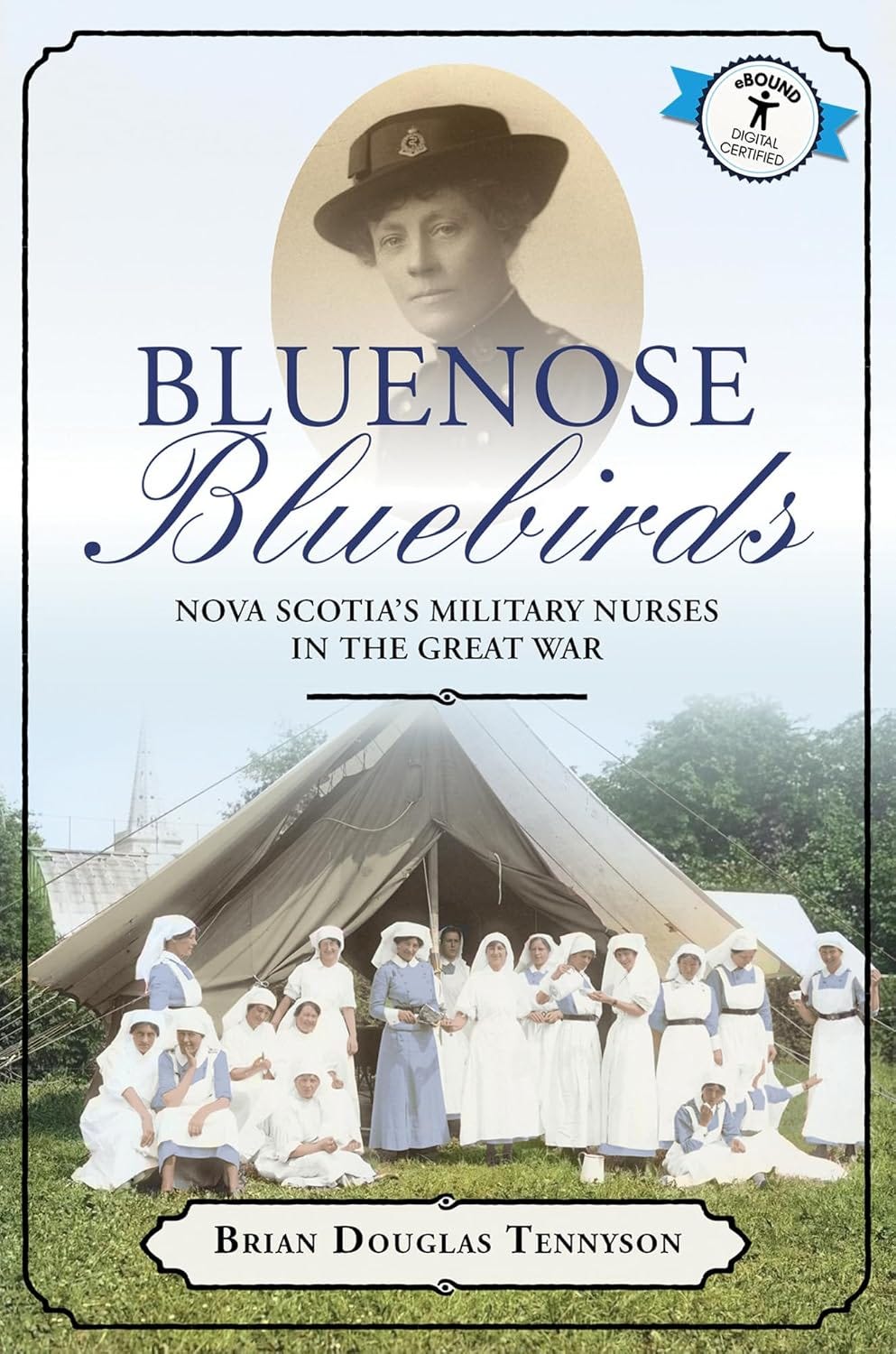
In 2017, Brian Douglas Tennyson published Nova Scotia at War 1914-1919. While Tennyson included military nurses in that account, he came to realize they merited more attention than he was able to give them in that particular book.
That led to Tennyson researching and writing Bluenose Bluebirds: Nova Scotia’s Military Nurses in the Great War. The nickname “bluebirds” comes from the uniform worn by the Canadian nurses, which consisted of a blue dress with a white apron.
To gather the information he needed, Tennyson scoured through personnel records on the World War I database at Library and Archives Canada, as well as consulting the Canadian Virtual War Memorial, genealogy records of the Nova Scotia Archives, and census records.
Tennyson performed internet searches and read books, journal articles, and postgraduate dissertations related to the topic. He also consulted memoirs, diaries, and other material written by and about the nurses themselves.
“Bluenose Bluebirds is a thoroughly researched, well-organized book that honours the diligent efforts of these nurses, highlighting in particular those connected to Nova Scotia.”
The first part of the book “briefly tells the stories of Nova Scotia’s military nurses as revealed in their letters, diaries, memoirs and biographies.” We learn what it was like to ship out for overseas deployment, about the various locations where nurses were assigned to work, and about some of the perils they faced and the conditions they worked under.
Not all of the action took place across the ocean. As Tennyson notes, Nova Scotia was the only province in Canada “that was directly exposed to the war.” Vital cargo for the war effort was shipped out of Halifax and Sydney. Halifax was also the major port of departure for soldiers, and the place where many wounded were received on their return.
In addition, Halifax was the “only community in Canada that experience massive destruction and loss of life due to the war” when the Mont-Blanc and the Imo collided on December 6, 1917, causing the Halifax Explosion. To assist with the response to that event, the Canadian Army Medical Corps supplied doctors and nurses from ships in the harbour, while doctors and nurses from “across the province, nearby provinces, and the northeastern US flooded into the city to help as well.”
In addition to the chapters providing an overview of the experiences of Canadian, and in particular Nova Scotian, nurses during World War I, the book also provides an extensive database that includes 311 Nova Scotian nurses.
The database entries, arranged alphabetically by last name, provide for each nurse year of birth and death, parents’ names, how they are connected to Nova Scotia (by birth or relocation), where they served during the war, and as much information as Tennyson was able to unearth about their lives before and after the war. In some cases, there is also information about the contribution family members (for example, brothers or husbands) made to the war efforts.
The book includes two appendices. One lists Nova Scotia hospital matrons and where they served. The other lists Canadian nurses who died in service in World War I, by year of death, then by last name, with Nova Scotians indicated in italics.
Endnotes provide references for the information mentioned earlier in the book, while a bibliography provides testament to the vast amount of research undertaken in the course of writing the book. A detailed and extensive index is also offered.
Throughout the book, photos support the reader’s ability to visualize the circumstances under which the nurses worked, as well as providing images of some of the nurses mentioned.
During the war, a staggering number of patients passed through the hands of Canadian military nurses. As Tennyson notes, all of “the 761,635 wounded or ill Canadians” as well as a number of other Allied soldiers, prisoners of war, and civilians, were tended to by Canadian nurses.
Canadian nurses who served in World War I, Tennyson says, “received 438 honours,” including one Royal Victorian Order medal. Bluenose Bluebirds is a thoroughly researched, well-organized book that honours the diligent efforts of these nurses, highlighting in particular those connected to Nova Scotia. It’s an important book that brings to light the history of these women and the significance of their contributions.

About the Author
Brian Douglas Tennyson is professor emeritus in the department of history at Cape Breton University and also served as founding director of the university’s Centre for International Studies. A specialist in early twentieth-century Canadian political history, his publications include Canada’s Great War, Percy Willmot: A Cape Bretoner at War, and Merry Hell, which was shortlisted for the Dartmouth Book Award. Brian lives in Bridgewater, Nova Scotia.
About the Reviewer
Ontario resident Lisa Timpf writes poetry, book reviews, short stories, and creative nonfiction. Her speculative poetry collections Cats and Dogs in Space (2025) and In Days to Come (2022) are available from Hiraeth Publishing in print and electronic formats. You can find out more about Lisa’s writing projects at http://lisatimpf.blogspot.com/. Lisa is also on Bluesky, @lisatimpf.bsky.social, and her author Facebook page is @lisa.timpf.author.
Book Details
Publisher: Nimbus Publishing Limited
Language: English
Publication date: April 14, 2026
Pages: 256
ISBN: 9781774715178