

Breathing is How Some People Stay Alive by Alison Gadsby
Reviewed by Steven Mayoff

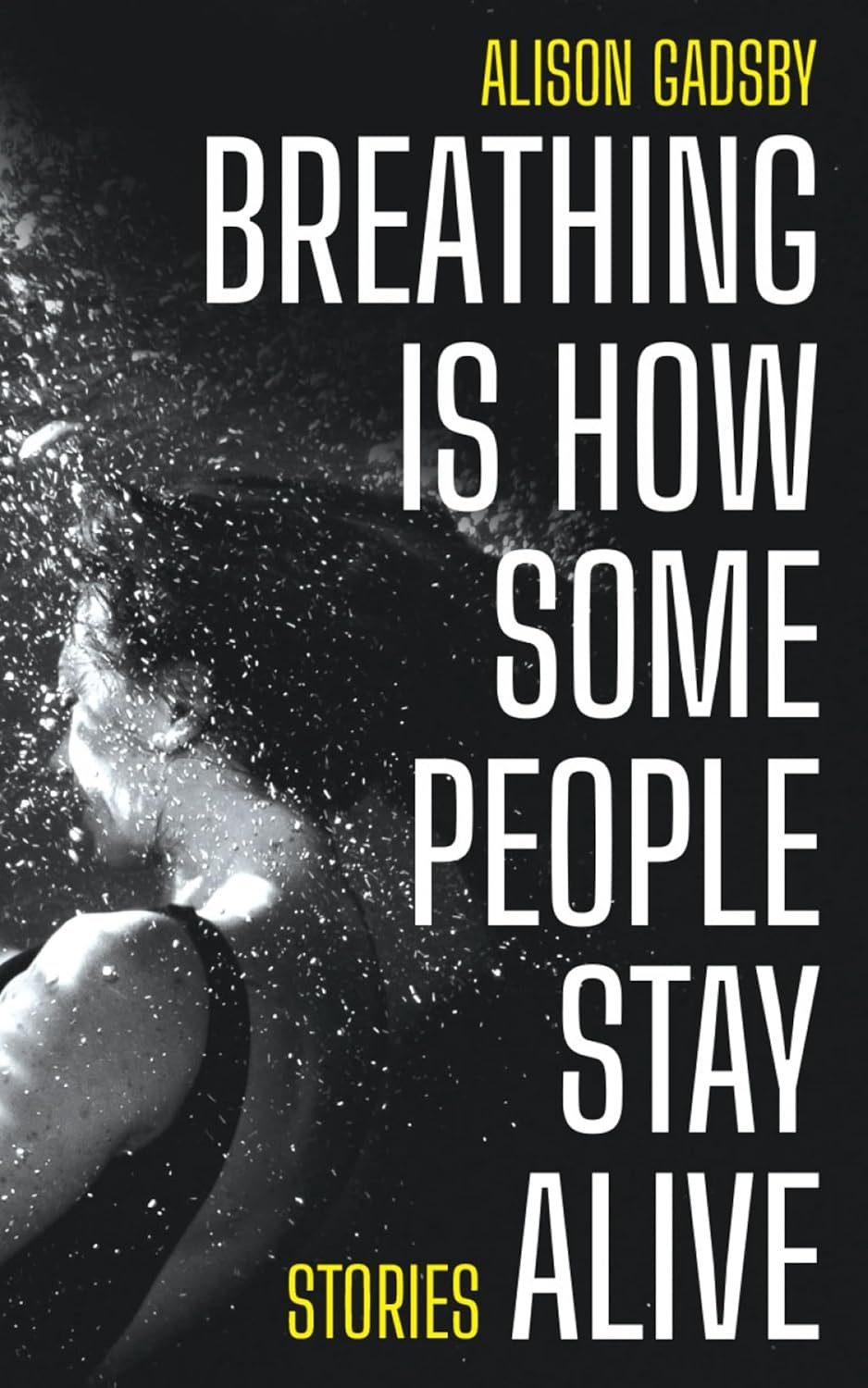
Alison Gadsby’s debut Breathing is How Some People Stay Alive (Guernica Editions, 2026) is a linked story collection, since the same characters populate most of the stories. Then there is the speculative (some might say sci-fi) aspect to the world that these people live in. The first indication of that is in the opening story, The Deal with Roger. Mirabel, a woman who has been made to feel self-conscious about her height and weight since childhood, is dealing with the progressively violent behaviour of her humanoid companion Roger, made by a manufacturer called Phantastic Phorms. Her safe mantra of “This is not appropriate” whenever Roger acts up is becoming less effective. Roger was given to Mirabel by her parents when she was younger because they believed she would never find a man of her own.
“…the stories individually bristle with their own energy. As a writer, Gadsby inhabits her fictional world with total conviction.”
The next few stories seemed to be one-offs, but then the same characters started to show up in later stories and humanoids from Phantastic Phorms were central to two others (Irreplaceable and The Going Rate for Grief). There seemed to be a kind of casual randomness in the way the stories were connected. At first, I wondered if these links were coincidental (which didn’t seem likely), or if the connections were meant to eventually dawn on the reader as a kind of gradual epiphany. That was how I experienced them.
In any case, the stories’ interconnectedness is too important to be ignored because of how certain characters can be seen in a different light at different times in their lives, giving a larger scope to the reader’s understanding of them. It’s the interconnectedness of the stories that makes these characters come alive and gives this collection its gravitas. The seeming randomness in how this is presented, can be seen as reflective of our own interconnectedness: not evident at first until one starts to pay attention.
There is no doubt that the stories individually bristle with their own energy. As a writer, Gadsby inhabits her fictional world with total conviction, exploring the complicated relationships of its denizens with unswerving commitment.
Despite the speculative flourishes of manufactured humanoids and a character who has the ability to “recycle” time, the tone of the stories is brutally realistic. There is a running pattern of parental abuse and traumatized children, all of whom seem to be trying to navigate their own histories of emotional and physical cruelty in order to salvage whatever vestiges of love might be found there.
A good example is in the story Bruises Don’t Leave Scars, where Clare takes care of her physically abusive father who is now dying of cancer. “As she softly sweeps a flannel cloth filled with shower gel over his legs, she focuses on each wine-stained splodge, rubbing them gently as if she can somehow erase them. When he dies will they disappear, removing any evidence of all this suffering? His arms and legs are now just brittle bones sheathed in tissue paper-thin skin when once they held powerfully sturdy bones buried deep beneath muscles strong enough they bruised her flesh with a light thump or swift kick.”
Another link between the stories is the image of water that gives the collection its greatest sense of unity, often in swimming pools but also in nature. Swimming, usually by children, is either a casual activity or practiced competitively, sometimes for their own pleasure and self-esteem, but also under parental pressure to excel. In these stories, water can be seen as a symbol of redemption, a means of escape, a source of respite, but also as a cause of death. In one particular moment of dark humour, a story that depicts a religious medal in an old woman’s sweaty cleavage is called Jesus is Drowning.
Gadsby’s style can frequently feel like an open wound, presenting to the reader all the raw details of her characters’ lives, both inner and outer. In Everything Was Fine Before Lisa Got Here, the arrival of a new girl disrupts the status quo of her classmates. “Rebecca thought a lot about stabbing Lisa or cutting off her long blonde braids with the scissors she stole from art class or strangling her until her glimmery pink braces popped off her teeth, but Chay said it’s probably no use because she’d definitely come back like a zombie or something.” In a later story, Between Living and Dying, older versions of Rebecca and Chay are living together and trying to deal with isolating in lockdown during the pandemic.
The Beginning of Sadness features the character (mentioned earlier) who has the ability to recycle time. Fern is preparing for her daughter Beatrix’s 10th birthday. “If Fern could recycle more than a year, she’d go back eleven years right here, right now, she would. She’d never have started the search for the perfect sperm donor, the IVF, she wouldn’t be a mother at all, if she knew this pain, if she’d ever understood the sadness Beatrix might one day feel.”
Later in this story Gadsby displays some impressively lyrical imagery. “Feels like a lifetime ago and with every birthday Fern is beginning to forget what Beatrix was like as an eight-year-old, her toddler tantrums, her first swim class, the baby teeth she swallowed in the middle of the night because she refused to let Fern pull them out. Time is like a beach, her mother says, and memories are the specks of sand. In original time you walk along the shore, sinking your feet into the present, comforted by the impressions you leave behind and excited for what lies ahead. In recycled time you stand still watching wave after wave wash away the life you made.”
Many of these stories are not for the faint of heart. What’s So Funny? is the transcript from a police interrogation of a mentally disturbed woman for the attempted murder of her father-in-law. I Don’t Want to Fall, but I Do is a harrowing and graphic account of an abduction of a woman by two men that begins: “I’m in the trunk of a car, laughing.” It is Alison Gadsby’s no-holds-barred ability to face the darkest inner reaches of human nature that makes Breathing is How Some People Stay Alive a startling debut.

About the Author
Alison Gadsby writes in Tkaronto/Toronto where she lives in a multigenerational home that includes several dogs. Her writing has appeared in various literary journals, including Blank Spaces, The Temz Review, The Ex-Puritan, Blue Lake Review and more. She is the founder/host of Junction Reads, a prose reading series.
About the Reviewer
Steven Mayoff (he/him/we)* was born and raised in Tiohtià ke/Montreal and has made Epekwitk/Prince Edward Island his home since 2001. His fiction and poetry have appeared in journals across Canada and the US, as well as in Ireland, Algeria, France, the UK and Croatia.He has had four books published: the story collection Fatted Calf Blues (Turnstone Press, 2009), which won a 2010 PEI Book Award, the novel Our Lady Of Steerage (B&B, 2015, ) and the poetry chapbook Leonard’s Flat (Grey Borders Books, 2018), and the full-length poetry collection Swinging Between Water And Stone (Guernica Editions, 2019; revised edition, Galleon Books 2025). Steven has also written lyrics, librettos and collaborated on scripts for radio and the stage.
Book Details
Publisher : Guernica Editions
Publication date : March 3 2026
Language : English
Print length : 214 pages
ISBN-10 : 1778490158
ISBN-13 : 978-1778490156