

Rum Diary: Canada, Alcoholism, and the Colonial Sweep
Paul Carlucci Reviews Canada in the Age of Rum by Allan Greer

At one point during the regrettable blur of my twenties, I was a dishwasher at a bar off the Sea to Sky Highway in British Columbia. Perks included a ten-percent discount on all drinks and food, and after every shift, we were allowed one free pint. Most of the staff would keep drinking until close, circling the coin-operated pool table, hollering incomprehensibly, and racking up enormous tabs. Every once in a while, a tiny bubble of awareness would emerge from the extensive froth of our stupors, and we’d understand just what we were doing with our so-called perks, which was funnelling a lot of our wages straight back to the employer and dramatically reducing the fee for our labour. But those bubbles were always popped by the pins of euphoria, frustration, or both, and night after night, we allowed ourselves to sink back into a toxic scheme that, it turns out, has rattled around this land for literally hundreds of years.
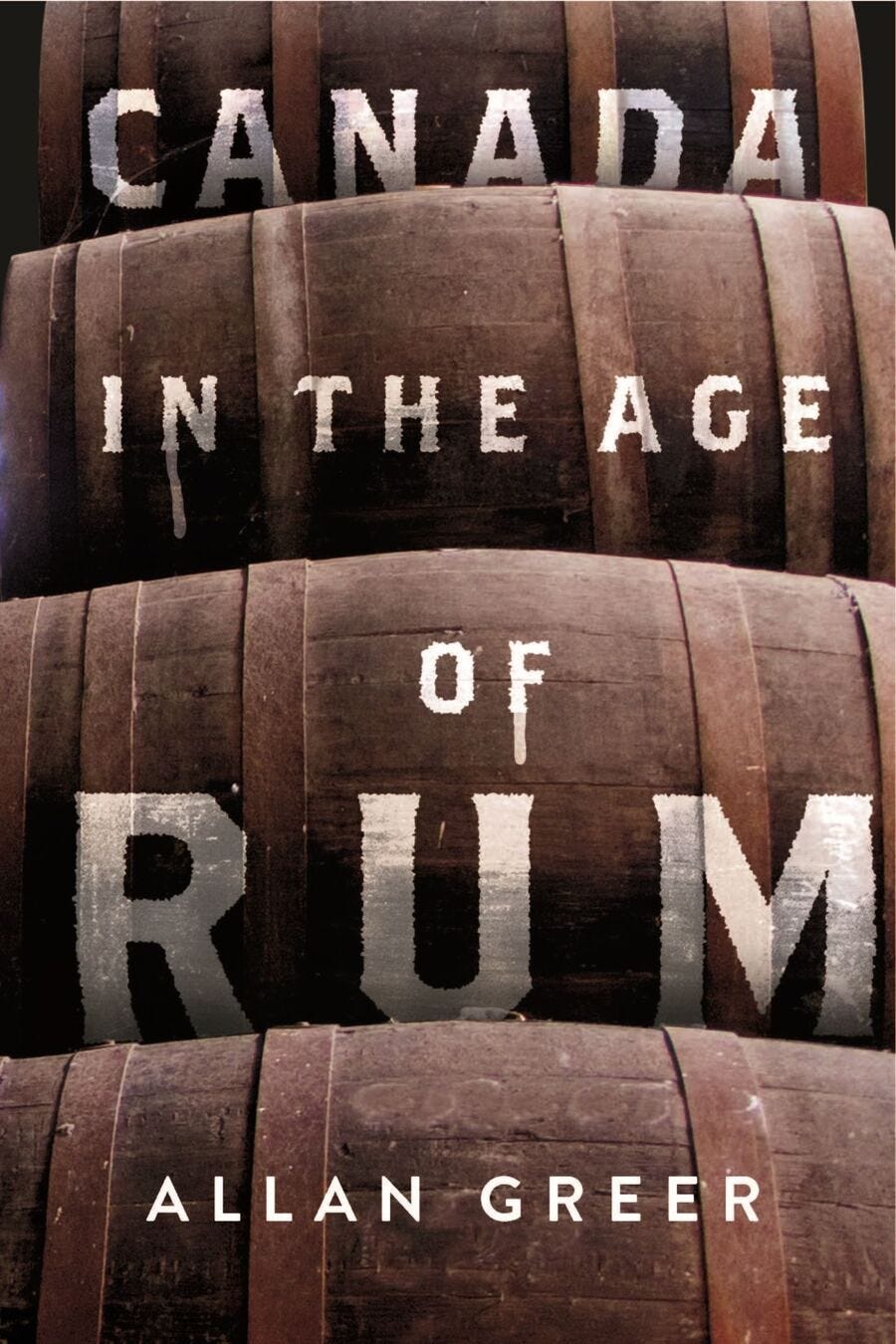
In Canada in the Age of Rum, author and McGill professor Allan Greer details an episode of our drinking history that differs in spirit from the frat-house whimsy underpinning more well-known accounts, like when John A. Macdonald threw up on stage during a debate and quipped off the embarrassment or when all the champions of Confederation got elegantly wasted on champagne in Charlottetown while courting the Maritime provinces into the fold. Instead, he focuses on how so-called kill-devil was used again and again to lure, exploit, and sicken workers across staple trades, from fishing to logging, as well as how it tied the successes of Canada’s foundational economies to the West Indies slave trade and unleashed a social devastation in Indigenous communities that was often much worse than what settlers had to endure, which was also pretty dire.
With his lively but intellectual tone, Greer begins by highlighting the ridiculous quantities of rum people drank back then, which, after some reasonable jockeying of sources, he determines to have been the face-melting equivalent of 31.2 litres of pure alcohol per person over 15 years old in New Brunswick in 1821. Again, this is rum alone, and only in New Brunswick. Today, the same age group imbibes the equivalent of 9.9 litres from all alcoholic beverages—nationwide.
Part of the reason people drank so much was because they thought alcohol had health benefits and that it kept you warm when you were stuck working in the elements, but undoubtedly, a more significant force was the employer class and the way its pox merchants offered rum first as a wage supplement and then as something that could be enjoyed on credit in their miserable labour camps, effectively indebting and indenturing workers season after season. Drinking on the job was also encouraged—and to some extent enforced—in part because the work was so awful no one would otherwise manage, but also because all those open tabs made for great lashes. That the masters pedalling this scheme were themselves exploited in different ways by the next class up doesn’t much forgive their self-interest. In fact, they remind us of human traffickers pushing opiates on sex slaves.
Throughout the book’s seven chapters, Greer explores rum’s role in capitalism and empire, its creep across the Atlantic provinces, its displacement of brandy in New France, its role in Quebec’s collapse at the hands of the English, its largely destructive impacts on Indigenous communities, its utility in the operations of the North West Company, and its ultimate decline due to temperance movements and the rise of whisky.
Today, Canadians are drinking less than ever, and some might be wondering just how alcohol got so pervasive in our society to begin with. But that question assumes a distinction between the two, and as readers of this book can reasonably conclude, booze is so fundamental to our national architecture that they’re essentially one and the same. Were it not for alcohol, rum in particular, we probably wouldn’t be here at all.

About the Author
Allan Greer is professor emeritus of history at McGill University.
About the Reviewer
Paul Carlucci is the author of one novel, The Voyageur, and three story collections, The High-Rise in Fort Fierce, A Plea for Constant Motion, and The Secret Life of Fission. He won the Danuta Gleed Literary Award and has been a finalist for two Ottawa Book Awards and two ReLit Awards. He’s a freelance editor, working with academics and research professionals, hybrid and traditional presses, and aspiring authors.
Book Details
Publisher : McGill-Queen’s University Press
Publication date : March 24 2026
Language : English
Print length : 252 pages
ISBN-10 : 022802689X
ISBN-13 : 978-0228026891