


Rhyming Compasses
In this age of free and freer verse, Richard Greene’s regular rhymes are welcome, not just because they buck a trend, but also because the rhymes are soft, light, and unobtrusive. What makes them so is the enjambment of lines and thought that flow across measured sentences and emotional responses. Greene keeps one eye on the clock, remembering time zones and untimely deaths; with the other, he follows points on a compass, tracking place and sunken ships in the Atlantic. Each of his collections of poetry features his Newfoundland roots. In his sonnet sequence, “Boxing the Compass,” he ties sea climate to rhyme: “baffling gales turned round in their weatherly / boxing of the compass, all thirty-two / points of tumult bearing on Baccalieu / or Bell Island? And things I could not see – .” These gales baffle because they contain an ever-shifting mystery at the heart of the sea and thirty-two points of Greene’s poetry repeated forwards and backwards, questioned and answered in a compass’s division and box of a sonnet.
“Greene crosses the Straits between Newfoundland and Toronto in his latest volume, Cannibal Rats.”
Boxing and baffling sea, weatherly, see, thirty-two and Baccalieu, the poet navigates an ocean of small sunken boats and whales: “An hour later, we watched through streaming glass / but I could not tell a pothead from a wave.” The poet’s hourglass is unclear, but later in life he achieves a clarifying vision of these diversions: “Forty years on, I lie through a night of gales / in your emptied house and see them pass, / blow, plunge in waters deeper than a grave.”
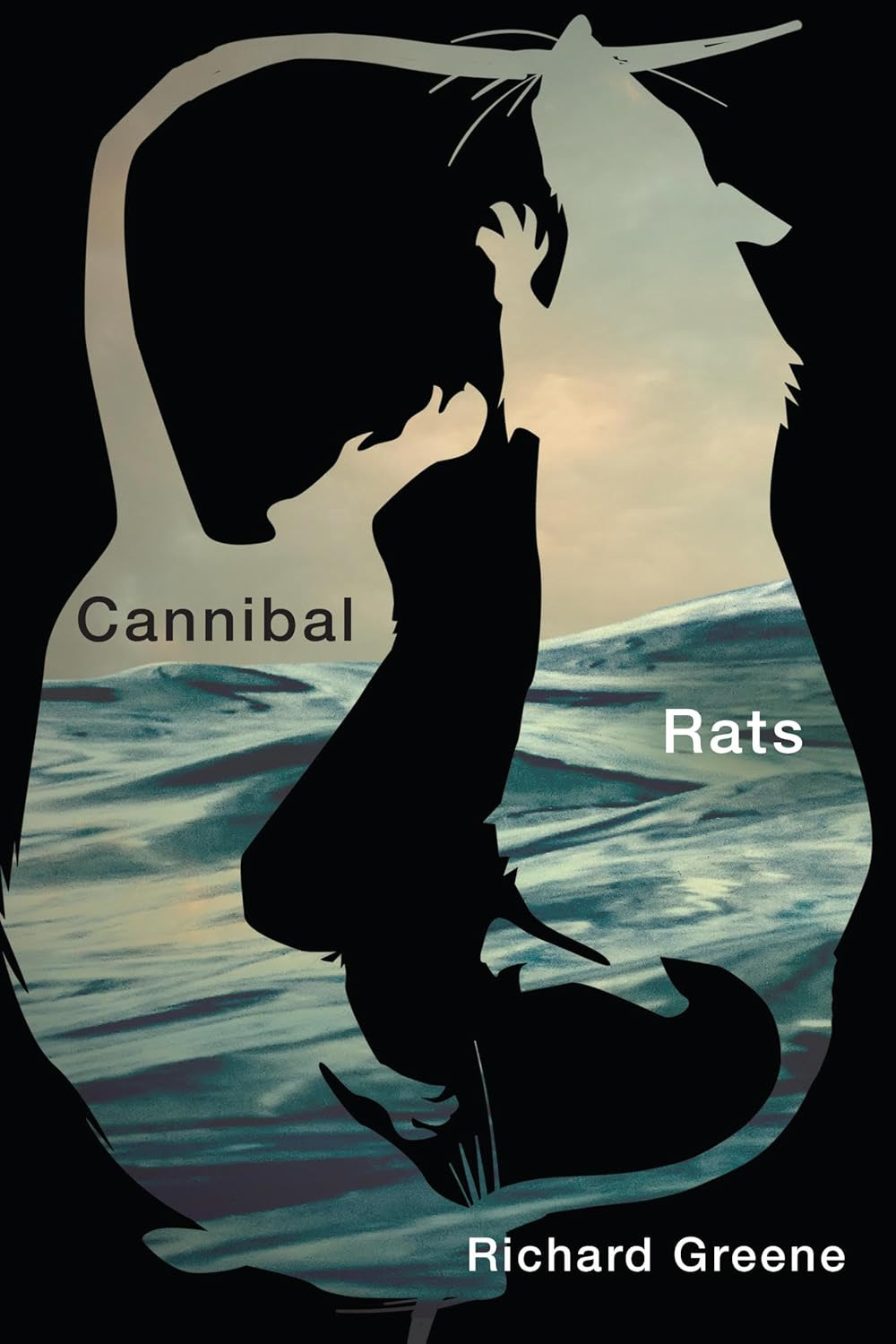
Greene crosses the Straits between Newfoundland and Toronto in his latest volume, Cannibal Rats. The opening poem presents those two creatures featured on the book’s cover:
Blue steel rusted by the sea, it was worth
only its salvage, years of South and North
Poles eating at her, while the rats who had run
aboard on mooring ropes were eating son
In varying pentameter rhythms, the poem echoes waves and running rats. Enjambed lines carry the motion from the amplitude of Arctic and Antarctic to the ship’s innards, years rubbing against a sinking instant. Opposite Poles eating at the Lyubov Orlova reflect the two rats on the cover, the eating activity reinforcing the connection of a cannibal sea. Rhymes of worth and North, run and son, are softened by enjambment and other sounds going on within lines – sibilance of steel, rusted, sea, salvage, South and son, and long internal e’s in steel, sea, only, years, and eating. The rats finish off the first sentence: “and daughter, but inside her belly – / generations of need in the galley / and the staterooms.” (Rat is silently embedded in generations.) Various levels of consumption occur in the belly of the sea, boat, and rats. Alliteration and internal “need” deflect from end rhymes. The stanza ends with a near rhyme of own and town, which is balanced by the o’s in no one and Lyubov Orlova, and internal echoes in dereliction and there: “No one wanted to own / her dereliction in this changed town / so she sat there, the Lyubov Orlova.” Time changes St. John’s and everything else in this voracious metamorphosis.
Sound waves wash through the second stanza:
Cash from Hibernia and Terra Nova
cancelled what we knew about the shipwreck,
green water running on the slanted deck,
a wooden ship broached-to and on her beam ends,
remembered, then, in song where nothing mends.
Nova turns back to Orlova, cash alliterates with cancelled, running water recalls rats running, and a series of m and n sounds tilt the chaos. Broached and beam deflect from end rhymes, while “then” pauses the memory of catastrophe.
Greene’s North Atlantic Gothic resurfaces in the next stanza where the poet has become a revenant: “Revenant myself, I may not cavil / about how art and memory unravel.” This stanza is shaped by its grammar – caesura in the middle of the first line offset by the balancing conjunction in the second, as the poet works through his dialectic of art and memory. He measures his personal past against a broader historical perspective of sunken ships and biblical parallels. He leaves Newfoundland for the mainland where he gets tenure (a permanence against the evanescence of a shipwreck), its paycheck (“found the taxpayers’ open hand”) against the cash from offshore oilfields. He is now a Jonah where he was born, confused by both fog and foghorn: “returning to my peculiar Nineveh, / I have no message: I’ve just been away.” Like the ship, the poet is in a liminal state between visual fog and aural foghorn, between mainland and island, between Nineveh and Terra Nova, and between the optical illusion of the cover’s rats and an auditory illusion of away, a way, and aweigh.
The next stanza searches for a message: “A tugboat dragged that ghost ship out to sea, / lost it when a rope broke or they let it free.” The earlier mooring ropes give way “just outside this country’s jurisdiction.” Justice, freedom, and jurisdiction carry the moral message through narrative lines, as the poet’s compass turns from Newfoundland to Ireland: “The Irish papers loved the rodent fiction,” which washes ashore in Galway, “full of cannibal rats looking for new prey.” Newness plays against tradition: “It joined all that history of drowned fleets / without song or poem but a million tweets.” “Cannibal Rats” takes its place among a thousand launched and lost ships, and even more tweets.
“Hurricane Season” also looks to Ireland after Louis MacNeice’s example. Greene has one ear in the vernacular, while the other probes deeper meanings. “Hurricane Bertha is giving up her ghost, / and from the window of the Jumping Bean / I watch the weather losing heart.” If the stanza opens with the hurricane giving up her ghost, it ends with the poet’s identification – “I’m the ghost.” Greene’s ghost haunts these lines and his origins. The second sentence completes an a b a b rhyme scheme and studies the barometer of comforting barista and disturbing atmosphere: “My dark roast / and that guy’s cup of tea are all the caffeine / they’ve sold this morning.” Like the season and ghost, the roast is darkened, while caffeine is responsible for the jump in bean. Window, watch, and weather offer some protection for the poet’s losing heart. The local Jumping Bean contrasts with the national Tim Hortons where there is “always gridlock / in the drive-through where the taxi-men load / up on crullers; inside, it’s RNC talk – / chasing maggots high on OxyContin – .” Gridlock is gripped through scattered caesuras competing with enjambment’s drive-through, and further arrested in maggots, giving, ghost, and guys. Hyphens give way to long dashes in the stanza’s calm hurricane, while “high” prepares for “The system’s been downgraded” at the end of the stanza.
Vernacular continues in Player’s Plain cigarettes, but the local economy has improved thanks to the oil industry, although there remains much to repair: “Just try to find yourself a carpenter!” The stanza concludes with a painted atmosphere that fades:
Wet asphalt is black, grey clouds are less grey.
The rain is growing slack, the wind will veer
a few points. Sadness itself seem faded.
Transparent among the empty tables
I’m the ghost. The system’s been downgraded.
The shifting midline rhyme of black and slack reinforces the changing weather pattern in faded and downgraded, as Greene boxes his compass and barometer. His regular rhyming thus serves as a kind of ballast or steering mechanism for rhythm and sense between polarities of island and mainland, past and present.
The second stanza offers more biographical background: “Years ago, I left these streets and their troubles,” which echoes back to Ireland as well. He pinpoints poverty against the vast Atlantic backdrop: “the top-floor rental flats with single panes / of glass to hold against the wind,” bare protection for “boarding-house souls.” Clapboard “flaking more each year down to the stains / of wood rained on and rotting.” The rhyme of panes and stains is offset by internal assonance in rained, which in turn deteriorates in the alliteration of rained and rotting. Among the boarding-house souls he situates his empathy: “The harboured / self in a place it clings to – all my life / I will see the shouldering hills, the Narrows.” A cadence of contours: body and soul in their surroundings between a long dash that reverses to a hyphenated “fished-out ocean, its greyness a grief / that gathers beneath all that the heart knows.”
Melancholy lingers in the rest of the stanza with the revenant poet disturbing memory:
Their dories labouring in memory –
the last men still jigging cod and squid,
then years of waiting for the fishery,
for the return of things that strong hands did.
Onomatopoeia captures fishing activity in “jigging” alongside short i’s and captive d’s. Slums amid the colourful cityscape accentuate St. John’s rags and riches, while cruise ships basking inside the harbour comment on the poet’s harboured self. After these concrete details the poem ends in a more speculative realm: “It’s all an answer / to a question our history didn’t ask / when it seemed that we could fail forever.” Greene stretches his season to a long-range question and responds to the optical illusion on the cover with its ambiguous chiaroscuro of cannibal rats and Rorschach tests that haunt the horizon.
Tidal rhythms are local and universal, spreading east across the Atlantic to Ireland and west to the rest of Canada. “Corner Boys” represents this dialectic between local scene and wider reach harboured through the poet’s specific traumatic memory. He corners his subject: “They chew the stems of pipes, loiter / in the sweet smell they make.” The opening sentence sets the scene and atmosphere through a synaesthetic combination of sight, smell, and sibilant sounds. The next sentence turns from observed to observer: “I remember / sleeves folded and pinned, a pant leg sewed / off at the knee – this vividness unexplained.” The poet closes the gap between subject and object, past and present as he tries to re-member Newfoundland’s veterans in folds of memory, sutured parts, and inexplicable clarity. Another wounded soul accompanies them in song: “Beside them, a blind accordionist / plays out-harbour songs for nickels and dimes.” Music wafts in and out of the harbour, while a man with a barrow sells cod and along the harbour cargo ships “crowd the coves.” Once again, Greene navigates between cove and corner with a “sense of going far.”
In this surge of waves and commerce his grandmother urges him on, and he lists local stores and their wares – kitchen things from Bowring’s. In the residue of memory during this passage of time and place, he questions: “but what of the men we pass, the ones whose years / came to little between armistice / and old age?” The men who have served abroad and the boys at the corner harden and soften any nostalgia:
the last of the Blue Puttees, the men
of Beaumont Hamel, of Arras and Cambrai;
crutch-propped corner boys on Water Street,
backs to brick and stone, their salient
a length of pavement, a few small shops.
Their pavement salient leaps across the Atlantic from shops to ships and shores.
“Broken Spoke” features “hurting songs” and dance rhythms. “You Must Remember This” is in memory of Kildare Dobbs. “On the Use of the Sextant” belongs with “Boxing the Compass.” “Next” ends with landslides and a sinking ship. “Thole” weaves through James Joyce’s “The Dead” to measure suffering against snow walls and clapboard walls in “this end-of-world snowfall.” This
long poem sequence includes a few sonnets. It begins with “Snow again,” which is general all over Newfoundland. Its six-foot walls suggest death, as does an urban moose with its head hung low “among buried cars.” The poet flies to St. John’s to visit his moribund mother, her heart rate slow, “her skin fading to tallow.”
The second poem, a sonnet, turns to another Irish poet, Seamus Heaney: “Enduring Seamus spoke of time ‘to thole,’ the bearing of what love may not console.” Rhyming couplets and iambic pentameter cling to an endearing tradition with rhymes at beginning and end of lines to compact the sorrowful experience. In Greene’s trompe l’oreille, the soul is combined in thole and console (which prepares for “counsel”), while bearing prepares for the final couplet that rhymes with the first: “I’ve seen the photos from a funeral / home with twenty coffins awaiting burial.” Astute counsel from his clear-eyed daughter links the generations and helps with his view from the plane and sorrowful photos of funerals. (Examples of Greene’s ear trickery or trompe l’oreille may be found in some earlier poems such as “Oil-Barrel”: “Leaves enclose the mind / where love unclothes itself” and “sees an unbearable light / refracted in icicles” where sound may be refracted to seize an unbearable light refracted in eye sickles. Similarly, he attunes his ears to his young daughter’s learning language in “Among Her Words,” while “Over the Border” substitutes “mumurs” for murmurs to remind us of Newfoundland’s mummering.)
The final poem in this sequence portrays his mother’s funeral, as “a hearse navigates as through a canal,” in the manner of his own navigations through canals of memory. As incense smoke rises over her coffin, “we make our small procession / to the door, ask for light perpetual, / and face the weather that awaits us all.” Greene’s elegy includes the promise of open water in compassion between mother and son.
“The Reenactor” is an even longer sequence of poems that covers the American Civil War, as the poet travels to Gettysburg to witness history. His odyssey begins with an exclamation: “What I’d give for a sense of proportion!” His quest for proportions unfolds through the rest of the poem about a world gone mad: “Perhaps I’d just be better off in motion, / go far among things larger than myself – / I’ve lost the knack of being on the shelf.” He veers between stasis and motion, narrow and broader concerns, vernacular and allusive meaning. Sibilant alliteration tilts the vernacular to set the shelf in motion: “Slanting sunlight says that push has come to shove – .” And further to the allusive year on the move, “what Cather called its splendid finish,” for Willa Cather takes us to the heart of America where Americans have “gone mad with their guns, / schools shot to pieces, dead daughters and sons.” At the poem’s centre a “grinding place” measures months and the season’s malaise.
Aside from the public pain of massacre in Sudan and Ukraine, the poet undergoes his own ordeal with prostate cancer. “And now a specialist is of two minds about me.” Greene’s double-mindedness balances on his fine rhymes: “waits on what the next test finds; / like so many others, I know my fate / will hang on dispatches from my prostate.” The second sentence boxes fate’s compass: “Each day I put my worries in a box, / then round the evening with whisky on rocks.” And the final sentence crosses the straits between the personal and universal: “Statistics and commonsense agree / that cancer should not be the end of me, / but my mind just won’t obey, gives in to care; / things narrow; I think of death now in prayer.” Silent devotion and deviation in the softened final rhyme.
The third poem picks up from the first’s going far among things larger than himself in the distance between past and present. “Years ago I rode Greyhound and Amtrak / through all the lonesome states, but now my back / couldn’t take the seating. Yet why not go far?” The North American voyager goes far among things larger than himself. His long drive takes him to Newfoundland by an odd route, then on to Gettysburg and Antietam (which resonates with Vietnam) “or some other troubled ground.” His modest journey of contradiction probes personal and societal wounds. Just as “go so far” returns to an earlier poem, so “I’ve looked for a sense of proportion” echoes the first line of “The Reenactors.”
Another personal note interrupts his narrative: “I have to spread a fair bit of sunshine / these days, assure people that I’ll be fine.” This spread contrasts with the possibility of metastasis: “There is a sort of turning / about with illness, as there is with mourning.” A bout with illness may turn with morning’s sunshine. He then turns to a memory of his father’s wake. Disease and late diagnoses surround him: “They speak of troubles greater than my own, / grief inhabits them, marrow within bone.” He continues on his rhyming road: “So this will be my limit: I might go on, / take the road north with the same intention.” He would go far into Labrador, “but the calendar / is against me” because he must return to work and an MRI.
Greene is a student of catastrophe and tense presence, “as the road takes me towards differences, / that unfinished country, my present tense.” W.B. Yeats and W.H. Auden accompany him: “The old people knew more about sorrow.” He crosses countries at the forty-ninth parallel, which is another source of difference: “An imagined line” of poetry’s quest with a longing for his own cure. Questions enter his song and story:
What if a few chords
of an old guitar or the low chanting
of some psalms becomes the last hiding
place of what is just? To shape into a rhyme
or a run of notes what was best in our time?
Just so for the psalmist of straits.

About the Author
Richard Greene is an award-winning poet, editor and biographer. He was born in Newfoundland, educated at Oxford, and is now a professor of English at the University of Toronto. His collection Boxing the Compass (Signal Editions, 2009) won the Governor General’s Literary Award for Poetry in 2010.
About the Reviewer
Michael Greenstein is a retired professor of English (Université de Sherbrooke). He is the author of Third Solitudes: Tradition and Discontinuity in Jewish-Canadian Literature and has published extensively on Victorian, Canadian, and American Jewish literature.
He has published 250 essays and reviews in books and journals across Canada, the United States, and Europe.
Book Details
Publisher : Signal Editions
Publication date : March 5 2026
Language : English
Print length : 80 pages
ISBN-10 : 1550656996
ISBN-13 : 978-1550656992
