
Cat Eaters, a Short Story by Zoë Sutton Harris
The disappearance of cats, not uncommon in our house, just took an ominous turn.

Mist settled over the pond and the air felt damp after a morning of drizzling rain. Sitting on a log of the old burned out dam behind our house at Ketepec above the Saint John River, I shivered. I went there to be alone to escape the chaos that often erupted in our house of too many people under one roof.
Holding a sharp stick, concentrating with the intensity of a six-year-old, I carved my initials into a decaying timber. Looking up, I startled and dropped my tool. Next to me on a decayed timber at eye level, lay the biggest fuzzy caterpillar I’d ever had the occasion to meet. I’d seen quite a few in my short life of clambering through the underbrush and abundant flora and fauna outside our kitchen door. The dark shape with brownish stripes looked familiar. I poked it with a twig; it didn’t move. I thought, it must be dead. I wanted to take it home to show Dad. We shared a love of critters. I remember him saying some caterpillars sting. I edged a big crinkled maple leaf under its body. The weight of it caused the leaf to bend. The furry thing rolled onto my knee.
I stared at it and saw little horns sticking out of one end. Slowly my heart froze. It wasn’t a caterpillar laying there on my corduroy pants. Those weren’t horns; they were claws. Horror of horrors, a cat’s paw rested on my knee. I screamed and stood up wobbling on the wooden truss. The object of my horror slid down into the helter-skelter of piled timbers, the remnants of the dam beneath me.
I think I stopped breathing. Then I gasped and I knew. The object of my horror, Tigger’s paw lay somewhere deep down in the tangle of beams. I thought, where’s the rest of him?
Tigger disappeared two days ago. I still held out hope I’d hear his meow at the door. The disappearance of cats, not uncommon in our house, just took an ominous turn.
Mom complained to dad about the number of kittens and cats that came and went from our house. My dad, the consummate rescuer, brought home an endless supply. Often the highway below our house or predators in the woods quickly claimed them. Sometimes they found another home they liked better. My grampy often joked, “no cat ever died of old age in our house.”
A slithering sound deep below me snapped me out of my inertia. An odour like old fish rose to meet my nose from under the labyrinth of time-worn lumber. I fled jumping from one timber to the next. I fell skinning my knee and the palms of my hands in one of the darker areas where cedar bows met overhead. Up I leapt. I fled like a startled deer through the woods that I knew like the back of my hand. I arrived in our kitchen, twigs in my hair, screaming “Mum I found Tigger’s paw. It fell down…” I burst into tears.
“Oh sweetheart that’s awful,” Mum said. She put her arm around me. Dad looked up from his lunch.
“Zoë, it’s the web of life,” he said softly. “A fox or bobcat probably got him. You know Tigger loved roaming in the woods. You can’t keep cats shut up; they love to go on adventures.” Soon the sorrow and horror of losing Tigger grew dim. Other cats came to curl up behind the kitchen stove.
A few years later steeped in those lazy days of summer, I lay on the concrete culvert on the river-side of the highway. Behind me the water flowed down from our chain of lakes, through the culvert, forming a deep pool as it trickled to the river. I jiggled my fishing pole consisting of a stick, string and a hook hoping to catch a fat brown chub. Lying on the concrete, feeling the sun on my back, remains one of those cherished childhood memories.
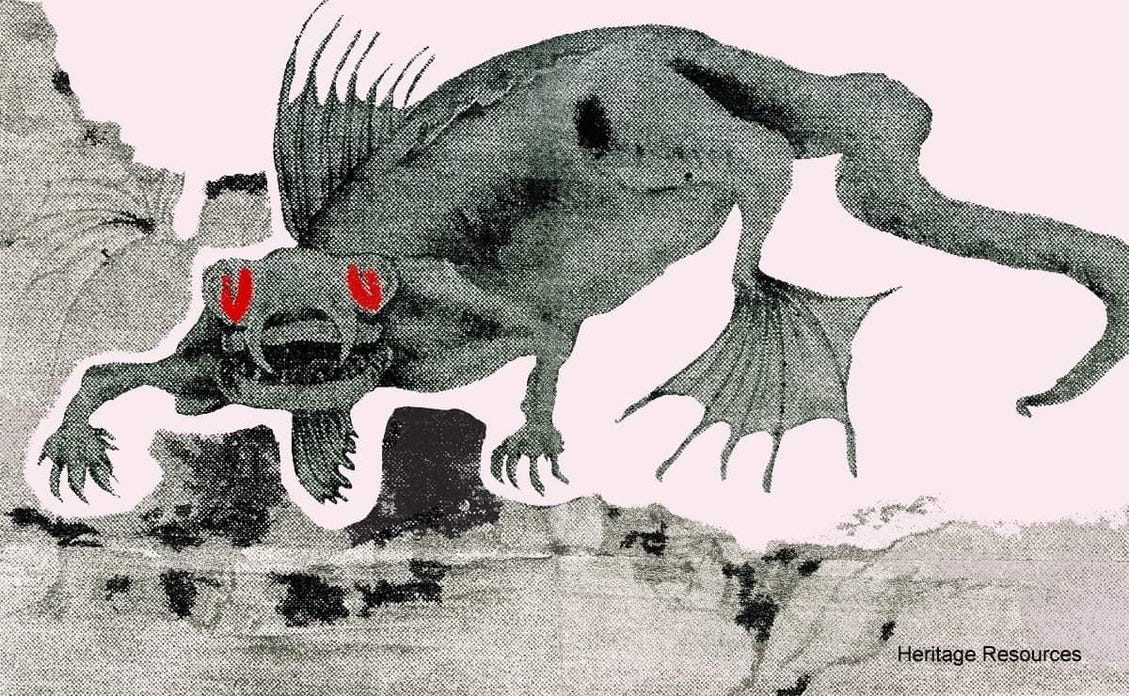
Sudden movement on the bottom caught my eye. As I stared into the murky depths, a big fish like a salmon took shape. I’d seen salmon lying in deep pools during spawning season in one of our river’s tributaries. What my gaze fell upon was not a salmon. Its head appeared rounded, dog-like with huge round eyes. Its jaws opened as if unhinged. Whatever it feasted on flew around its head in bits and pieces. I squinted trying to make out the shapes on the bottom. Holy cow! I saw the outline of what was left of a cat! I jumped up heading for home leaving my fishing pole and two chubs circling in my bucket.
I burst into the kitchen. “Mum, I saw a huge fish eating a cat. Dad, you have to come see.” Dad looked up from his newspaper.
“Fish don’t eat cats.” He shook his newspaper and went back to reading.
“Dad it only looked a little bit like a fish.”
“Maybe it was an otter, but I don’t think they eat cats either”, Mum said. Grammy stood by listening.
“Zoë, I think you saw an Ugwug. I’ve often wondered where they spawned”. Her eyes twinkled.
“Mumma, for god’s sake don’t fill Zoë’s head with anymore scary tales. You’ve scared her enough with your ghost stories.”
“Gram, what’s an Ugwug?”
“Zoë, the old timers say they are half salmon and half seal. They live in the caves deep in the gorge at the Reversing Falls. I saw one once jump out of a whirlpool when the tide reversed. It shot straight up into the air.”
“It was a log,” Dad said. Grammy pursed her lips and glared at Dad.
“Don Harris, you don’t know everything. I heard stories years ago from the mill workers along the river. The mills could never keep a cat. Mice ran wild. Something systematically killed the mill cats and they were a tough bunch.
Your grampy once told me when he fished for trout way back up our chain of lakes, he caught the ugliest fish he’d ever seen, with long sharp teeth. He told me as he pulled it up, red eyes stared at him, but he challenged what he saw in his mind. He told me it must have been the sun glinting on the creature’s eyes. He cut the line and let it go. He said he saw it in his dreams for years and it made him shiver.”
I couldn’t wait to tell my girlfriends about the Ugwug. From that day forward, Arlene, Sharon, and I made it our mission to find a baby Ugwug. We clambered over a rough trail back into the woods along the chain of lakes. We never found one, but we were always on the lookout. We did find the skeletal remains of two cats in the muck on the shore of Red Bridge Lake.
Adolescence approached and Ugwug hunting took a back seat to sunbathing on the beach and talking about boys. One night lying in bed listening to the top forty on WKBW out of Buffalo, New York on my crystal set, I heard a hideous yowling behind our house. Always fearful for the safety of our cats over the years, I went outside in my pajamas to call our latest cat, Toby. I saw an axe leaning against the woodshed. I heard Toby’s pitiful yowl again; I picked up the axe and headed into the moon-lit woods. Often scary in the dark, the woods took on a magical quality under the full moon and starry sky. I knew every inch of the woods. I wasn’t scared. Toby’s cries led me along a well-worn path toward the old burned out dam.
Not more than a few hundred yards from the lake, I saw Toby running for his life, clawing his way up a tall cedar tree. Then a huge lumbering black shape, that could be nothing else but a bear, threw itself against the tree. More hideous yowling erupted from Toby.
Somewhere deep down, I knew it wasn’t a bear. Moonlight caught its eyes, huge and glowing red. It turned toward me, stumps for legs ending in frog like feet. It threw itself in my direction; I knew it meant business. On the first lunge, I turned tail and ran on the winged feet of Hermes. Flying at full tilt, I crashed through our front door. I flew up the stairs into my parent’s bedroom slamming their door against the wall. I hurtled onto the foot of their bed. Mum screamed. Dad sat up and peered at me. “Christ, is that an axe in your hand? Are you trying to give me a heart attack?”
“Dad, dad you have to get up. There’s something in the woods. It tried to get Toby and then it came after me.” I ran out of breath.
“You went into the woods at night? You go straight to bed right now. We’ll talk about this in the morning. But first, put that axe in the woodshed.”
“But Dad, the thing was the size of Gypsy.” Gypsy, our neighbour’s rotund Labrador retriever, ate every leftover in sight after dinner including the cat’s food. “Dad, it had red eyes.”
“Go, NOW,” Dad said. As I deflated and exited the bedroom, I heard Dad mumbling to Mum. “That child has no common sense and too much imagination.”
The next morning when I finally pulled Dad away from his newspaper, we walked to the spot where I’d seen the creature. Dad still held his coffee mug. We heard mewing. Toby balanced high up on a branch of a cedar tree. He’d stayed treed all night.
“Well I’ll be damned,” Dad said.
Telltale marks disturbed the blanket of cedar needles on the ground. Dad looked perplexed. “Well, it must have been an adolescent bear. Never go into the woods again at night. Do you understand me? Answer me.”
“Yes, Dad.”
I pointed, unable to speak. I put my hand over my mouth to stifle my scream. Slime lay around the bottom of the tree. Dad looked at me, alarmed. I stammered. “It’s an Ugwug. Grammy’s right.” Dad choked on his sip of coffee. It came out his nose. A clear slime made a path back to the lake.
“Look Zoë, if there was such a creature as an Ugwug, more people would have seen it. Somewhere, someone would have found the remains of one. You need to use common sense.” Dad took another swig of his, now, cold coffee. He looked perplexed. He seemed to be talking to himself, Bears don’t usually come this close to houses. I’ve never seen one this close. He turned to me. “My guess is it’s a small bear and there is something wrong with it, injured maybe. I’m going to alert the neighbourhood. Injured and sick animals can be dangerous.”
“Dad, do you smell fish?” I grabbed his arm.
“Bears like fish,” Dad said. He ruffled my hair.
Toby left the tree with a lot of coaxing. He streaked home like a pellet let go from a slingshot. He stayed behind the stove for two days. No one could entice him out. Mum finally lured him at the end of the second day with a saucer of Carnation milk.
I went back to the cedar thicket later in the light of day after the incident the night before where the creature treed Toby and lunged at me. I took a small Mason jar. Slime still clung to some of the underbrush. I scooped a good cup full of it into the container. I showed it to Arlene and Sharon. They gagged at the sight of it. It looked like snot. The jar sat on the floor of my closet and eventually ended up pushed to the back in a corner. I forgot about it.
Back in the fifties people didn’t put up signs on telephone poles about their “Missing Fluffy”. Most cats in rural New Brunswick never saw a vet for neutering or spaying. No litter box sat in the halls and no Fancy Feast cans of cat food lined the cupboards. Cats came and went when they chose. If they didn’t come home, well in my dad’s words, “It’s the web of life.” So cats that went missing over the years didn’t sound any alarm bells.
Research, now a topic in my ninth grade science class, piqued my interest. My girlfriends and I decided to employ what we learned. We went door-to-door canvassing Ketepecers to determine how many cats in their household disappeared in the last twenty years. Well to start with, about twenty-five in Grammy’s and our house, fourteen in Arlene’s, and twelve in Sharon’s. Just knowing those figures gave us pause.
We canvassed most of the neighborhood. We met few non-cat lovers. It turned out to be a tedious job. People took time to remember all the cats they housed. Some brought out photos; others shed tears over their missing furry friends. We found most people lost between ten to twelve cats in twenty years. So all in all 2,652 cats disappeared never to be seen again from 1950 to 1970 in Ketepec.
Other findings surfaced, only about 1,000 cats died of natural causes. Many people told us stories about their cats that lived twenty years, but with further questions, we found those cats went under the knife, neutered or spayed. They stayed close to home. After almost three weeks of going door-to-door, we sat on Grammy’s front stairs with our clip boards on our knees staring at each other.
“This can’t be right,” Sharon said.
“Numbers don’t lie, “Arlene said.
Dad leaned on the doorframe. “That’s impossible, there can’t be that many cat disappearances.” Dad hummed the theme song from the Twilight Zone.
Grammy, always ready to add her two cents, chimed in.
“Someone once told me statistics are just numbers with the tears wiped away. All those poor cats. I cried when that old yellow Marmalade cat vanished. He never bothered the birds in my garden because of the bell your dad put around his neck. He used to sit on my lap after dinner.
Don, didn’t you find his bell up by Red Bridge Lake?”
“Yes, Mumma, I used a brass clasp to fasten it to his collar so I’m sure I found Marmalade’s bell. The bell still dangled from the brass clasp.” It now hung on a nail in the woodshed.
“Remember Mrs. Sweet said she found her Velvet’s pink collar on the sawdust beach by the marina at low tide”, Arlene said. We nodded our heads, wide-eyed.
“Oh yes,” Sharon said. “…And remember that awful story Mrs. London told about finding Scrappy’s tail at her back door by his water dish? She said a slimy substance clung to her paving stones and it shone in the moon light.” Tigger’s paw flashed in my mind along with the slime around Toby’s cedar tree. The moon shone full that night. I thought, we’re onto something; an “aha” moment fast approached.
A question bothered me—why did a big Ugwug stay around our lake? I took my question to Grammy. “Gram, the thing…the Ugwug that chased Toby a few years ago wasn’t a baby. He was big. Why didn’t he go down the chain of lakes, through the culvert, and down the river to the caves in the gorge? Why was he hanging around?” Grammy thought a bit and didn’t seem to have an answer. Grampy looked up, surprised Grammy was at a loss for words. He was a man of few words himself.
“Hunting must be good,” Grampy said.
In earnest we started to research the Ugwug. Grammy said a diver who went into the gorge when the Reversing Falls’ bridge was under construction came up with his hair turned completely white. He refused to tell what he saw and died a short time later. First factoid. We hastily scribbled notes.
I consulted with our Britannia Encyclopedia regarding fish with red eyes and found that red eyes showed up in small predatory fish. Red eyes aided in foraging at greater depths where the light conditions were in the blue-green spectrum. Greater depth and blue-green conditions screamed at us—THE GORGE. Our monster wasn’t a small predatory fish so something caused a mutation, but what? Could the Ugwug be prehistoric?
Questions stymied us. If small Ugwugs came down from the chain of lakes behind our house after they hatched, how did big Ugwugs come up the river, through the culvert to the chain of lakes, and spawn unnoticed? Then an answer popped into my head. There must be an underground system of caves leading up into the lakes. It made sense.
Grampy used to say the last lake in the chain of lakes was bottomless. Second factoid. We never ventured that far, afraid of bears. I asked Grampy about the Ugwug.
“Oh yes,” he said. “I know about them. In the 1850s, a graphite mine existed at the Falls. My father told me that one night a watchman lost his leg when he fell down a shaft. A jagged pipe severed his leg during his fall. They never found his leg. People say the Ugwug carried it off. Third factoid.
“Grampy, did the man live?”
“Yes, Zoë he wore a wooden leg. He carved a likeness of the Ugwug on it. He never went back to the mine, but he had a great story to tell.” I sat rapt listening to Grampy. He chewed on his unlit pipe.
“There’s more Zoë. A few years later, a trout fisherman drowned in a lake not far from our chain of lakes. People say he stood in his waders, waist deep, and just sort of slipped under the water. They searched for his body, but they couldn’t find him. Four days later his remains showed up on a shale shelf at the gorge. A huge portion of him was missing.”
“Grampy how could that be?”
“Some people believed a series of tunnels brought the man’s body to its resting place at low tide on the shale shelf. Many believed the Ugwug dragged him through the tunnels. Some said it acquired a taste for human flesh after the graphite worker’s leg went missing. Fourth factoid.
Time passed, high school and boys called to us and gleaning factoids about the Ugwug faded into childhood memories. At seventeen my calico cat, Patches, disappeared. The Ugwug surfaced briefly in my mind, but leaving home and going to university took precedent over my cat’s departure.
The University of New Brunswick at Fredericton seemed far away and freedom loomed. I lived in residence the first year and then I moved to a small studio apartment. Mum sent me my old trunk filled with stuff from my childhood bedroom. A Mason jar in an old shoebox, its lid rusted, held a now solid yellow material—the slime. I couldn’t believe it; memories of Ugwug hunting popped into my head and made me smile.
At that time I dated Roy; he studied genetics. I handed him the jar one evening. I taped my name and mum and dad’s phone number on the lid. I teased him. “I dare you to identify this substance.” A few days later, he called asking me to meet him at the Hitching Post. In a quick goodbye, he told me he was leaving to study at the University of Toronto. I never heard from him again. The jar and Roy faded into the past. I still hung out at the Hitching Post though.
Five years later working as a social worker in Saint John, my mum received a call from a UNB professor asking for me. I returned his call and he invited me to the Anthropology Department regarding a sample I’d left with my name on it. Wow, I thought, after all these years. I borrowed my mum’s car and walked through the campus to the Science Building. I knocked on the department head’s office door. My jar from all those years ago sat on his desk in front of four white coated professors.
“Miss Harris, I’m Dr. Sheppard, Head of Anthropology. This is Dr. Lee, Head of Paleontology. This is Dr. Straus from Vertebrate Paleontology and this is Dr. Paul; his field is Desmatophocids. We all shook hands.
“I’m sorry, I said. I don’t know what Desmato…is.”
“It’s the study of species that evolved around 23 million years ago, Dr. Paul said.
Questions flew before I could sit down. “Where did you get this sample?” Dr. Paul sounded accusatory. Somewhat taken back I stammered.
“I found it when I was a kid behind our house at Ketepec.”
“WHERE,” they all asked in unison. I almost fell off the chair at the intensity of their barrage.
“In the woods behind my house, I reiterated. An animal, my father thought it was a bear, tried to kill my cat and it lunged at me. It left a slime behind and I put the yucky stuff in the jar the next day.”
Dr Straus looked incredulous. “The sample you left here is a protective mucus from a creature that lived millions of years ago. However, we can’t quite identify the creature. The DNA we were able to extract points to an amphibian, and possibly Salmonidae.”
“A salmon?” I asked. My voice squeaked. Dr. Straus cleared his throat. I started to feel hot and thought I might fall off my chair.
“It lived 11 million years ago. It measured nine feet long and had spike-like teeth”.
“That’s not all,” Dr. Paul said. “The sample also shows DNA to Phocidae.”
“Pho…what?” I questioned. I’m sure they thought I was dim-witted. Unable to articulate; I repeated their words like a parrot.
“A seal, Miss Harris. An eight foot long seal that existed 23 million years ago. Its eye sockets held eyes as big as poolroom billiard balls.”
Something was coming together in my head. I could only get one word out.
Red?” I asked, my voice barely audible.
“Was what red?” Dr. Paul almost shouted.
“The eyes.”
“Miss Harris, we can only surmise, but there’s a good chance they were red. They were both deep diving predators.
Miss Harris did you touch or contaminate this sample in anyway?”
“Eew, no. It was gross.” Dr. Lee stood up and addressed me.
“Miss Harris, we can’t let you go. We believe this is a big prank. A prank that could see you sitting in a jail cell. Where did you get this?” He held up the jar. “This is a prestigious university. We’d like you to stay here until we get to the bottom of this.”
“What? Are you kidnapping me?”
“We could call campus police,” Dr. Lee said.
I stood up, grabbed my sample from under their noses, and headed for the door. As I lifted the door lever, my heart pounding, I turned to look at the four white coated geniuses, probably the best in their fields the world over. A smug feeling came over me. I paused, still looking over my shoulder.
“I know what it is.” They leaned forward together in one motion.
A single word left my lips and echoed down the hallowed hall behind me.
“Ugwug.”
About the Author
Corrienne Zoë Heinemann writes under the pen name of Zoë Sutton Harris. Four of her short stories were published in 2022. A fifth story was published in 2025 on the international front. Her eclectic writing holds the common thread of humor that she cleverly weaves into each recollection. The first story introduces the Trio-of-Trouble. The collection, Family Dance, heads to publishers soon. Her short stories give readers a sweet, poignant and often humorous glimpse of growing up in Ketepec, a small village, on the Saint John River in New Brunswick, Canada.
Zoë graduated from the University of California, Berkeley with a master’s degree in social work. Her time as a social worker brings a rich perspective to her writing.
For the past 44 years, Zoë calls the San Francisco Bay Area home. During that time, she enjoyed sojourns to The Bahamas for four years and to Kazakhstan for eight years. She lives with her husband and rescued mutt, Lucy. Two adult children call her mom. Recently, she celebrated the arrival of her first grandchild.
A beautifully haunting piece! Zoë Harris captures memory, fear, and folklore with tenderness. Cat Eaters stayed with me long after reading. Hope to read more from her.