

Colour Fielding by Penn Kemp
A Guest Review by Jennifer Wenn
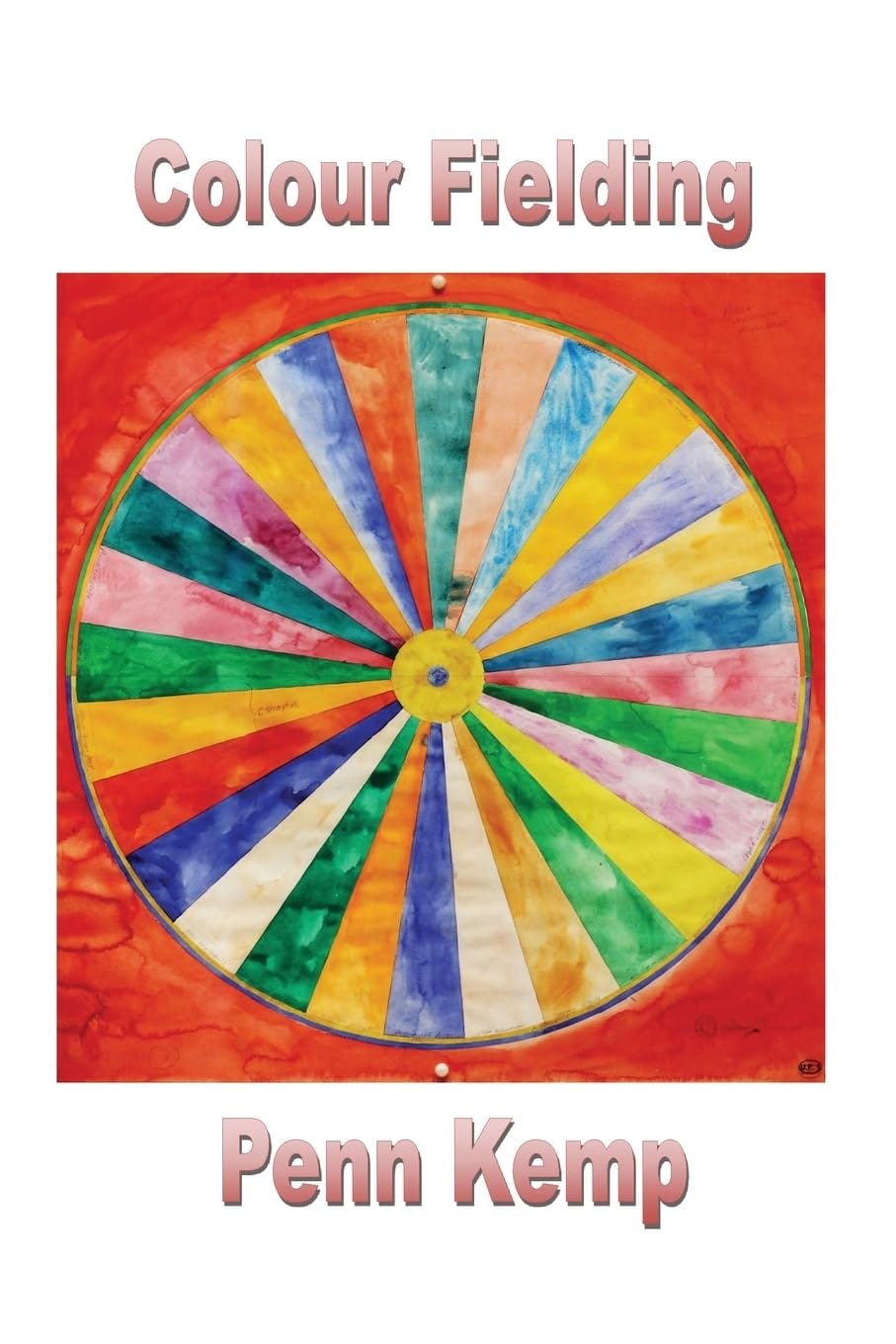
In the wake of being honoured in 2025 with the League of Canadian Poets’ Lifetime Achievement Award, the ever-prolific Penn Kemp (still at the peak of her powers) completed Colour Fielding (Silver Bow Publishing) a poetic exercise in memoir and in responding to, and writing about, visual art and artists, and their intersection with the written word.
Two figures are conspicuously celebrated: Greg Curnoe (a prominent London, Ontario, artist whose ninetieth birthday would have been in 2026); and the author’s father, Jim Kemp (also a notable London artist and mentor of artists). In fact, the front cover features Curnoe’s Circle Divided Into 28 Equal Sections, an entrancing colour wheel; the back includes an image of his Mariposa, one of his beloved bicycle paintings. Inside, five of the book’s seven sections are introduced by colour renderings of Jim’s works (the exceptions are the first section, which is preceded by a humorous photograph of him as Father Time and curator Clare Bice as the New Year Babe; and the third, a little dive into Georgia O’Keefe). The title Colour Fielding, meanwhile, is a reference to, among other things, both a work of Jim’s that prologues the final section, and to “the work of abstract painters working in the 1950s and 1960s characterised by large areas of a more or less flat single colour” (Tate Museum website). Importantly, Curnoe was also a noted explorer of colour.
Colour is also a central consideration throughout Penn Kemp’s investigations in this volume. These are comprised of three main themes that wind through the seven sections. These sections could be summarized as follows:
Very Local Heroes, the longest part, extends the work with memoir that Kemp undertook with her collection Ordinary/Moving (and her chapbook Lives of Dead Poets)
Triple Takes on Carr, O’Keefe [sic] and Kahlo foregrounds three women artists (Emily Carr, Georgia O’Keeffe and Frida Kahlo, especially the last of these), focussing on how they have been portrayed and imagined
Three for Georgia on Exhibit (really a subsection of the above), a trio dedicated to O’Keeffe
Reflecting Interplay, a fascinating interrogation of Kemp’s own creative process
Confronting the Muse, an examination of the Muse, conceptually and in real life
Ekphrastics, which, as expected, focusses on responses to visual art pieces
Light Eaters, a look at some objects of art, notably Mary Magdalene, who figures into three poems
The first of the three aforementioned themes centres on the artists themselves. This includes Carr (“…Caring not a fig for convention…// //Wild woman of the woods”; Massif) and O’Keeffe, who “enters landscape” (Brush Strokes); and also Kahlo, who fiercely defends herself in Three for Frida on Exhibit (“‘Just try to forget me now. I dare you, double dare you. Already//my art has outlived all you onlookers of this ostensible life.’”); and, through her, Diego Rivera, whose signature Kemp spies at a reading in Detroit on an overhead beam (At the Scarab Club). There is additionally a tribute to Mary Pratt’s generation in Sing a Litany of Women Painters.
Very importantly, though, this category includes a heavy infusion of invaluable memoir. Jumping off from Ordinary/Moving, this collection explores the art scene in London, Ontario and the wider Souwesto region, populated by such luminaries as Greg Curnoe and Jim Kemp of course, but also Clare Bice (“…the bane of Greg Curnoe’s cohort”; At the Beaux Arts Ball), Jack Chambers (Kemp “…basked in his aura since//I was allowed to sit in, enthralled//by words, the man, a life lived outside//our little London in his much wider world.”; After Velasquez), Tony Urquhart (“This bearded Aries wunderkind…”; Drawing in Miniature), James Reaney (“Jamie’s drawings continue to fly//high and wide, a flash of orange//(that tiger burning) in the wings”), and, via Jim Kemp, outwards to the famed Group of Seven (here we have the hilarious picture of Jim Kemp having his daughter serve them “for nibblies, chocolate-covered grasshoppers,//identity undisclosed until my tray was empty”, which resulted in “a flurry of coughs// //I feared would kill them.”; When Dignitaries Visit).
But Curnoe and Jim Kemp predominate. For the latter, in addition to the previously-mentioned episodes, we have a meditation centring on his massive coronary, the author “Called back to London. Called by emergency…” where she wanders the family home waiting with it “until// //my mother and brother return from the hospital”. “On the walls,//dad’s pictures wait with me patiently, prescient// //as dreams.” These include early wartime pictures, which tie back to “…the pure fear dad felt when a buzz bomb caught//him on an English street against a white wall…” (Knock, knock). A bit farther on, in Literalizing the Metaphor, Jim Kemp “The Christmas after his coronary…strung up a branch//to hang instead of our usual tree. Upon//it perched a vulture, black paper maché.”
The gregarious figure of Curnoe, meanwhile, bursts into several pieces, ranging from a lesson in “what an artist can get away with in//flaunting freedom from convention” via scooping pizza slices from an unfinished restaurant plate (Artist in the Hinterland) to a lovely elegy on his tragic death (Travelling Lights). There is also a beautiful piece (From DREAM SEQUINS; set after both Jim Kemp and Curnoe passed on; one of a number of dream poems scattered throughout the volume) describing one of the author’s dreams in which Jim Kemp and Curnoe are working in an otherwise empty building: “…Just as dad welcomed Greg and Jack to//London’s nascent art community in the Fifties, so now//he’s there to greet Greg in beloved fields of pure colour.”
The second theme of the book consists of Ekphrastic poems, direct responses to pieces (or groups of pieces) of art. The Ekphrastics section is naturally important here, but this theme is represented in other sections as well. Artists responded to include:
Jim Kemp (whose “painting of a mysterious holy woman wrapped in red” [which seemingly is Lady in Red, which appears in the book] is ruined in a dream by New York critic Clement Greenberg; Palimpsest for Dream Sequins)
Curnoe (who produced a “…riposte to President Trump, already//depicted in prescient paintings eliminating//the United States entirely, so that Canada//directly borders on Mexico…”; Maps of North America)
Carr (in whose “…one self-portrait, broad brush strokes//obliterate boundary to fling her bosom across the can-//vas like horizontal wheat sheaves”; Massif)
Kahlo (“The monkey on her shoulder peers//at the viewer it knows is there…”; Iconography Con Monos (1943) )
O’Keeffe (“…Seed potency//bursting beyond hard casement//through the boundary of design.”; Sunflowers)
Paraskeva Clark (“Weeds around us flower and are still”; Bass on the Grass)
Kim Dorland (“He paints incongruous zombies into//Tom Thomson tree-scapes…”; Where We Belong)
Joan Miró (“What is it about putting on//the mask that allows for//freedom, for Surreal symbols”; After Miro)
L.L. Fitzgerald (“…Let me present//these things as if saying were enough to// //conjure the perfect illusion of presence”; From An Upstairs Window, Winter)
Pieter Brueghel the Younger (via a dream which carries the author into one of Brueghel’s famous villages, Enter the Peasant Painting)
Titian (“…A confusion of delight//ripe and ready to turn from cinnamon to ginger.”; Titian)
Dante Gabriel Rossetti (“But what am I doing sulking viridescent//and regarding you as complicit in guilt?”; Mary Magdelene to Dante Gabriel Rossetti)
The third and final theme might be characterized as philosophical reflections, covering both the practices of art and writing, and Kemp’s own creative process. These begin in the opening poem in the book, where, recalling that she “used to prime my father’s canvasses by//painting them white with Gesso…” she later indicates that “I still wait with paper’s white space till/words arise, images in words, watching//them come into form, specific entities// //with their own character and personality//ready to burst off the page into life.”
These personal considerations are picked up in the Reflecting Interplay section, whose seven pieces (which in places have a feel of prose poetry) form a most interesting little treatise on the subject, with linkages back into visual art. There are many insights here; a few follow:
“The dead are always present when we continue//to listen, alert, on the watch. If we don’t attend,//what are the consequences, what will be lost?” (On Perpetual Perception)
“My intention is to translate//the image into a language that corresponds.” (On Multimedia)
“I like to live in the place before colour and sound//hive off tangentially…” (Colour Coded)
“My work is the translator’s, to move one//sense into another’s arena…” (Life Sketches)
“I never learned poetic structure but//relied on sound and image to lead me//to the poem…” (Projection)
More philosophy permeates the Confronting the Muse unit, which does just that. Many of these reflections are personal (e.g., Wearing our Words; Bearded Snake Around the Collar; What Times Demand); a couple are general interrogations (e.g., Nude in Umber). Dreams are included via Lines of Legend. We also have an Homage to St. Elmo, and meet a friend who threw “her true star//sapphire ring//into the trash.” Kemp, on the other hand, says she “…held on to my own//pale sapphire engagement ring, like//a token or treasure, with a mild horror//honouring her.”
Farther on, in the Ekphrastics section, On the Ear-Whispered Lineage presents a series of quotes from Leonardo da Vinci proclaiming painting as superior to poetry; the piece concludes with Kemp’s instruction “Argue//amongst yourselves.” Continuing the debate, the next poem, Mute Poetry, Blind Painting promotes the virtues of sound (“Trackless, sound cannot be traced the linear way the eye perceives.//While the eye drains energy, sound steals our attention.”).
The final aspect of this theme is covered in Light Eaters, the last section in the book. It begins with a mini-essay on colour, spread over three poems: Scaling the Colour Bar, Titian [which is also an ekphrastic piece] and My Muse Wears Burgundy from Head to Toe. Three poems on Mary Magdalene follow, often, of course, a subject of paintings. The first, Recall, observes, among other things that “She’s always depicted wrapped, contained//and rapt.” Magdalene Rising references the scene in the Gospel of John where she does not at first recognize Christ after his Resurrection, and proceeds on to philosophical reflections. In Mary Magdalene to Dante Gabriel Rossetti (mentioned earlier; this is one of the pieces that does double-duty) she confronts the painter regarding his depictions of her, a tie-back to the poems about Kahlo, O’Keeffe and Carr (and other pieces) in addressing how women artists and subjects have been portrayed, in paint and in the broader culture. The final piece, Figure head, riffs off the carved female figures once-upon-a-time seen on the prow of ships.
There is clearly a lot in this very enlightening and thought-provoking volume. A first-rate addition to Kemp’s already-storied oeuvre. me

About the Author
Penn Kemp is a poet, playwright, and performer who lives in London ON. Her most recent collection is Colour Fielding. The League of Canadian Poets honored her with their Inaugural Lifetime Achievement Award, 2025-6. Check out www.riverrevery.ca for poetry films based on her text.
About the Reviewer
Jennifer Wenn is a trans-identified writer and speaker from London, Ontario. Her first poetry chapbook was A Song of Milestones (Harmonia Press). Her first full-size collection was Hear Through the Silence (Cyberwit). Her newest collection is Emergence (Wet Ink Books). She has also published poetry, reviews and essays in numerous journals and anthologies; has spoken at numerous venues; and is the proud parent of two adult children. Website: https://jenniferwennpoet.wixsite.com/home
Book Details
Publisher : Silver Bow Publishing
Publication date : Feb. 28 2026
Language : English
Print length : 112 pages
ISBN-10 : 1774034190
ISBN-13 : 978-1774034194