

Decolonizing Wilderness Adventure Narratives by Gyllian Phillips
Reviewed by Dawn Macdonald

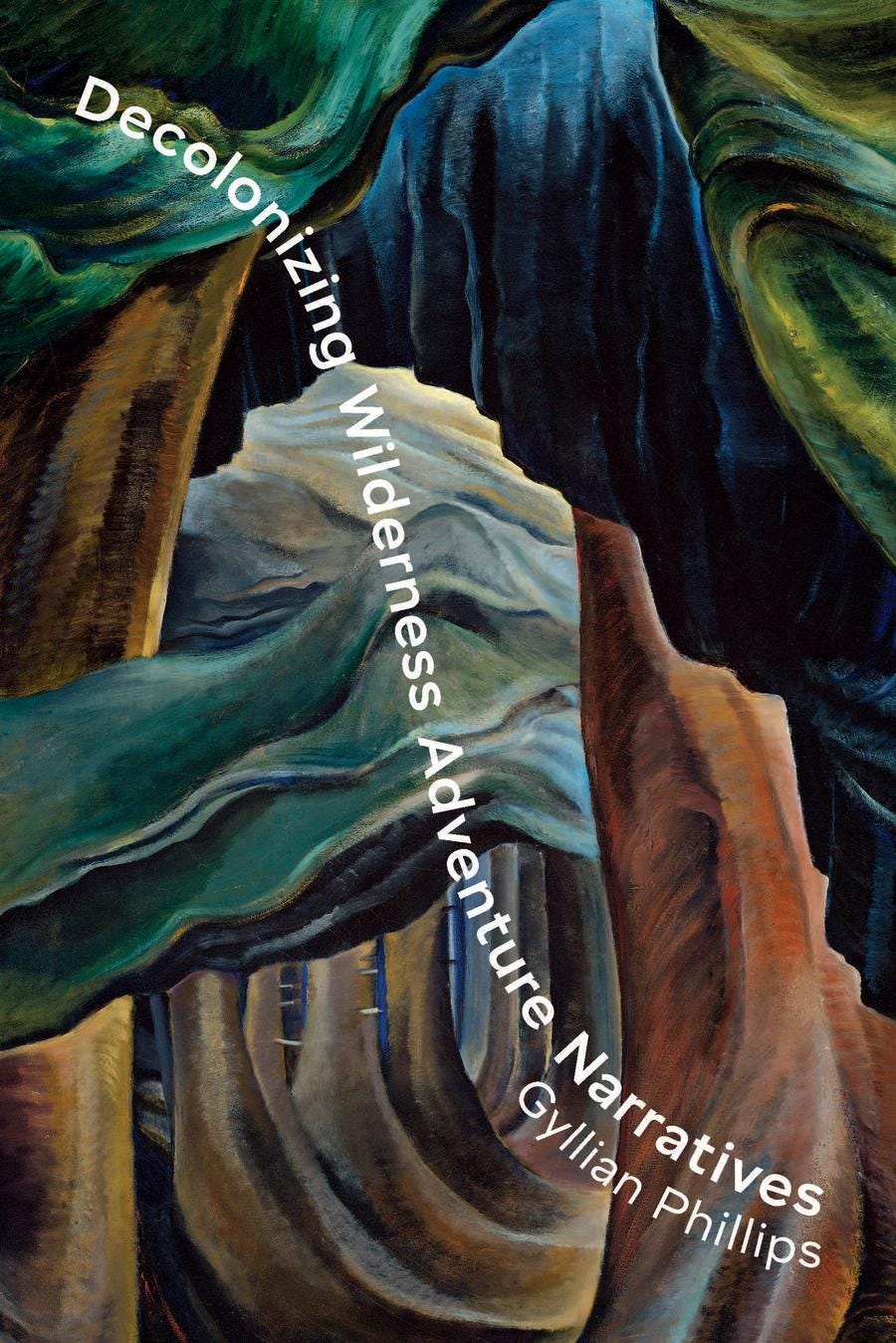
Call of the Wild. Little House in the Big Woods. Thoreau’s musings in Massachusetts, Cheryl Strayed’s revelations on the Pacific Crest Trail. These wilderness adventure narratives are much loved, for good reason—they speak to yearnings felt by the urbanized citizen for a simpler life in which artifice falls away, and we find our true, inner self shining like the stars you can finally see once you get away from the streetlights. These are settler-authored narratives that speak to and for settlers, encoding and (particularly in the case of children’s literature) serving to produce settler viewpoints on the wilderness—what it is, and what it means to venture into it.
Gyllian Phillips doesn’t mention the tradition of English pastoral poetry in her analysis of the above texts, but I think it’s relevant. Here is critic Frank Kermode writing in the introduction to English Pastoral Poetry from the Beginnings to Marvell (1952): “The first condition of pastoral poetry is that there should be a sharp difference between two ways of life, the rustic and the urban. The city is an artificial product, and the pastoral poet invariably lives in it, or is the product of its schools and universities. … The first condition of Pastoral is that it is an urban product.”
What Phillips would argue is that the settler-authored wilderness literature posits a landscape that is “empty” and “untrammeled by man” where the heroic settler can experience “solitude” in contradistinction to the socially mediated environment of the city. The characterization of North American wilderness as “untrammeled” erases millennia of Indigenous habitation, and its portrayal as “empty” elides Indigenous displacement. Furthermore, in imagining the land as empty and oneself as living in solititude, the settler refuses relationship with non-humans such as animals, plants, and waterways.
Phillips contrasts her close readings of settler-authored texts with a selection of works by Indigenous writers, such as Louise Erdrich’s The Birchbark House and Waubgeshig Rice’s Moon of the Crusted Snow. She is reflective about how some of the settler-authored books spoke to her when she first read them as a child, uncritically:
“As a child reader, I felt that Wilder’s “little house” was a mythical assertion of security and self-sufficiency. The walls of the Ingallses’ house seemed to be a bulwark against wilderness, and, as I have said, I did not notice that this was an explicitly settler perspective. Instead, it felt universal to me. Reading The Birchbark House, Moon of the Crusted Snow, and The Marrow Thieves has made me realize that the structures of Euro-American culture are in fact the signs of invasion, dependency, and entrapment.”
Funny enough, for all her careful analysis of the meanings imposed on wilderness, Phillips does fall into one trope in speaking of her experiences off-grid. She mentions that she wrote much of the material during rural “retreats” where she felt like she had so much more time to contemplate, away from the “hustle and bustle” of urban life. I hear this sort of thing quite a lot, and here I think it’s common to confuse “life in the wilderness” with “being on vacation.” Having lived a more rustic life growing up, the main reason why I now live in town is because I have so much more time to write when I’m not doing the endless round of urgent and arduous chores involved in getting wood, feeding fires, hauling water, growing food, gathering food, hunting food, preparing food without running water or electricity, maintaining structures, and so forth. Modern conveniences really do make life more convenient, and while it’s true that you won’t look at your watch as often in the woods, you do need to pay close attention to the angle of the sun. Certainly, you’ll have more time on your hands than usual if you’re staying for a few weeks in a well-maintained cabin with a supply of foodstuffs and no need to go out for paid employment, just as you would if were you doing your writing in a hotel room with sufficient funds to keep ordering room service. Anyway, end of rant, but I think the fact that most people encounter wilderness in the context of a holiday does tend to amplify various attitudes as to what it means to dwell outside an urbanized setting.
You’ll get the most out of Decolonizing Wilderness Adventure Narratives if, like Phillips and myself, you’ve previously read quite a lot in this genre. It helps to be familiar with at least some of the specific texts and authors she cites, a list that on the settler side includes Jack London, Laura Ingalls Wilder, Henry David Thoreau, Cheryl Strayed, Jon Krakauer, and Edward Abbey (among others). If you’ve not read as much among the Indigenous-authored texts, you’ll still be able to follow Phillips’ arguments, and you’ll come away with an excellent reading list. To quote Phillips again, “My reading of literature from Indigenous writers does not come with any claims to special insight or knowledge of Indigenous lived experience, but instead I read (and aim to model reading for others like me) in the position of dialogue: What can this novel tell me about how to understand colonialism, human-nature relations, and novel writing itself?”
If this sounds like a way in which you, too, would like to approach your reading, then Phillips’ book provides a helpful and provocative guide.


About the Author
Gyllian Phillips is a Professor in the English Studies program at Nipissing University, in North Bay, Ontario. Her current research interests centre on ecocriticism with a decolonial focus. A recent publication is “Getting Away From It All, or Breathing it All In: Decolonizing Wilderness Adventure Stories” in the collection Not Hockey, (2023).
About the Reviewer
Dawn Macdonald lives in Whitehorse, Yukon, where she grew up without electricity or running water. She won the 2025 Canadian First Book Prize for her poetry collection Northerny. She posts weekly on Reviews of Books I Got for Free or Cheap (on Substack), as well as reviews for journals and The Seaboard Review of Books.
Book Details
Publisher : Wilfrid Laurier University Press
Publication date : June 30 2026
Language : English
Print length : 292 pages
ISBN-10 : 1771127074
ISBN-13 : 978-1771127073
 | A guest post by
|