

Dickens Quickens and Thickens
Great Expectations by Charles Dickens for Throwback Thursday

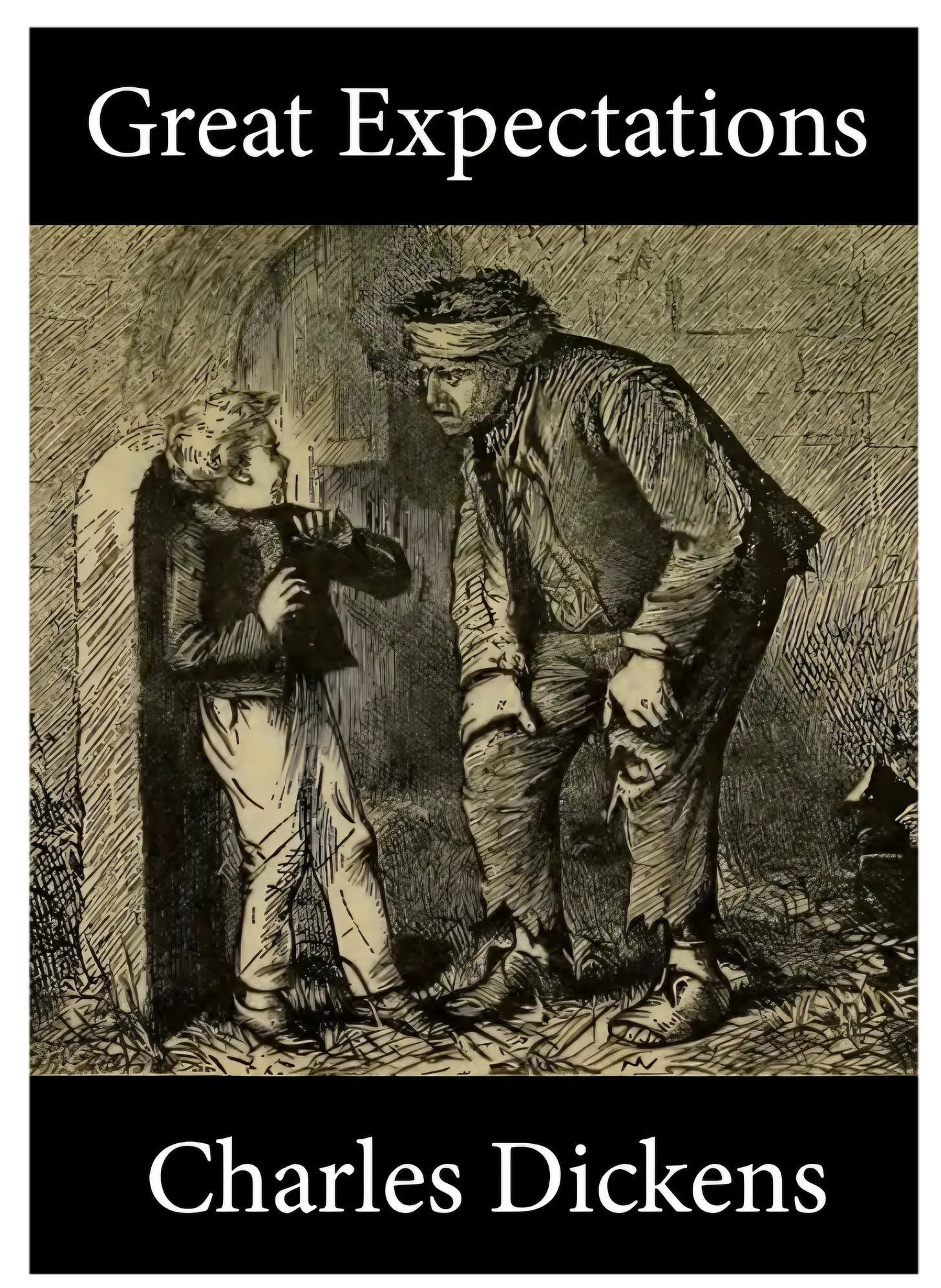
From the very beginning of Charles Dickens’s Great Expectations, narrator-protagonist Pip quickens and thickens his prose in a style that his author developed from his early mastery of shorthand, which he called the “devil’s handwriting.” This expansion and contraction of his diabolic script may be found in the palindrome within a palindrome of Pip’s name, a monosyllable bouncing consonants and mirroring his fluctuating identities: “My father’s family name being Pirrip, and my Christian name Philip, my infant tongue could make of both names nothing longer or more explicit than Pip. So I called myself Pip, and came to be called Pip.” (Published a decade after Herman Melville’s Moby-Dick, Dickens’s novel echoes the American opening “Call me Ishmael.”) This condensation is part of a larger pattern of condensation in Great Expectations where Freudian features from Dickens’s humiliating and traumatic childhood experience in a blacking factory while his father was in debtors’ prison work their way into the novel in a variety of guises. Those boots and bottles at Warren’s Factory left an indelible stain on his psyche.
Just as the protagonist looks back on his life, so his author filters his own manual labour at the blacking factory through black and hand imagery that recurs in almost every chapter. Orphan Pip is brought up “by hand” by his cruel sister and grows up under the influence of the forge, for his kind brother-in-law Joe Gargery is a blacksmith and serves as a surrogate father figure. Pip undergoes a traumatic coming of age at every turn of plot, phrase, and mood. “As I never saw my father or my mother, and never saw any likeness of them (for their days were long before the days of photographs), my first fancies regarding what they were like, were unreasonably derived from their tombstones.” Dickens’s photographic memory projects his childhood onto Pip’s and blackens it through a gothic lens of tombstones. Author identifies with orphan, substituting fictional parents and protagonist in written forms of shorthand and condensation from graveyard to blacking factory. Pip turns back the clock to his childhood, Miss Havisham freezes time at twenty to nine, and the plot advances with the alacrity of expectations.
Reading, writing, and arithmetic are part of Pip’s education and expectations. Without photography, he forms images of his parents: “The shape of the letters on my father’s, gave me an odd idea that he was a square, stout, dark man, with curly black hair.” From the alphabet he projects a portrait of life coloured in blacking. Similarly, he inscribes his mother in shorthand, confounding character of letter and physiognomy: “From the character and turn of the inscription, ‘Also Georgiana Wife of the Above,’ I drew a childish conclusion that my mother was freckled and sickly.” To round out this graveyard family portrait, Pip interprets the five little stone lozenges that represent his five little brothers who died in childhood: “I am indebted for a belief I religiously entertained that they had all been born on their backs with their hands in their trouser-pockets, and had never taken them out in this state of existence.” His indebtedness to belief is part of a larger economic indebtedness that runs through the novel, even as hands and pockets recur significantly in Great Expectations, as more than gestures and attire. Even in the still womb his siblings entertain expectations from a mother who is too sickly to deliver.
While the narrative burrows down beneath the gravestones, it also broadens in its painting of the marsh setting. Commas thicken and imprison the river’s progress: “Ours was the marsh country, down by the river, within, as the river wound, twenty miles of the sea.” Dickens extends his vista from the marsh to the sea where typography is closely linked to psychology in Pip’s identity: “My first most vivid and broad impression of the identity of things, seems to me to have been gained on a memorable raw afternoon towards the evening.” His dusk vision connects “first fancies” to first impression in a Wordsworthian awakening of the soul. The next sentence meanders like the river from Pip’s source to his mouth, from local churchyard to family names and out to sea: “the dark flat wilderness beyond the churchyard, intersected with dykes and mounds and gates, with scattered cattle feeding on it was the marshes; and that the low leaden line beyond was the river; and that the distant savage lair from which the wind was rushing, was the sea.” Scattered cattle gather in sound, just as the alliterated low leaden line extends the horizon, “and that the small bundle of shivers growing afraid of it all and beginning to cry, was Pip.” The traumatic atmosphere between birth and death ends in Pip’s squeak.
At every turn Dickens delights in onomastics, arranging names for onomatopoeic effect between comic and gothic nervous laughter. The author pauses at P for Pip and Pumblechook, the greedy uncle who is the object of Dickensian satire: “Mr. Pumblechook’s premises in the High-street of the market town, were of a peppercorny and farinaceous character, as the premises of a corn-chandler and seedsman should be.” Herbert Pocket, Pip’s closest friend, nicknames him Handel as a musical allusion, but also within a cluster of pocket handkerchiefs. Abel Magwitch, the benevolent criminal, unites with Joe Gargery as surrogate father to Pip and as exemplars of “low” status lacking expectations. Jaggers, the lawyer, combines daggers and the jagged edge of his finger, which wags and skewers criminals. Dickens’s names are aspects of his propensity for caricature, exaggerating features as a shorthand of identity.
Jaggers’s office is a magnet, attracting repellent elements around London. “There was a red-eyed little Jew who came into the Close while I was loitering there, in company with a second little Jew whom he sent upon an errand; and while the messenger was gone, I remarked this Jew, who was of a highly excitable temperament, performing a jig of anxiety under a lamp-post, and accompanying himself, in a kind of frenzy, with the words, ‘Oh Jaggerth, Jaggerth, Jaggerth! All otherth ith Cag-Maggerth, give me the Jaggerth!’” After Fagin in Oliver Twist, Dickens resumes his belittling stereotype – red eyes replace red hair in blood lust, lisp distorts speech, and his dance is as diabolic as the devil’s handwriting. In short, he is a projection of Pip’s own anxiety in the nervous cluster of Jaggers, Jew, and jig. The slang “Cag-Maggers” (for inferior quality of work) contrasts with Jaggers’s uncontested professionalism.
Dickens also borrows this merry sport from Shakespeare’s Shylock. Indeed, in Chapter XXXI a cag-mag version of Hamlet is performed ineptly by Mr. Wopsle who becomes Mr. Waldengarver for the occasion. After the play Pip and Pocket (or Handel and Herbert) rush to meet Wopsle. “Standing at the door was a Jewish man with an unnatural heavy smear of eyebrow.” Like the earlier, red-eyed creature, this stagehand is unnatural and responsible for dressing and undressing “Hamlet,” as Dickens exchanges Elizabethan and Victorian eras, and tragic and comic genres. In low comedy this nameless character removes the stockings from the over named Wopsle-Waldengarver-Hamlet character. “With that, he went upon his knees, and began to flay his victim; who, on the first stocking coming off, would certainly have fallen over backward with his chair, but for there being no room to fall anyhow.” Kneeling, this nameless character comments on the acting out of Hamlet: “The last Hamlet as I dressed, made the same mistakes in his reading at rehearsal, till I got him to put a large red wafer on each of his shins.” Dickens rehearses Shakespeare with the help of this comic rearranger of tragedy. Only a few years later Dickens changed to a more sympathetic portrayal of Jewish characters in Our Mutual Friend.
After the play Pip dreams that his “expectations were all cancelled, and that I had to give my hand in marriage to Herbert’s Clara, or play Hamlet to Miss Havisham’s Ghost, before twenty thousand people, without knowing twenty words of it.” In this psychic space between dream and reality, Dickens confounds identities and condenses twenty thousand people to twenty words in the shorthand of the devil’s handwriting. With its promise of marriage at the end, Great Expectations turns to Shakespearean comedy; but only after Estella has escaped her tragic marriage to brutish Bentley Drummle. “I took her hand in mine, and we went out of the ruined place.” From out of these ruins there now shines a broad expanse of tranquil light.

About the Reviewer
Michael Greenstein is a retired professor of English (Université de Sherbrooke). He is the author of Third Solitudes: Tradition and Discontinuity in Jewish-Canadian Literature and has published extensively on Victorian, Canadian, and American Jewish literature. He has published 250 essays and reviews in books and journals across Canada, the United States, and Europe.
 | A guest post by
|
Wonderful analysis. It has opened up _Great Expectations_ for me in utterly new and fascinating ways. Yes, the onomatopoeia is so much a specialty of Dickens that I tended to take it for granted. Call me Ms. Deafmore.
"At every turn Dickens delights in onomastics, arranging names for onomatopoeic effect between comic and gothic nervous laughter."
That was one of his great trademarks throughout his career. Although I'm not entirely sure whether or not any real people ever had the surnames he gave his characters.