


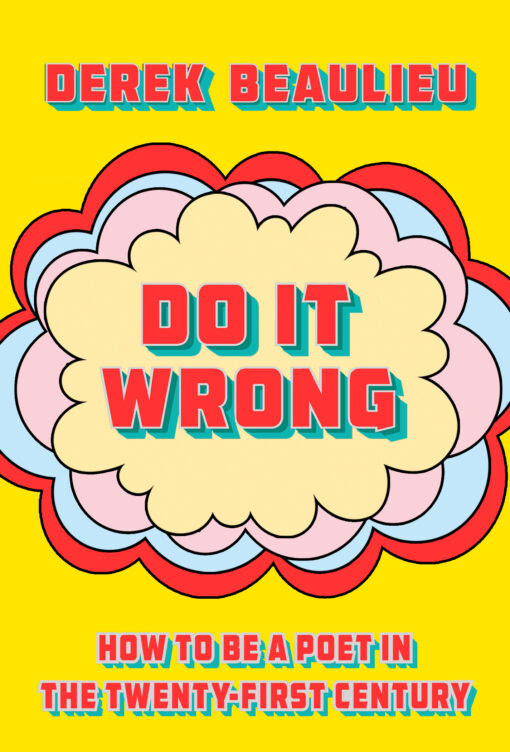
“Do it wrong,” Derek Beaulieu urges his fellow poets. The rewards for doing it right are so meagre. In doing it right, you risk your soul. Well, he doesn’t say “soul.” But he would exhort us to eschew the poetry economy, with its contests and winners, for the poetry ecosystem, wherein each poet contributes vital soil to the flowering of our collective art.
Beaulieu takes us through the math of poetry publication: a hot seller in the Canadian market moves 500 copies over five years; work out your royalties on that and it’s coffee money at best. You’re not going to quit your day job. Five-hundred divided by forty-million Canadians is a number so small it might as well be zero, so why worry about even those five-hundred readers? Dance as if no one is watching, and write as if no one is reading, Beaulieu suggests, because no one is anyway, or so few as to constitute a mere rounding error.
“Do It Wrong really has me fired up. This is the book I needed and will need.”
Now, I would argue this is a bit disingenuous as regards the financial aspect. Royalties are indeed peanuts. That said, it’s my impression that most people who are making some sort of a living out of poetry are doing so through a combination of government grants, contract work, and academic or arts-adminsitrative jobs (as is the case for Dr. Beaulieu, who serves as the Banff Centre’s Director of Literary Arts). Some of these jobs you could get without a publication record, but for the grants and many of the bigger employment opportunities, the words “published author” do go rather a long way. So there are indeed strong incentives within CanLit to “do it right” according to the aegis and aesthetics of the Canada Council and all the other assorted gatekeepers awarding publication and prizes. However, it’s not the only path—we’re talking about a very basic middle-ish class-ish income here at best, which you could choose to earn in some other, unrelated way, freeing your poetry to be as wild and unfundable as it might desire. (That has been my choice, and I, alongside Derek Beaulieu, would 100% recommend it for all the reasons he outlines.)
Being free, however, doesn’t mean you are free to be lazy, or a jerk. You’ll have your work cut out for you if you go this route, forging your own authentic style. Beaulieu would also strongly encourage you to cultivate your place in the poetic commons, with care and gentleness towards your peers. Repudiate capitalist demands to monetize your art, but do attend to your social capital within a community of readers and writers, uplifting the work of others alongside your own. Evading capitalism also entails an openness to, perhaps, giving your poems away, which is something you can do regardless of whether they attain publication in traditional venues. (Beaulieu himself offers much of his work as open access downloadable PDFs on his website.)
Even the non-poets are assigned a task under Beaulieu’s mandate, and that is to “Read wrong.” Don’t just read the bestsellers or the critical darlings. “Seek out the weird, the strange, the unexpected.” Then flip to the back and check out the acknowledgements and bibliography for more hot reading tips. “Read books from front to back, and then from back to front across a web of communities and influences. Read everything you can get your hands on. If we all keep reading voraciously, outside of what’s expected of us, and checking things out of the library, we’re doing our part to keep more writing in greater circulation.”
He’s also got quite a lot to say about university writing programs and their grading systems, which will be of interest to those who teach or study in the field (i.e. not me, but I found his arguments interesting and provocative).
Do It Wrong is a punchy manifesto, delivered in short, two- to five-page arguments. Consistent with Beaulieu’s call to work in community is his use of numerous supporting quotations from the likes of John Cage (“I can’t understand why people are frightened of new ideas. I’m frightened of the old ones.”) and The Grateful Dead (“Trust the weird.”), which add flavour and verve to what is already a toothsome text. It’s a vital rallying cry, and a book I’ll be returning to again and again to remind myself why we do this ridiculous, improbable work. We need voices like Beaulieu’s to confirm for us, in the face of another email saying, “Thank you for your submission, but these poems are not a good fit for our journal at this time,” that it’s more important to stick to your guns than to smush your individuality into currently fashionable modes. If you have a strong conviction about what you are doing and why, then poetry as a whole is better served by you writing in your own way (even at the risk that it’s just not very good at this point) than by you imitating what already exists. Anything new will initially appear to be ugly, ungainly, awkward, and wrong.
Okay, I’m getting a little carried away here, but Do It Wrong really has me fired up. This is the book I needed and will need. (The rejection emails keep rolling in as I’m typing this. The pressure to conform can feel intense.) I might just carry it around in my backpack forever. That’s how much I need to hear Beaulieu assert that all poems, all poetry books, are failures in the sense that none of us has yet written the poem to end all poems, but, “The poetic failure, the striving, is why we write, why we read.”
Equally crucial is his reminder not to go it alone, but to uphold and connect with all the peculiar creatures of the poetic ecosystem—fellow poets, beleaguered editors, cash-strapped publishers, stalwart organizers, and generous readers. I mean, nobody writes as many book reviews as I’ve been doing without wanting that dialogue, wanting to participate in that collective space. So this review has turned out more personal than most because a call to action demands a response—a response that, it turns out, is coming straight from the heart.

About the Author
Derek Beaulieu is the author/editor of over twenty-five collections of poetry, prose, and criticism. His most recent volume of fiction, Silence: Lectures and Writings, was published by Sweden’s Timglaset Editions, his most recent volume of poetry, Surface Tension, was published by Toronto’s Coach House Books. Beaulieu has received the Queen Elizabeth II Platinum Jubilee Medal for his dedication to Albertan literature. He is the only graduate from the University of Calgary’s Department of English to receive the Faculty of Arts ‘Celebrated Alumni Award’ and the only graduate in creative writing to receive Roehampton University’s Chancellor’s Alumni Award. Beaulieu has served as Poet Laureate of both Calgary and Banff and is the Director of Literary Arts at Banff Centre for Arts and Creativity.
About the Reviewer
Dawn Macdonald lives in Whitehorse, Yukon, where she grew up without electricity or running water. She won the 2025 Canadian First Book Prize for her poetry collection Northerny. She posts weekly on Reviews of Books I Got for Free or Cheap (on Substack), as well as reviews for journals and The Seaboard Review of Books.
Book Details
Publisher : Assembly Press
Publication date : April 7 2026
Language : English
Print length : 144 pages
ISBN-10 : 1998336298
ISBN-13 : 978-1998336296

So well said! So affirming! I've been thinking about these issues for years. Love this—"more important to stick to your guns than to smush your individuality into currently fashionable modes." Lift each other up and be who we really are.