

Earth for Sale by Maude Barlow
The Fight to Stop the Last Plunder of the Planet

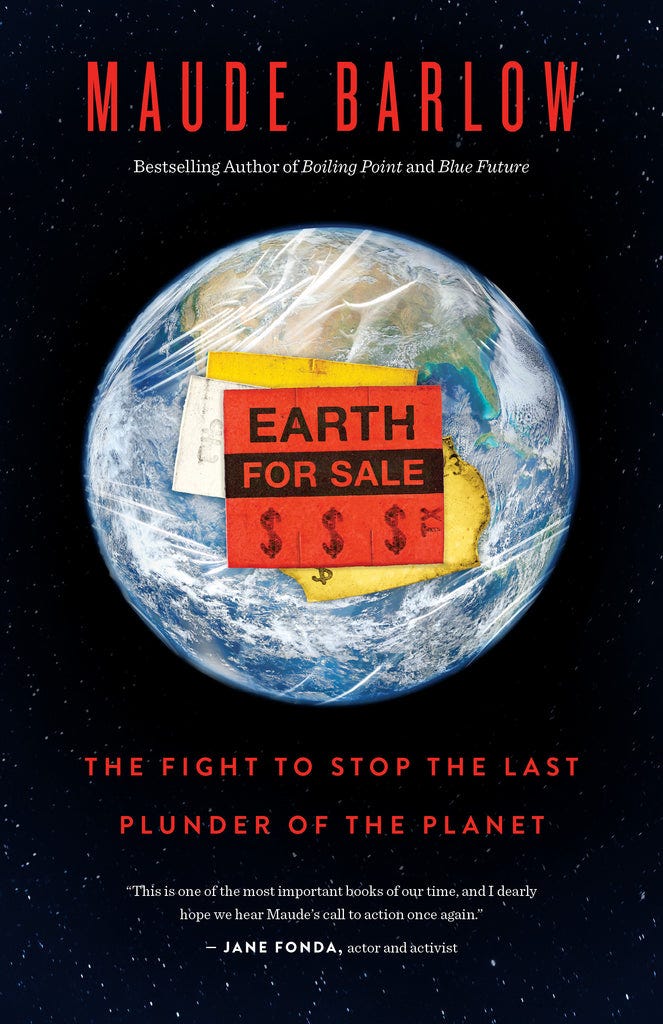
In Earth for Sale: The Fight to Stop the Last Plunder of the Planet, Maude Barlow discusses the “financialization” of nature, and offers cautionary examples that show why this trend is problematic.
Barlow argues that in modern times, we are seeing a new “enclosure of the commons.” This time, instead of landowners shutting off access to public lands, the enclosure is being performed by corporations taking control of public resources.
“Many of Earth’s resources, which, Barlow argues, ought to belong to all of us, have been financialized, and the next frontier could be in the financialization of nature.”
Barlow points to economic globalization, “the explosive growth of transnational corporations and the introduction of free trade agreements that limited the ability of governments to regulate and protect their forests, minerals, fisheries and water sources—now often labelled as tradable commodities,” as part of an ongoing problem.
In addition, permitting companies to use “offsets” like carbon credits (although these offsets have now spread into many other areas as well) rather than avoiding polluting in the first place is a dangerous practice. Barlow provides data that shows offsets are often merely an “accounting exercise” that overstate their impact on the environment. Meanwhile, hazardous chemicals get dumped into rivers, pollutants spew into the air, and global warming continues at a dangerous rate.
Many of Earth’s resources, which, Barlow argues, ought to belong to all of us, have been financialized, and the next frontier could be in the financialization of nature. How does it work? By putting a dollar value on a given living entity. The idea sounds simple, and might seem on the surface to be reasonable (pay “x” amount of dollars to protect an endangered animal, for example), but it’s fraught with problems.
For one thing, the financialization of nature implies that living creatures are nothing more than items for our use, rather than having the right to exist in and of themselves. For another, when you let the market rule, the risk is that the market will decide it’s more economical to let nature expire than to keep it going. Furthermore, using the financialization of nature as an opportunity to offset polluting or damage to the environment removes the onus on corporations to not pollute in the first place.
When discussing the fact that Canada is working on legislation that would allow biodiversity offsetting, Barlow doesn’t mince words. She quotes a Greenpeace document that states that this practice “opens up the possibility of a market-based system wherein wealthy developers or corporations simply pay a fee in order to destroy biodiversity—a pay-to-slay mechanism.”
Earth for Sale illustrates the risk of privatizing specific elements of the environment. Barlow gives several examples of municipalities that have privatized their water, only to later decide it’s better to keep control. Likewise, some municipalities, provinces, states, or countries may think it makes financial sense to privatize parks or public lands. But privatization means loss of control, and it isn’t always the best way to keep nature intact.
The bottled water industry is an example of how corporations impact resource availability for citizens. Barlow notes that “Many farmers and villagers of Catalonia in northeastern Spain are angry that foreign bottled-water companies are taking the water from the springs and streams that used to be a source of their drinking water, forcing them to buy the water back in plastic bottles at supermarkets.”
Written with passion combined with a sound knowledge of the topic matter, Earth for Sale is an illuminating read that raises awareness of the importance of maintaining power and control over our resources, rather than handing that control over to corporations. Legislation to curb pollution and other negative impacts, Barlow argues, is important. There’s a risk in trusting that the same corporations and financial forces that have gotten us into the current mess are going to get us out of it.
Despite the grim state of affairs depicted in the book, Barlow encourages readers not to give up. “To give up on hope is to give up on the young, and that would be profoundly wrong,” she says. Barlow advocates for “wise hope,” which means “that you look at the situation squarely” and avoid sugar-coating. Near the end of the book, she provides suggestions for the best way forward.
Small gestures to make things better are important, says Barlow, as is having “faith that many others around the world are doing the same.” Informative and insightful, Earth for Sale is an indispensable read for those concerned about the future of the planet.


About the Author
Maude Barlow is the bestselling author of 21 books. She co-founded the Council of Canadians, chairing its board for over three decades, sits on the board of Food & Water Watch, and the board of advisors of the Global Alliance for the Rights of Nature. She served as senior water advisor to the UN General Assembly and was a leader in the campaign to have water recognized as a human right. She is the recipient of 17 honorary doctorates and many awards, including the 2005 Right Livelihood Award. She lives in Ottawa, ON.
About the Reviewer
Ontario resident Lisa Timpf writes poetry, book reviews, short stories, and creative nonfiction. Her speculative poetry collections Cats and Dogs in Space (2025) and In Days to Come (2022) are available from Hiraeth Publishing in print and electronic formats. You can find out more about Lisa’s writing projects at http://lisatimpf.blogspot.com/. Lisa is also on Bluesky, @lisatimpf.bsky.social, and her author Facebook page is @lisa.timpf.author.
Book Details
Publisher: ECW Press
Publication date: May 5 2026
Language: English
Print length: 240 pages
ISBN-10: 1770418660
ISBN-13: 978-1778525728