

Edna Taçon, curated by Renée van der Avoird
Reviewed by Michael Greenstein

Painting Music
Edna Taçon is an eye-opener in every respect as Goose Lane presents the artist and her work in a consistently splendid volume. Thanks to her family members, a substantive and insightful essay by Renée van der Avoird, and an earlier recovery by Joyce Zemans, a clearer portrait of Taçon and her non-objective painting throughout the 1940s emerges. The title of the essay, “Verve and Decorum,” may be applied not only to her aesthetics during that decade, but also to her life which combined verve and decorum (where the latter derives from honour associated with decoration). Nevertheless, not all was harmonious in her difficult relationship with her husband Percy and with her status as female artist in a world dominated by men at that time. In addition, much of her work was completed during the Second World War.
Taçon divided her time between Canada and the United States, much as she combined her talents as a musician and painter. Born in Milwaukee, Wisconsin in 1905 and raised in Goderich, Ontario, she studied music at the University of Toronto in the 1920s and practiced violin and piano for hours each day, developing a work ethic that later carried through to her painting. Indeed, musical elements make their way intriguingly into her canvasses. As she wrote in 1941: “The artist is working out a theme all the time. Just as an orchestra produces a symphony through sound, non-objective art produces a symphony through colour.” Rhythmic colours, musical shapes, and abstract sounds are represented in her paintings. While van der Avoird points out the appearance of bass and treble clefs in “Tonal Poem” (1945), there are many other musical elements that come into play in her synaesthetic aesthetics where the curvature of a labyrinthine ear vies with the circular eye.
Aside from these anatomical considerations, the full musical score with its circular or oval-eyed whole notes, stems, beams, flags, staves, and curlicued rests serves as one template for the artist’s audiovisual palette. The violinist in particular has more to draw on: scroll, neck, waist, strings, bridge, bow, and above all two f-holes with circles or eyes at the ends of their flowing curves. Whereas circles in traditional painting may represent a witnessing eye, Taçon’s balls or balloons colour rhythms to produce her sonatas, fugues, and symphonies. In other words, all of these musical notations and instrumental designs were available for her to translate into circles, triangles, lines, and curves that swirl throughout her canvases. Bow and brush are as close as ear and eye in the assembling sound of her painted arpeggios and the transfer of soundboard to easel.

That she was most strongly influenced by Wassily Kandinsky may be seen from the juxtaposition of Kandinsky’s “Composition 8” (1923) and Taçon’s “Untitled” (1941). Circles, triangles, diagonal lines and arcs make their way into “Untitled”’s medley of pen and ink with gouache, watercolour, and graphite on paper. The viewer may derive meaning from matching colours, shapes or directions, which head towards the upper right hand. The largest circle contains eyes within eyes overseeing other circles in motion. While that dominant circle surveys other smaller spheres, a vertical line of related colour descends from the centre to divide the surface and a lighter pink circle, which in turn contains a tiny black circle. To the right, several blue balls or whole notes descend diagonally, guided by a black line. These smaller circles contrast with the medium-sized circles on the left where a blue triangle pierces the circle in concert with similar triangles in the upper right section. Squares and rectangles recede, giving the optical illusion of foregrounds and backgrounds in differing dimensions. Musical notes take flight, melodies and harmonies made visible through shapes in motion. A black diagonal bow from a bent elbow seems ready to cross the body of a violin centred in the picture. One way of listening to “Untitled.” Whether as soloist or symphonist, Taçon expresses the inner life of eye and ear through bow and brush.
If Kandinsky believed that shades resonated with each other to produce visual chords, then Taçon’s compositions and impressions create a synaesthetic effect. Her art constantly aspires to the condition of music and the ineffable, where charm combines with verve and decorum. While Bach and Mozart were performed in New York’s Museum of Non-Objective Painting (MNOP, now the Guggenheim Museum), Taçon composed her symphonies through colour and geometry. Her love of French may have drawn her to the music of Debussy and Ravel. The music and art critic for the Toronto Star noted her visual fugues and geometric music-paintings, but jazz rhythms may also have influenced her painterly musicality. Another “Untitled” from around 1941 creates musical flow through a bent instrument, black and white triangles like masts crossed by an orange bow with thin black strings intersecting sound in all directions. A circled head sits above the central instrument. While triangles hint at easels, strings turn to bows and lines to brush.
“Blue Nocturne” (1943) swirls Chopin in shades and shapes of blue, red, green, and turquoise in their choreography of colour, their arcs and boomerangs within an auditory imagination. With its central sickled blue band, jazz-inflected “Ecstasy (Black Accent)” (1944) looks back to Gershwin’s “Rhapsody in Blue.” Various black accents point to the bridge and bow of a violin crossing through the blue arc, setting everything in motion. “Caprice” (1944) displays a capriccio of colours bending and swimming across abstraction. “Swinging” (1945) evokes jazz through a black triangle and circle in perpetual motion and balance of colours; the black cedilla signature in the upper-left corner echoes the bass and treble in “Tonal Poem.”
Similarly, the watercolour “Improvisation No. 2” (1946) bends violin shapes and allows music to flow through crimson shapes and sounds. If Chagall’s folkloric fiddles rise above rooflines, Taçon’s violins abstract their melodies through swirling shapes and shades of crimson and magenta. She shares an interest in Kandinsky and music with Canadian artist Bertram Brooker (1885–1955) whose 1927 painting “Chorale” (Bach) waves arpeggios, swirls and undulates ribbons of fugue. Taçon’s collages run circles and triangles through musical instruments and instrumentation. “Primavera” (1940) floats notes, while “Magic Carpet” (1941) has a harp-like quality about it. A symphony of colour and shapes may be heard in “Composition” (1940) – a multicoloured collage. Palette and piano, “Study in Motion” (1941) swirls a black piano and its resounding notes.
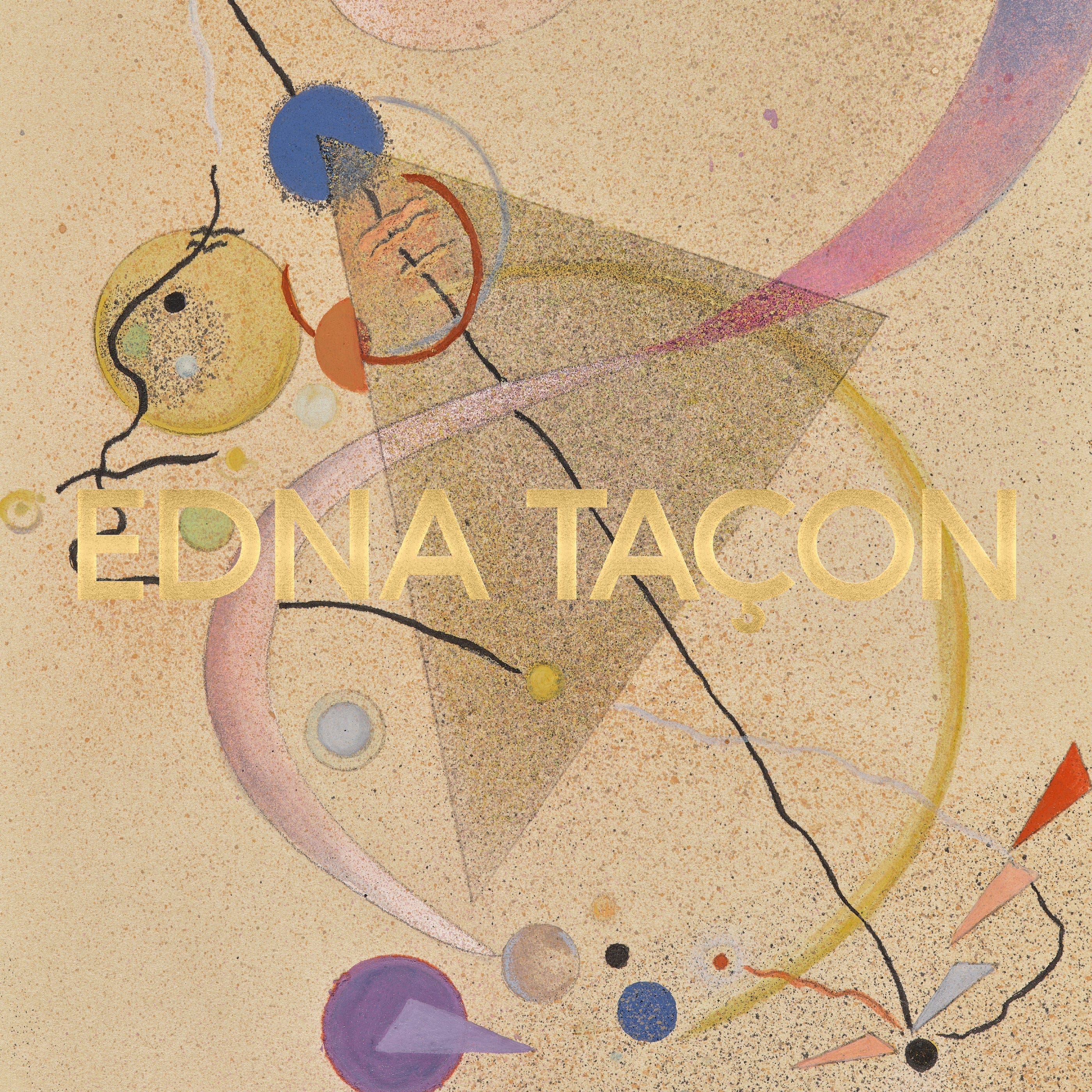
The catalogue’s cover depicts part of “Untitled” (c. 1941). A tilted beige-grey triangle is sliced through by a black diagonal string. At its upper-left corner multiple arrows energize the top of the painting and are synchronized with a path of colourful triangles meeting a small black ball. The central large triangle is also crossed by a curling mauve ribbon or f-hole. Part of a large faint orange circle glows in this song within a graphite tapestry and pigments of sound. On one level, all of the balls or balloons circle the triangular kite; on another level, these orbs, or globes, become planetary in a harmony of spheres. The energy derives from geometry: the combined beauty of Calliope and calligraphy. The same energy appears in the circles and triangles of “Composition on Pink” (1942) with a black bow cutting across these geometric shapes and a white curl of melody swirling in counterpoint.
To make ends meet, Taçon designed window displays for leading department stores in New York. She engaged in dressmaking, millinery, jewellery-making, and restaurant murals – her talents inherited from her father who worked as both tailor and musician. The book catalogues exhibits of Eaton’s Fine Art Galleries to add historical perspective. In the Canadian Review of Music and Art she stated her aesthetics: “Vibrant blues and greens, unexpected devices of design dash into a bright rhythm. A certain grandeur or dignity is seen in their concerted brilliance. Verve and decorum combine.” The verve of jazz and decorum of classical music combine in her rhythms and concerts. “Green Symphony” (1945) looks back to “Green Organization” (1943), centres instruments, and stages a performance. A slanted green violin performs with the help of crimson crossings. In a solo exhibition at Eaton’s she included “Fugue” and “Sonata”. We are invited to see musical forms explode in “Ecstasy” (1944), circle and triangle through “Composition on Pink,” and improvised jazz in “Swinging.” In her “Self-Portrait” (1955) she clutches a pet cat, but the triangle covering her chest suggests the lingering presence of her favourite musical instrument, for if music was at the back of her mind, her violin fronted her torso.
Ironically, some of her last paintings portray Marcel Marceau where her colours and shapes add musical voice to the mime’s silence and French accent. Taçon conducts her colours and performs her shapes, stringing her collages between non-objective representation and subjective interpretation. “Grand-mère: An Interview” acts as a coda to the volume with Carl Taçon, artist and grandson, offering insights into Edna’s career. His sculpture, “Grace Note,” (2024) recapitulates the family’s musicality in generational swirls and swivels, meeting points and legacies of lines and edges.
Edna Taçon: Verve and Decorum, Opened February 28, 2026 at the Art Gallery of Ontario.

About the Author
Renée van der Avoird is the Associate Curator of Canadian Art at the Art Gallery of Ontario. Prior to joining the AGO in 2018, van der Avoird held positions as Associate Curator/Registrar at the MacLaren Art Centre, Barrie; Assistant Director of Susan Hobbs Gallery, Toronto; and Curatorial Mentor at the Art Museum at the University of Toronto. She holds a Master’s degree in Museum Studies from the University of Toronto and an Honours Bachelor of Arts degree in Fine Arts and French Language & Literature from Wilfrid Laurier University, Waterloo. Van der Avoird’s areas of specialty are modern and contemporary Canadian women artists and postwar Canadian art.
About the Reviewer
Michael Greenstein is a retired professor of English (Université de Sherbrooke). He is the author of Third Solitudes: Tradition and Discontinuity in Jewish-Canadian Literature and has published extensively on Victorian, Canadian, and American Jewish literature.
He has published 250 essays and reviews in books and journals across Canada, the United States, and Europe.
Book Details
Publisher: Goose Lane Editions
Publication date: March 3, 2026
Print length: 100 pages
ISBN-10: 1773104551
ISBN-13: 978-1773104553
 | A guest post by
|
Brilliant and evocative intro. to the paintings of Edna Taçon. Kandinsky sings!