


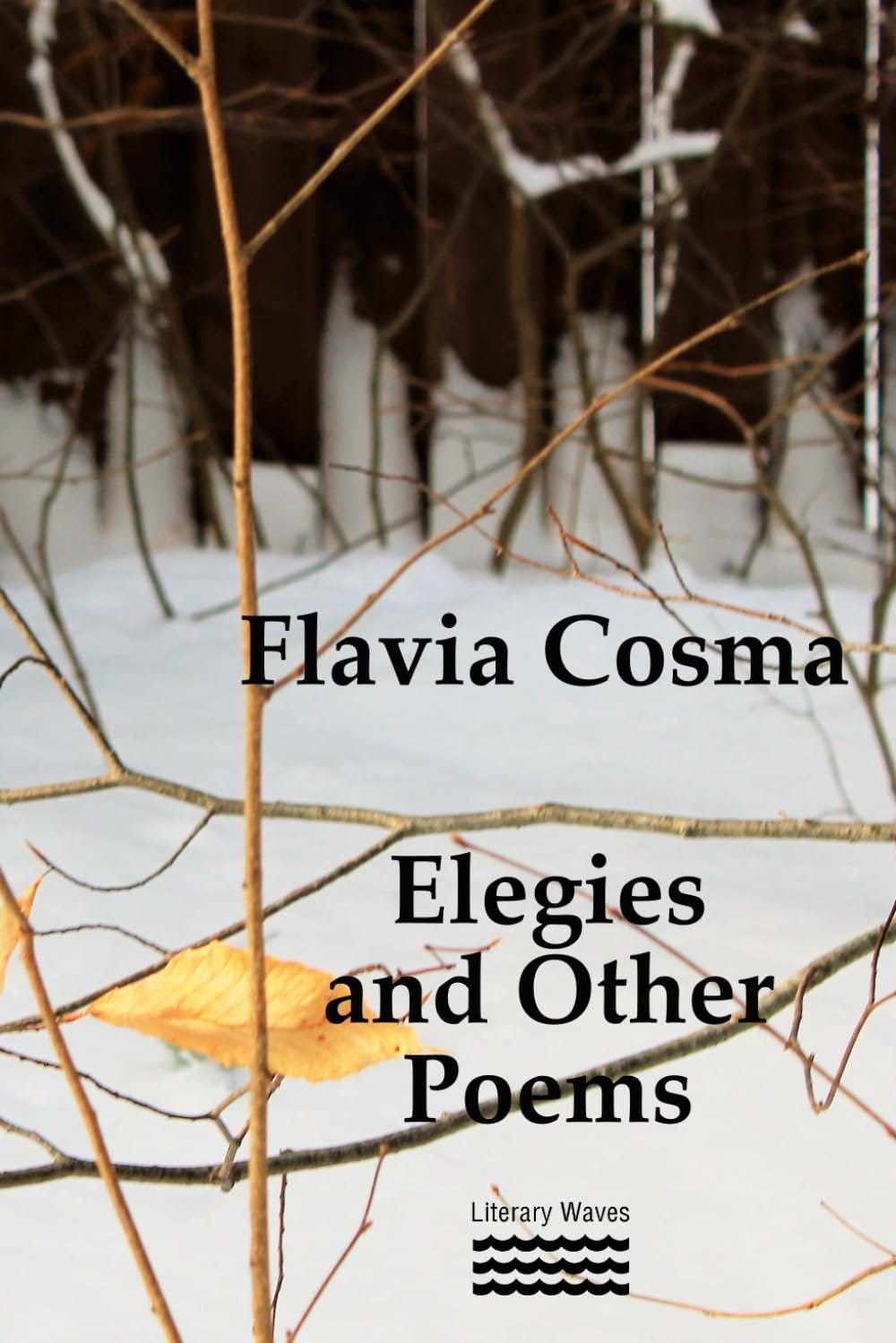
Author of more than fifty books of poetry, award winning poet Flavia Cosma continues to delve into the invisible intricacies and mysteries of the heart. An attentive, sensitive spirit seeking eternity in the tangible manifestations of reality and of love’s multifaceted essence, she gifts us with poems that lead from loss, grief and dark nights of the soul to the redemptive power of nature and the subsequent poetic awareness of our complete belonging to its immanent embrace.
In her dedication Flavia Cosma writes: I dedicate these verses to those attracted by non-existence, who descend the steps of time and discover in their fall the mysteries of it. For them I have dressed in red, taken the buck by the antlers and learned a few things about love.
The book is divided into two sections: Elegies and Other Poems, with the first part comprised of ten cinematic poems, leading us to the scene of what could be the metaphorical intent or the fait accompli of a suicide over the end of a love relationship.
“The images of these hauntingly beautiful poems are indeed elegies to life and beyond.”
The poems in this first section are set in a hotel, going from a prologue, which forewarns us of danger to the details of the scene of a death. We read of sunken skulls rolling down the alleys, and of distorted bodies lying among the ruins. All balconies, windows and skylights situated on the seventh floor of every hotel should be banned. We assume something horrible has happened on the seventh floor, something deathly and from there, the poems begin to unravel reality by leading us to each level from the ground up.
In the poem Ground Floor, the poet leads us to a yellow ribboned crime scene. There is a body on the asphalt. The words allude to someone who has jumped to their death. Camouflaged/ under golden, sad autumn manes,/ the sidewalk remains as damaging as ever/ to health, bones, blood, flesh./ …/ A body transformed/ to something gelatinous and virtual,/ lies motionless on the asphalt./…/ A yellow ribbon sways, descending/ in the rain of leaves/ from the sky/ and otherwise, as far as the eyes can reach,/ rolls a sea of indifference.
As in entrance to the circles of the psyche’s quintessential hell, we are guided into the first floor’s seeming normality: The room is narrow, rectangular,/ commonplace. It is here that sins of omission, lies and rejection wound the heart: and the outstretched hand and a puzzled bird/ knocks its body against the window.
Progressing from the ground level up to the ninth, gives us some hope, though definitely, something life-altering has transpired on the seventh floor, and we are relieved the protagonist of the poems has survived, filled with grief, but alive still. Love’s illusions ended on the seventh floor. There is no eighth and the ninth floor has phantoms above it, which makes us wonder if the woman is already dead and a ghost herself now, or whether the death is purely metaphorical, a soul death after a painful break-up. We read:
On the ninth floor/the air smells mildewy and stale./ It’s getting hotter and hotter,/ and the room ferments./ On the roof above my head,/ phantoms chase one another/ in broad daylight./ …/ I’m not staying here./ I have to run, disappear./ I can’t breathe this poison.
The death of love in Elegies, is a wounding, unbearable grief. The poems in the second section attempt to return to homeostasis and to transcend deep anguish, shifting the focus towards life. The poems that follow are remedies to salve the pain of living after loss.
The piece Solutions begins the second part of the book titled Other Poems. Like Dante and Virgil emerging out of their harrowing journey through the nether world, to see the stars again, in the first line of this first poem, after the hellish pain of the loss of love, the poet sees how the night gets covered with whirlwinds of stars. Only poetry can save us now, although: people rush themselves, stand in line,/ to consult psychologists, psychiatrists, mediators, shamans, gurus, healers,/ avoiding with great care/ the One who is bleeding on the cross for our sins,/ for the poems we chased away from ourselves/ or refuse to write. For once the pain of the heart is acknowledged and appeased by awareness, the wild animal…/ shaking itself as if from a burden…/ leaves…/ Autumn swallows it and leaves no trace. For, once the pangs of pain are subdued by a return to the peace of breath and awareness, life goes back to its tranquil rhythms: the first day of the year was wrapped in peace, endless peace from the sky.
Life gifts us the remedies our hearts need to survive. We are led to reflect on the ephemeral nature of our passage through life on the earth. In order to survive, we construct language to describe the mystery of what we are, of life, of reality and of love.
Against the coldness of the world, we nestle into love. In the poem Autumn Flowers, like asters and autumn roses, beauty lingers through shades of death as small moments of happiness with the sober eyed cognizance of tardy flowers that face the day’s cold, fearing nothing anymore.
If, as we read in the poem Solutions: our sole achievement, our great success in life, is to deceive time, one hour, as Blake wrote in Auguries of Innocence, can indeed hold eternity.
In the poem Shipwrecked, we read: We shipwrecked together/ on the desert of a narrow hotel-room. We were given one hour’s time.
We believe we are hard done by love unmet, but on our life journey we realize that it was not love’s fault, but error, the imperfection of the lover. Love comes, but is imperfect, human, an angel whose arm is crippled, and sadly he limps. Like the blind leading the blind, as in the adage of love is blind, the voice of reason that has been silenced by the hope of love. Reason and clarity finally re-emerge once the ending clarifies that which had been clouded over by love’s blindness. I believe only in you,/ and trust only in you./ You don’t seem to know anything/ and look at me,/ wait for an answer. Reality is not beautiful once the eyes of reason finally see. Once burned we are like a child scalded by fire: in pain, disfigured and alone. The red flowers of passion blooming too fast, wither and shatter as if suicides, yet love survives beyond time. Daydreams save us from harsh realities for it is difficult to continue hoping and living after loss. The poem We so powerfully expresses the inexorable entity which are two lovers once quantum entangled.
We are the primordial embrace,/ the forgotten childhood dream/ become void/ obsession/ …/ two white stones with cut faces,/ looking for each other everywhere, always./ We,/ both immortality and non-being,/ melted into one another.
There are no answers for the suffering of the world and poetry doesn’t offer any either.
To sleep in order not to feel, to be drunk with oblivion is the only way out. Nature offers healing in mysterious ways as in the lines: An angel flashed like lightning over the hills./ For a moment, his wing draped my half-open window. In spite of grief, we can be alive with hands outstretched,/ with the birds, smooth arches in the sky, with the slow rain/ trickling on the windows. Song, dances, echoes and waves of harmonic sound: the universe and reality are shaped by vibration. We can heal by re-entering its rhythm. The sun, the wind and even God do not know what they want. Perhaps no one knows the reason for our existence. It may be just to be, just to exist for life’s sake.
Even facing death, Jesus told us not to be afraid. In the last poem titled I Saw You Under The Olive Trees, Nathaniel…, the ancient olive trees along mount Golgotha speak loudly their own message of survival and resilience. The old stems. Twined, contorted/ they bring hope and sustenance singing in the evening breeze with silver voices. This is what we live for ultimately: to revel in the beauty of the world and to create meaning to feed ourselves and others with the nourishment of hope, happiness hard-won through pain.
Like us, like our lives, those knotted, ancient olive trees withstood millennia of onslaughts yet, fragile and innocent, were born from a drop of sun, from a miracle,/ they exude songs about paths, truths and the endless mystery of Life.
The images of these hauntingly beautiful poems are indeed elegies to life and beyond.
Threaded like sunlight and shadow recurring throughout the collection, Flavia Cosma’s words are a lace of leitmotifs evocative of moments we have all lived or dreamed. Their air-like, vibrant fluidity magically sparks into being a crystal clear, tangible reality. Such a difficult task it is to pin down with words the phenomenology of life and the real world, yet in these poems existence blooms and becomes alive, with all its fears and hopes, its corporeality and sensorial facets, welling up into full dimension.


About the Author
Flavia Cosma is a Romanian born Canadian poet, author and translator. https://www.flaviacosma.com/
About the Reviewer
Josie Di Sciascio-Andrews has written seven collections of poetry and two non-fiction books. Her work appears in various journals and anthologies among which: Canadian Literature, The Malahat Review, Descant, The Canada Literary Review, Acta Victoriana, Canadian Poetry Review, The Blue Nib and Lothlorien, among others. Her poetry won first prize in the 2023 International Poetry Prize in Rome’s Antonio De Ferraris contest. Her poem “The First Time I Heard Leonard Cohen'' was nominated for the 2022 Pushcart Prize. Her latest book of poems, A Nomenclature for Light was released September 2025 by Mosaic Press. Her poem “Quantum Sparks in the Tabernacle” is the first place winner of the 2025 Ontario Poetry Society’s Long Poem Prize. Josie is a member of The League of Canadian Poets, the Ontario Poetry Society, the Italian Canadian Writers Association and The Heliconian Club for Women in the Literary Arts. She teaches workshops for Poetry in Voice and is the host & coordinator of The Oakville Literary Cafe series.
Book Details
Publisher : Independently published
Publication date : May 1 2025
Language : English
Print length : 92 pages
ISBN-13 : 979-8282095203