

Empties by Neil Surkhan
Reviewed by Dawn Macdonald

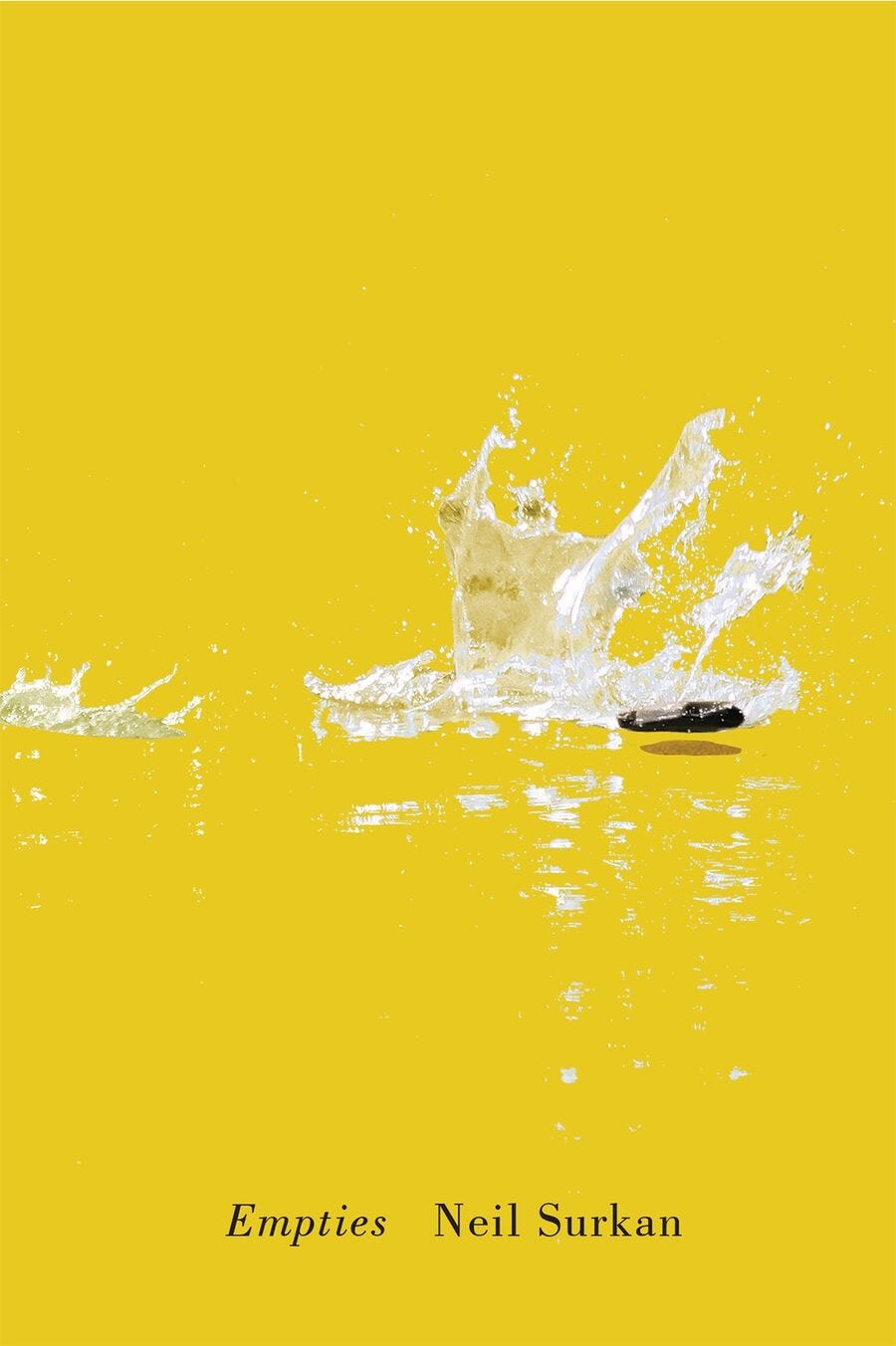
Is parenting a kind of emptying out, a spilling of one’s self into a new and precarious vessel? How much more so in uncertain times, standing as we do in sight of the abyss? In Neil Surkan’s third collection of poetry, Empties, he confronts gaps and openings, dropped calls and vanishing fauna, while attempting to answer his young son’s questions like, “Where was I before / I was born? ... / Was I alone? Was I / lonely?”
Surkan is a lyric poet working in short lines and neat appearances, given to image and aphorism. Some of his images startle and defamiliarize, as in the poem “Flounder” where, at the swimming pool, he notices that “A bandage crawls over the tiles, / lost in a wound it tries to heal.” In the poem “Remains”, standing outdoors on the day of a death, he experiences a moment in which “More aloneness / entered my body // the way a creature makes a hollow / under crumpled leaves.” Objects and emotions stir into action and exchange places; space dilates and telescopes.
His occasional drift into an aphoristic style is by turns wise and baffling. When he asks, “What keeps // me too full // to be open // if not emptiness?”, I can only answer, somewhat crankily, “I don’t know; what?”
The poems, brief and spare, give the impression of having been carefully worked to achieve a sense of casual simplicity. “My lines have been shrink- / ing; now, while / writing, I / tingle at the // thought of checking my / phone and there being / something hap- / pening …” he confesses, suggesting that the compression is attributable to distraction, yet we know it takes focused attention to winnow text down to its bones in this way. As he tells us in the notes at the back of the book, “I consider myself a lyric poet, which means I couldn’t bear to completely give up / control / hope / control / hope / control / hope”.
The penultimate piece in the collection, a series titled “Die Workbook,” cedes some of this control to the reader. “Die” should be read here as the six-sided cube you use in playing board games, not (strictly) as a verb implicating mortality (nor as German for “the”). The die can be used to select one of six words from lists of options shown on the page, like a prescriptive form of Mad Libs. Here’s part one:
1. the dead can’t                   you
                       protect
                       remember
                       owe
                       forgive
                       love
                       punish
Rather adorably, he tells us in the notes that he drafted this series upon arriving home after a trail run while still “in my little shorts”. The little shorts could almost be the keystone for the book—there’s a pun on the brevity of the poems themselves, and the implied reference to, well, the portion of the body that’s involved in becoming a parent. Is this a stretch too far? Maybe so, but Surkan mines his material from the quotidian, whether that’s a rain-drenched mail-order package or a remembered laundry chute or a broken cup, so I’m not going to discount the potential significance of the running shorts.
If this review has more interrogatives in it than usual, that’s because Surkan leaves a lot to be guessed and pondered. In Empties we don’t find answers; we do find space to ask the big questions, and to pause.

About the Author
Neil Surkan is the author of two other books of poetry, Unbecoming and On High, as well as the chapbooks Die Workbook, Ruin, Their Queer Tenderness, and Super, Natural. He is the poet laureate of Nanaimo, BC.
About the Reviewer
Dawn Macdonald lives in Whitehorse, Yukon, where she grew up without electricity or running water. She won the 2025 Canadian First Book Prize for her poetry collection Northerny. She posts weekly on Reviews of Books I Got for Free or Cheap (on Substack), as well as reviews for journals and The Seaboard Review of Books.
Book Details
104 pages, 5 x 7.5 inches
Paperback : 9780228027317, March 2026
Ebook (PDF) : 9780228027324, May 2026
Ebook (EPUB) : 9780228027331, May 2026
 | A guest post by
|