

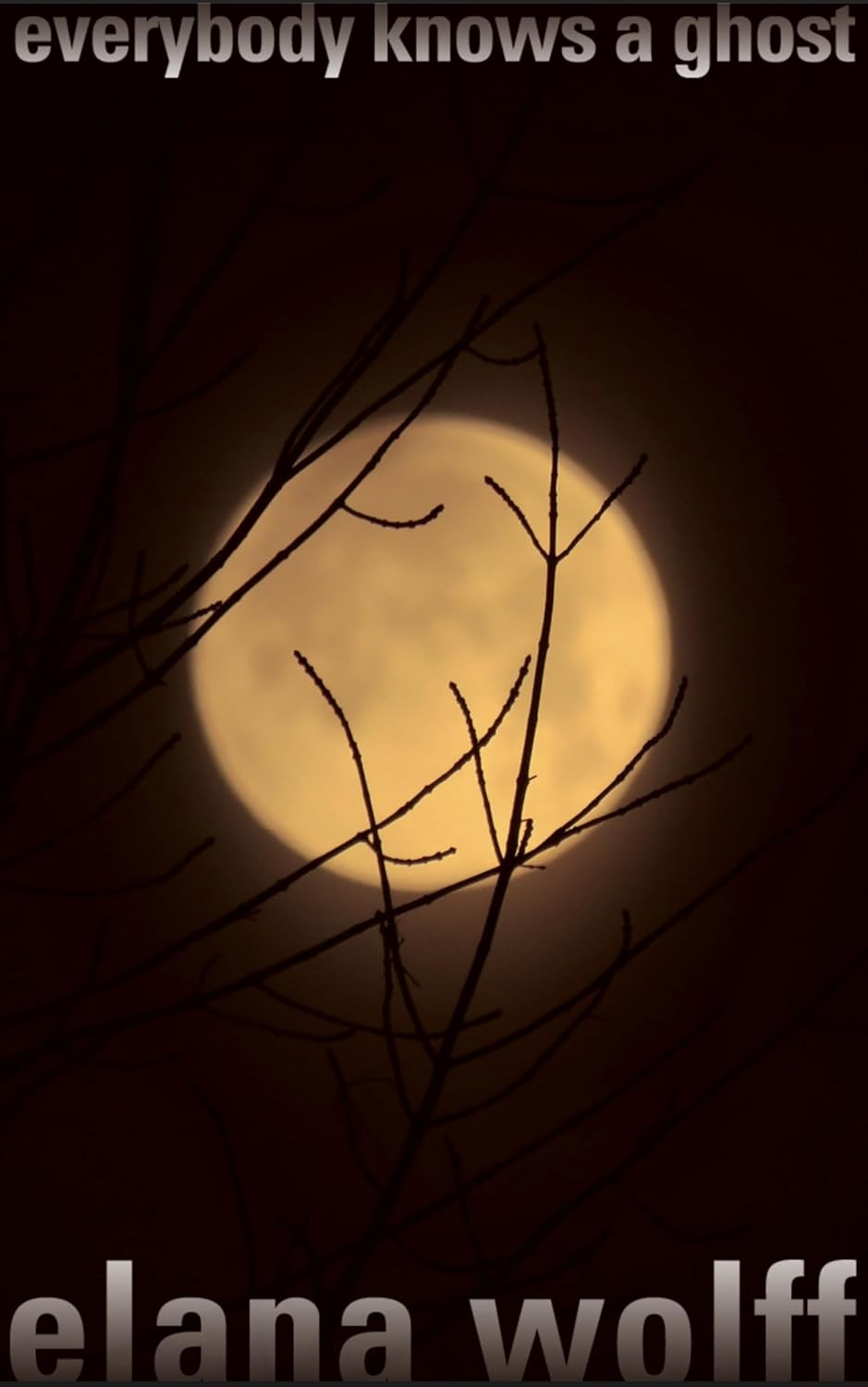
Everybody Knows a Ghost by Elana Wolff
Reviewed by Michael Greenstein
Lunar Sonatinas
In her latest collection of poetry, Everybody Knows a Ghost, Elana Wolff’s ghosts are moonstruck between Sandra Barry’s “Perigee Moon” – “… shadows / wander in the dark, / their shapes the ghosts of day” – and the dictionary’s etymologies of spirit, memory, and trace. Her ghosts have their wits about them, for they colour in painterly poetry and sound in vibrant tones, all the while leaving a residual mystery in their wake. She lets her language dance through the hues of sound and sight – a family of words related, estranged, and syncopated in ghostly ragtime.
Consider the cadence in her opening poem, “Manu’s sphere,” shaped through couplets, alliteration, and migrating rhymes. “Manu’s sphere / may seem like a game of shades –” Long a’s and e’s lead to the long dash, a prevalent form of punctuation attributable in part to her association with the Long Dash group of poets. Atmosphere and manuscript are manifest: “conjuring in the corridors, runes / on hidden lintels, / demi-creature.” Ghostly c’s and r’s shift to sibilants to end the sentence: “staging stunts, reminding us we dwell in many / nebulous worlds at once.” The pouncing rhyme of stunts and once reminds us of plurality within unity, or hidden ghosts lurking amidst spooked architecture and enjambment within and between stanzas. “Sirens // sounding human voices -- / lower than infrared, higher than visible violet.” Colours come into play in the poet’s game of shades and shared sounds – a synaesthetic spectrum of sun colours, garden yellows, and bright blue stars. Beyond the poem are sirens, fire, and a burning bush garden.
The sphere invades neighbourhoods: “The city hoods its head / whenever the trouble comes, // it comes.” Head rhymes with infrared and alliterates “hoods.” Spectral sounds turn cosmic after domestic corridors and lintels: “The sea continues seeing, the rivers run, the / skies arise.” The Queen of the Night blooms to “Manu’s eye-light preternaturally pale.” Nature within preternaturally appears in Manu’s words: “Bluish-white, he says, is a natural colour.” From infrared and violet to bluish-white the poet paints a strange prismatic colour: “It flies / like a stick from our fingers, we draw and write.” We dwell in many worlds simultaneously, and secrets dwell as well in uncanny domiciles. Wolff’s wit continues until the end with its turns of thought and phrase: “The notion // that agape is chaste / may be incorrect. Nevertheless, I love it.” The poem is almost complete on that note, but a final line returns to Manu to enclose his sphere of thought and thinking: “And don’t even think of speaking badly of Manu.”
Wolff’s manner of speaking carries over some seventy pages later to a different Manu in “Kangaroony” with its lighter tone of familiarity: “Manu wearing his elf ears / still; they don’t even look ironic.” Post-Purim costume and pizza contrast with “rising world unrest” and “worldly strife,” as her family performs its Kangaroony dance frivolously. This poem returns to the earlier “Kangaroo” with its couplets of hope. “January got you going – cut from mom, / her blue-light eyes and almond- // blossom smile.” January turns to August, and the mother’s colours enter her child: “The blue-light veins of your perfect head.” Kangaroo is the trademark of the plastic bags and pump for nourishing the child and a line between generations. The baby’s stroller with its pocket is another pouch in the “map to where we’re going after this –” Marsupial and matrilineal, this map heads in the right direction towards the end of “Concertina” with its rising chorus “higher than a hope.” And that hope is a tightrope – the long dash at the end: “The whole wide world’s a narrow bridge, a / concertina wire. The key is not to fear, // to make it across – “ In major and minor keys and middle C Wolff’s lunar sonatinas make it across phantoms of ghost chasms.
She makes it across in “Use of the Room,” which describes a family rained out of its tent in Algonquin Park. Fractured words capture this experience of dislocation: “L / ucky we found a motelier / willing to let us / ten-to-a-room.” Ten echoes tent, L Algonquin. Grandparents get the bed, “the grandkids squeez / ed between them, feet-to-head.” The split “ed” mediates between bed and head, familiar and strange territories mapped by hyphens and lengthened dashes. “The wall-clock, like a Cyclops // , stopped to watch:” This stop-watch clocks time, mythologies, and sounds: “our dreams / tipped into twisty images.” These images twist between cosmic stars and visual stares: “frozen star / es – yours and mine --.” The poet opens the room’s Bible at random to Isaiah 12:3: “With joy you will draw water / from the wells of salvation.” Isaiah draws attention to “the ark of a pulled-out / drawer” and to Algonquin rain. Wolff concludes her biblical commentary with her own prophetic vision:
What I’m getting at is people
build up meaning between them
selves and all
the seemingly
random things
	that present.
What matters is contending with
these afresh.
From makeshift tent to contending, and from random pages to events, Wolff builds meaning.
“One Act with the Night Wolf” echoes the poet’s surname, contends with the moon, and returns to mysterious or cabalistic spheres where Lupu replaces Manu. “How did you hear of the moon, Lupu? / Think about it.” Couplets pace with the wolf in thought and sensory spheres: “If you believe in mystery, step here. / Watch your footing.” She enters its dream dance: “It’s a green light for wolves tonight, / moon the nearest I’ve ever seen.” There is no stopping for this song of ascent to the spheres and Lupu’s perigee in the poet’s astronomy of the near at hand.
Ghosts enter “Gloss”: “Blue at the back of the trees -- / the tarp that never has to be fastened.” Couplets hasten to “air on air. / The chariot that crossed the sky on wheels in wheels – “ Apocalyptic visions trap air in chariot and the speed of wheels. An ampersand joins “mother-//pulse within the womb” to father in the “Y” chromosome. A family gathers in frenzy and frantic dance of “corybantic cousins” with Kafka’s jackals and jackdaws. Things become thoughts, blues overhead turn from colour to tunes overheard.
“Spectral” ends with a pale palimpsest, the final stanzas fading into a “quiet / spectral kind of life” – almost invisible print. “Impromptu with an Emptying Pen” offers one formula for penetrating poetry: “Let’s navigate by plain first lines / that link to closing words / like knell and nugget.” The closing words of this poem: “Let’s celebrate the short days, hours, tap dark’s deep and radiating hearth.” Emptying pen and radiating hearth turn to fire pan and burning bush garden in “Catalytic.” When she wearies of being woman, she thinks of the golden cherubs on the holy ark: “fire issued swiftly from that space – “ A flame’s spirit ignites the imagination and the paradigm of a burning bush garden:
arrowed along the tent of meeting,
entered the priestly nostrils of Aaron’s

sons, Nadav and Avihu,

& burned their souls
for offering alien incense.
Whether in tents of meeting or camping tents, she reads the Bible and thinks of the gripping centre-point with its catalytic causes and effects.
Wolff moonbeams old ghosts and corroborates the audio of self and others, the knells and nuggets of a lyrical sensibility, the one in alone, the any in company, phantoms across a canvas of spruce and ash. Somewhere between evanescence and transcendence, everybody knows a ghost and the corybantic dash to the finish.

About the Author
Elana Wolff is the author of eight collections of poetry and a collection of essays on poems. She has also co-authored, with the late Malca Litovitz, a collection of rengas and co-translated, with Menachem Wolff, poems from the Hebrew by Georg Mordechai Langer. Elana’s poems and creative nonfiction pieces are widely published in Canada and internationally and have garnered awards. She has taught English for Academic Purposes at York University in Toronto and at The Hebrew University in Jerusalem. She currently lives and works in Thornhill, Ontario. Elana’s collection, Swoon (Guernica Editions, 2020), received the 2020 Canadian Jewish Literary Award for Poetry. Her latest book, Faithfully Seeking Franz (Guernica Editions, 2023), a cross-genre quest for dead mentor, Prague modernist author Franz Kafka, is the recipient of the 2024 Canadian Jewish Literary Award in the category of Jewish Thought and Culture.
About the Reviewer
Michael Greenstein is a retired professor of English (Université de Sherbrooke). He is the author of Third Solitudes: Tradition and Discontinuity in Jewish-Canadian Literature and has published extensively on Victorian, Canadian, and American Jewish literature.
He has published 250 essays and reviews in books and journals across Canada, the United States, and Europe.
Book Details
Publisher : Guernica Editions
Publication date : April 1 2026
Language : English
Print length : 100 pages
ISBN-10 : 1778490220
ISBN-13 : 978-1778490224
You've captured the feel, craftsmanship, and heart of Elana's book well. It's ghostly encounters with the ordinary extraordinary haunt us long after reading this collection. This is a fine book indeed. Elana at her best!