

Excerpt: The View From Stansberry Lookout by James Gaitis
Coming in September 2026

The Story
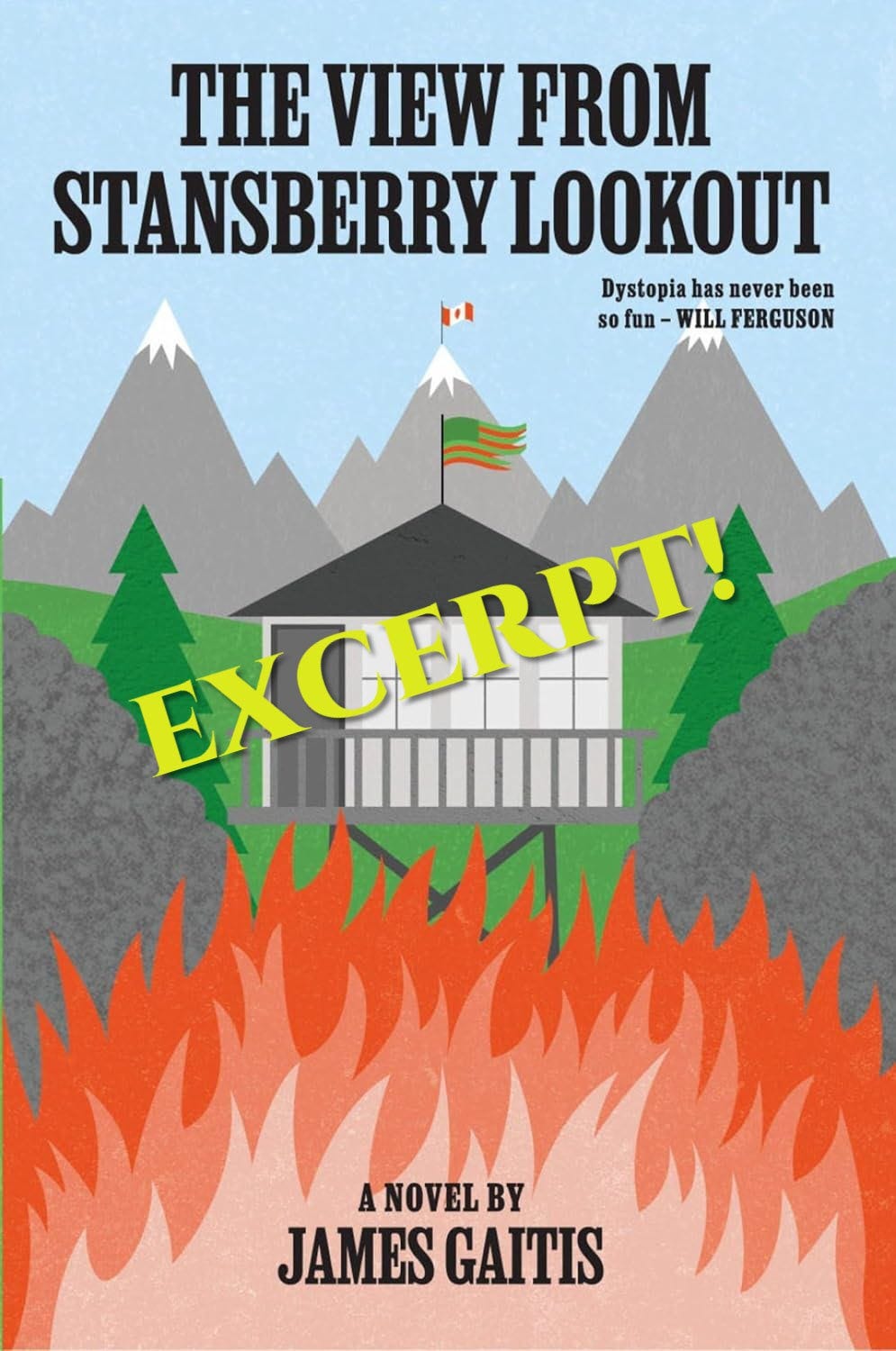
The View from Stansberry Lookout—the third novel by American lawyer, international arbitrator, and satirist James Gaitis—which was written sixteen years ago but only now has become relevant, is a Canadian-centric cautionary tale now come true. As the Confederation to the north struggles to confront the governmental, social, and environmental collapse of its much larger neighbor, the Republic to the south, the Confederation’s Prime Minister slowly implements her three-prong plan to save the Confederation and to either bring the Republic to its senses, or to its knees. An international political eco-dystopian satire, with romantic underpinnings.
This book is available for pre-order from Guernica Editions

Across the border. But not that far across because the Royal Quantum Physics Testing Facility was situated in an isolated cleft of the opposite flank, and only forty or so kilometers to the north, of the same jagged and yet youthful mountain range on which stood the Stansberry Lookout. Across the border then, at the Royal Quantum Physics Testing Facility, the Prime Minister and the Captain of the Royal Militia and the Minister of Border Security—being at that time of global anxiety the three most prominent, or if not prominent then at least by their own assessment the most important, governmental officials of the Confederation to the north—were deep in conference with the Chief Physicist of the Royal Academy of Science. The physicist’s name was Dr. Everett Tindler, the winner of many prestigious awards bestowed by the Confederation and the namesake of several theories and more than several hypotheses and a variety of formulas and at least sixteen different compounds and two phenomena almost certain to occur somewhere from time to time. Dr. Tindler thought he soon might become The national hero of his fellow citizens and a great man for the history books and historians alike, but first he had to humor and educate the three Confederation officials who stood before him and who were, in his mind, all as dumb as the pick-up sticks his parents once tossed upon the ground and then insisted he play with when he had preferred to sit in the quietude of a nonadult setting and think and ponder and consider.
The three officials had all heard the same thing from Dr. Tindler and none of them understood it or how it could be possible. So the Prime Minister repeated the question, again asked the white-coated physicist how something like that was even possible. “How can you make a barrier that lets things out but does not let things back in? I mean, how is that possible?”
Professor Tindler looked over the edge of his bifocals and out from beneath his bushy eyebrows and smiled condescendingly. He considered repeating the only valid explanation. But he knew he would not get through to them, that their own intellects, stunted by the linear orientation of their careers and ambitions, were impenetrable and impervious beyond redemption. “You’ve heard of revolving doors,” he said instead, more or less repeating what he had already said before. “This is a quantum revolving door. It revolves to let things out, but changes randomly and unpredictably from moment to moment such that the door isn’t where the door used to be.” The three officials looked at him and shook their heads to show they now understood, but then looked to the ground or their knees or to the others to unconsciously show they did not. And the scientist saw this because it was common in his experience: his students, his colleagues, his audiences, his superiors always wanting to show they understood what they did not and, in their egoism, thereby failing to grasp the knowledge well within their reach if only they would make the effort to gain it. So he added, “The door can’t revolve to let things back in because it is no longer where it was before. In a manner of speaking, that is. There’s a lot more to it than that, of course.”
They talked about it more and the scientist deferred to the three officials by entertaining all the questions they could muster and posit in the soft-spoken and accommodating manner of speech customary to the Confederation. Until the Prime Minister finally said, “Perhaps another demonstration would help us understand,” with the result that the four of them retraced the walk through the narrow secret unadorned hallways that led to what was marked as Quantum Experimental Chamber C. Followed by four of the members of the Royal Special Forces military detachment that provided security at the facility and who wore their special uniforms with an artificially stiff and truly awkward pride. As if when they put them on, all semblance of personality and persona were not merely stifled but were actually eradicated, if only until their workday was done. And once the steel- and titanium-reinforced doors had been opened by secret code and secured key and other, even more ingenious, devices, and then shut securely again with the guards now outside and the three officials and the scientist in, the scientist performed the experiment again, with a slight alteration merely for effect. And when he threw the two balls this time instead of the one, they both did what the first ball had done on the first occasion. Which was to sail through a sheet of unseen energy and particles that were one and the same although the three officials could not comprehend that either—that everything was at once solid and not solid, energetic and not energetic—and then bounce off the glass wall only to bounce again when they encountered the invisible and impenetrable barrier of the quantum field.
“It works with bullets, too,” the scientist said with a smile. “I can show you if you like.” And when the Prime Minister said, “No, that will not be necessary; we’ve read the reports and watched the videos,” the scientist opted instead to light a cigar, which he drew down on deeply before he blew a steady stream of fragrant smoke through the invisible field. And the four of them watched in wonderment as the billowing cloud first spread and then curled about as it dispersed in every direction except back into the side of the room from which it had originated.
The Prime Minister excused the scientist with the usual thanks and the standard condescending reminders of confidentiality and security risk and all of that and the military detail stiffly ushered the three officials to the secret elevators and the secret garage where they loaded them into a dark vehicle with darkened windows and bade the drivers and new security detachment farewell with knowing nods and a final test of radio communication. “Mama Bear departing” and “Roger, Goldilocks.” With another dark nondescript vehicle with dark windows to the fore and another to the rear, and another to the rear of that; as if that particular arrangement of uniformly vague thoracic segments was the norm for any foursome centipede of vehicles, such that this particular entourage would not be noticeable once it came out unto the public roads and into public view.
Back unto the back roads leading out and away from the Royal Quantum Physics Testing Facility and back unto the official scenic mountain highway marked with sign after sign stating Scenic Highway and finally unto the regional motorway that posted speed limits no one noticed and no one obeyed. Back through the glorious mountain passes where old-growth stands of larch and white pine and Douglas fir and spruce canopied thickly and darkly overhead. Around the frost-chiseled limestone cliffs and igneous outcroppings and around the hard curves and unmarked turns that followed the creeks and streams just now cresting with the sudden accelerated snowmelt of early June. Past sauntering groups of lazy elk coming down to the valley floor to browse on the first browse of spring and past bighorn sheep and mountain goats perched narrowly along the rocky ledges of the road cuts. Down and down, slowly and with regret, past the last foaming cascade of waterfalls and out of the mountains unto not prairie but at least into foothill and then something that once might have been open plain filled with wild herds and stalking predators but now was a suburban spread encircling a still-modest city that rose up to break the long horizon to the east. And finally into the secure confines of the Confederation Centre—the Confederation’s western capital—where the Prime Minister now stayed as the final days and weeks and months in the making and execution of her plans unfolded and the new day dawned.
***
The Prime Minister led her two confidants into her private study and ushered them into two enormous overstuffed chairs upholstered with the black leather of the finest Confederation stock of cattle. She opened the walnut liquor cabinet and sorted through the collection of bottles and pulled out a leaded and cut-glass decanter, a decanter emblazoned with the gold-plated crest of her own family name and topped with a pewter topper in the likeness of a mounted grandsire from long ago. And she poured herself and her two companions full tumblers of an imported whiskey pricelessly aged beyond reason. “Well, lads,” she said as she lifted her amber drink to the level of her green-to-hazel eyes so that the crystal cut the Captain of the Royal Militia and the Minister of Border Security into myriad fractal and kaleidoscopic versions of their real beings, “let’s raise our glasses to redundancy.” And when the Minister of Border Security said, “Then you mean to continue with more than one of the alternatives?” the Prime Minister answered, “We take all three, lads. We take all three. There’s no justifying taking chances with what’s ours by natural right.”
This book is available for pre-order from Guernica Editions
“The View from Stansberry Lookout is a tale for our times. A richly imagined satire of quantum doorways and dying republics engulfed in flames—both metaphorical and real—it is timely, funny, and frightening. Dystopia has never been so fun. Fans of Vonnegut, rejoice!” —Will Ferguson, Leacock-winning author of Meanwhile, Back in Nokomis.
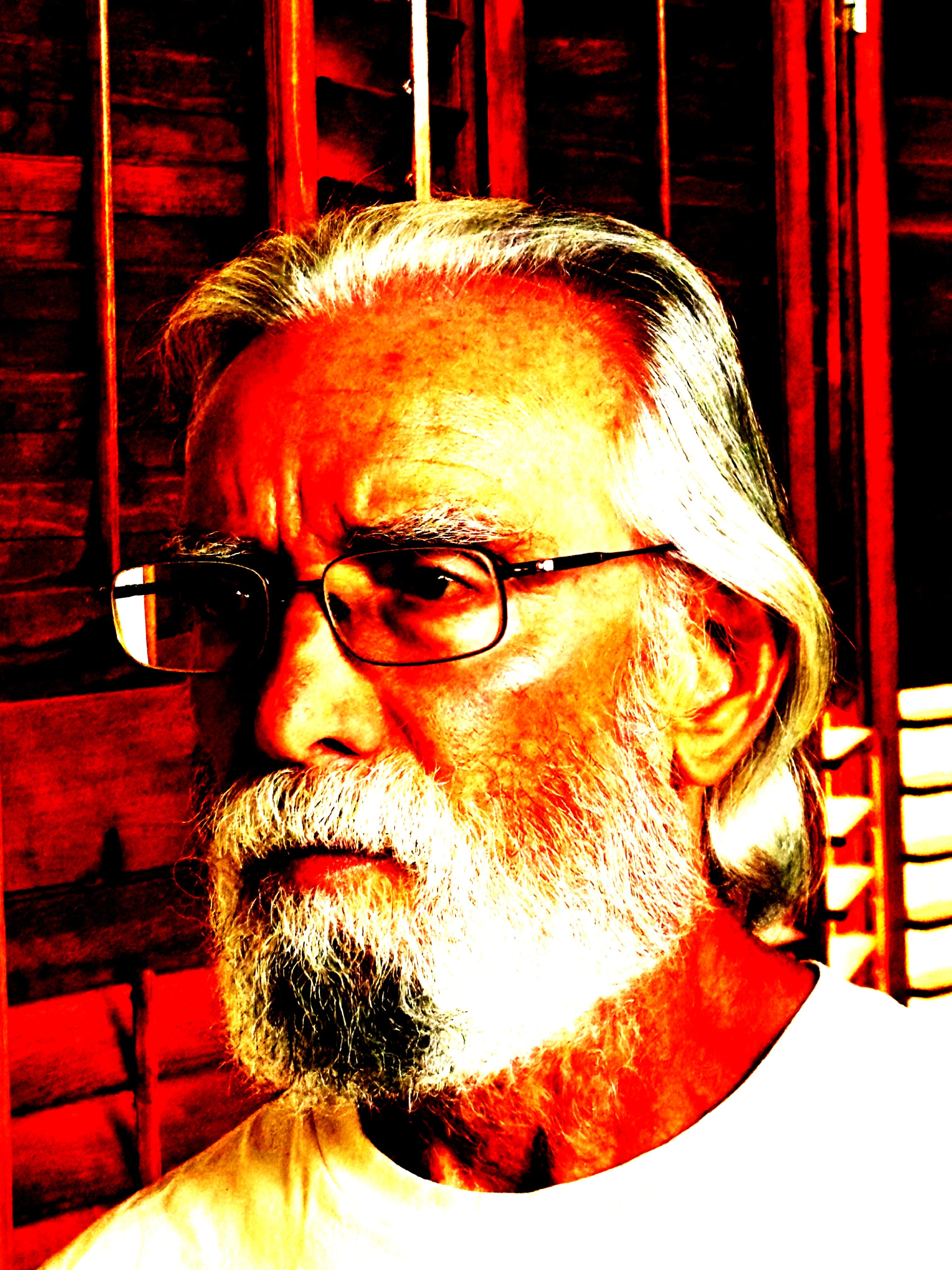
James Gaitis obtained a BA in English Lit from the University of Notre Dame and a JD from the University of Iowa College of Law. The author of two previously published novels—A Stout Cord and a Good Drop and the award-winning The Nation’s Highest Honor—he is a lover of all things wild.
