

Fugue Body by Bridget Huh
A Michael Greenstein Review

Encounter Points
The seven lines in Bridget Huh’s opening poem, “Emerging Orchestra,” in her debut collection Fugue Body reflect seven musical chords from A to G. These parallel lines repeat, moreover, three beats as if the poet were also a conductor whose baton expresses emerging sentiments:
For what we call the present.

For the sake of future loss.

For what we hope will endure.

For the essential nature of a work.

For its body bound in time.

For the rhythm of a language.

For the glorification of singing.
Tenses give way to endure and essential, body bound, rhythm and singing where body is also a book bound and framed by another “Emergency Orchestra” in the penultimate poem: “To end without resolution” and “To carry on forever.” Huh’s unfinished symphony resonates throughout this collection.
A third “Emergency Orchestra,” sandwiched between the other two, features triads or tercets (Huh’s favoured stanzaic form): “The trees want / me to recite. / What do you save // from the disaster?” Recitals from the other “Emergency Orchestra” poems emerge in this one that questions what can be said and saved. The poet wants to untangle the voices of past from the present; she wants “the violins to shimmer / I want them to stand for impermanence.” Violins, voice, and verse shimmer through enjambment until the end of the poem: “while the soloist / hangs over them / like an omen.” Personal pronouns also shift and shimmer in her orchestrated universe: “ – you too / will one day find / yourself alone.” The soloist oscillates between self and ensemble in Huh’s poetry.
Her eponymous poem, “Fugue Body,” uses tercets for the most part to examine herself in relation to society. Human anatomy is situated between the body politic and body of a musical instrument. In a fugue state a person dissociates from reality, but a fugue body dissociates from itself and society in complex counterpoint. “My body has always asked what I have asked / of it. This is called communication, and also / confrontation. This is called being 19 / & healthy.” Precocious in her final teen year, the poet confronts her 71-year-old piano teacher, as well as two of her white friends. Her second stanza interrogates bodies: “Am I allowed to write about bodies? I think / so. I have one. It hangs onto me like / dampness, like deceit.” Deceit of body and mind constitute trompe le corps and trompe le cerveau in her poetry. Sentences and stanzas coalesce in their own fugue, while the first simile offers a physical condition before giving way to an alliterated abstraction of deception.
Her body threatens to leave her in a compact and helpless state – as compact as a stanza in her life. When she repeats the question “Am I allowed,” we become aware of a loud volume in her fugue body and its quest for boundaries. “My body and I are too young / to realize our circle / that endless shape – .” She circles, fugues, and encloses her body: “all things depart from / and arrive at the body. Enclosed / and enclosing. Such is the body. Yes, mine.” Her syntax circles fugue states. Body is destiny, especially when viewed by a white person who sees not the face of the other, but rather a body othered in colour and gender, “Enclosed until a white person holds it / in their enclosing eyes. I have white friends, / I do. I have friends.” In this insistence lies a disturbing experience: “who wrap around me like a ring of yellowing teeth. / One is my roommate, White 1.” Witness, wetness, and whiteness all conspire against the fugue body.
Her roommate, White 1, is male; White 2 is female – both objectified as they would objectify her. “White 1 tells me I am a stick figure. Weak / arms. White 2 asks, You’re how many pounds?” They encircle her body with their paining inane conversation. Huh performs Wallace Stevens’ “Peter Quince at the Clavier,” itself a performance of the biblical story of Susanna and the two white elders who witness her nakedness. “Their reinventing of my body, the way / white people say things // you’d think their eyes were hands, / putting everything in its wrong place. The body / becomes bruised.” Her exclamation “Reinvention – how ingenious!” serves as a commentary on Stevens’ refashioning of the apocryphal Susanna. The two Whites spy on her stick figure or conceal their own image: “how you hide your own / behind it” – hidden in history. Aside from weight and colour of body image, the poet probes body language through breaths and deaths, ears and years in a cluster of sound.
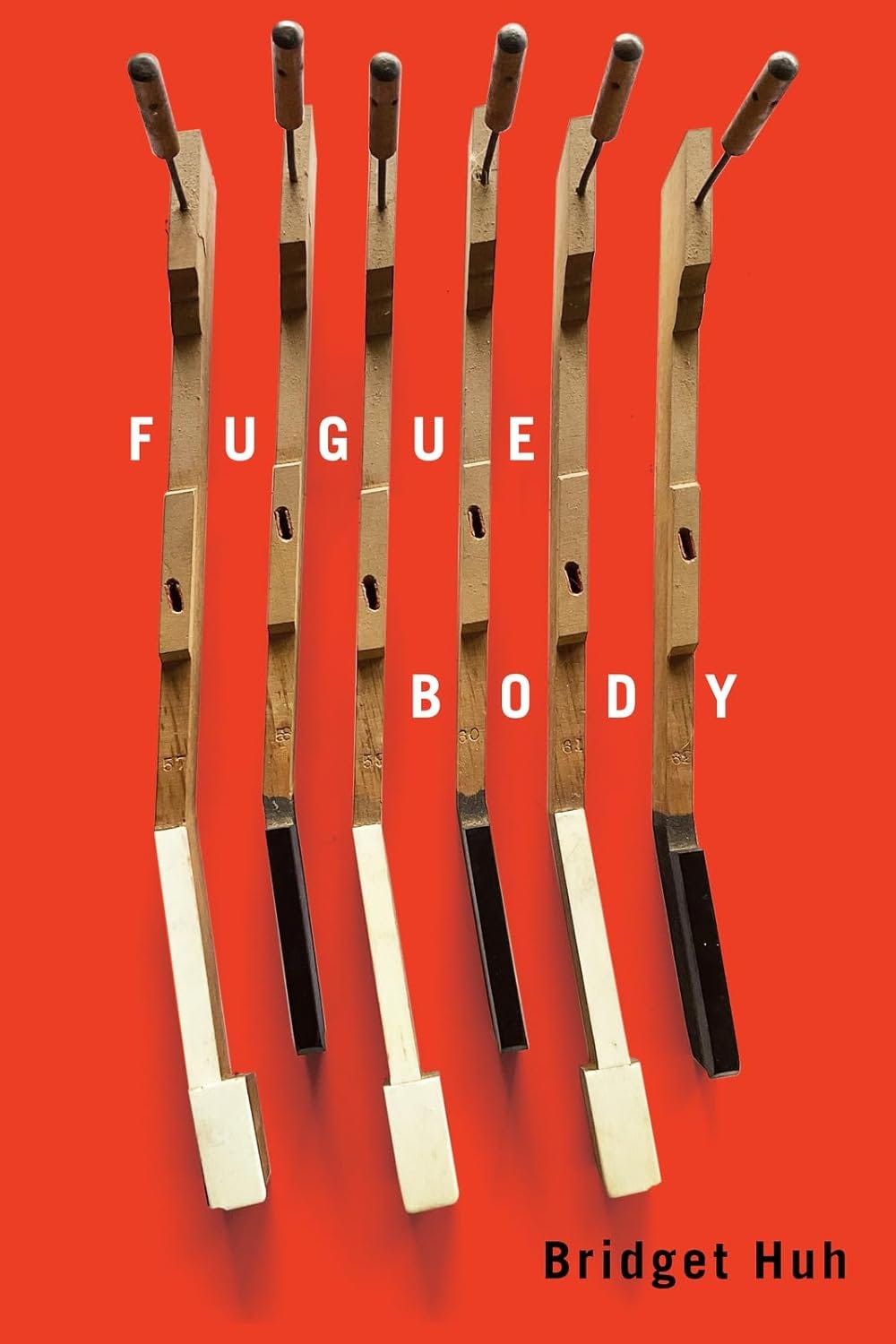
Huh borrows Stevens’ fingers on the keys and the red-eyed elders watching in witching chords. She identifies with the other Susanna in a cyclical enclosure: “encloses the whole of my body / in its hands, which is to say I want to unskin / the outline of my body, peel it off with those bladed // eyes, each word a whetting.” Different thresholds: where Susanna bathes, Huh showers, but the whetting is a wetting, the whole of her body in the hole in the middle of her mother’s chest. Her fugue body is further “tethered to a piano by arms” that finger a clavier “into Chopin’s first Ballade, the G minor one // that everyone loves.” Which explains the book’s cover of six tines attuned to Huh’s melodious instruments and fugue body.
The poet’s piano lesson involves her 71-year-old teacher who criticizes her playing for muddling the notes and blurring the music. According to him, her music stains the score, for he is classically trained and knows the score while she is more open to interpretation, an ephebe fumbling through free verse – “The notated ever lyric, operatic.” The music teacher’s certainties constrain her body which “clings wetly over them.” She unsettles the score and sets the score straight. After Chopin’s fugue she turns back to her two White friends who ask her to explain when she opens her “raced / mouth.” Their conversation recapitulates counterpoint: “What is the point / of putting language against it.” In their dialogue White 1 replies “Okay, I see / your point.”
Her body or circle of absence returns to the Ballade she plays with her hands. Her elderly teacher “spent a long phrase / of time describing how the sound of the piano / is entirely handmade.” Her fugue body with its pulse pizzicato plays the Ballade which “rings out like a mouth full / and wordless, each tooth a bell.” Melody, stain, and score trope in contrapuntal rhythm: “a cascade of black notes / filling my blank eyes.” Those black notes contrast with her teacher’s “white person thoughts” in her “little house / of racelessness.” If Emmanuel Levinas posits the face of the other in any ethical encounter, Huh incorporates and reciprocates the entire body: “Or one is the other, or the other’s the other.” Her body is always in the way, “Striking bars / of black rain” and circling “Enclosed / and enclosing.” “Fugue Body” mirrors the psyche through the body.
Huh paints a number of musical portraits: “Portrait of Soloist,” “Portrait of Sibelius,” and “Portrait of Accompanist” among others. The first of these poems ends with “Let me go on / forever;” the long Sibelius portrait concludes with “ – but I go on living;” “Emergency Orchestra” ends with “To carry one forever;” and “Camera” concludes with split lines: “It waits // for time’s return.” Huh’s quests are ongoing processes of opening enclosures. So much of her music is devoted to Sibelius who is captured in tercets in “From Which Time”: “Within the fold of a brief century / the time it took to perform the Sibelius / Violin Concerto spun outwards.” Spun is fugue body’s centrifugal force, as well as time span between century and half-hour performance. The fold complicates, implicates, and explicates belated stanzas which play in counterpoint to enjambed lines: “[where he pauses for a breath / opens the tunnel as if / coming to an exit.]” Brackets serve as measures or markers of time tunneled on violin strings and vision. She turns to Beethoven who made the distinction between time in the body and tempo which belongs to the soul. Stanzas become fugues coursing through concerts where a musician stands in the bend of a grand piano, holding a bow but no violin. The performance is timeless when she conducts Sibelius.
She conducts in “Portrait of IIIIIIIII”: “The first baton was none other than a rib” or baton on the cover of Fugue Body. Music from Eve’s rib enters her fugue body: “The rib and I are weaving / long threads of inward wind.” “Portrait of EEEEEEEE” personifies Violin. In “Portrait of Sibelius” she again distinguishes between tempo and time: “My voice wanders / the empty picture frame – “ where wanders doubles as wonders. She gives voice to Sibelius’s wife Aino, herself a composer who lived to almost 100 years. “Silence of Järvenpää” traces the composer’s silent years with their “ghost notes.” She traces her fugitive footprints in another long poem about Cuba. Her “Seascape Suite” experiments with sound and forms, as does the final poem, “Argument,” which sits on the side of the page and splits between “If” and “Then” stanzas:
“If mothers

	If memory” crosses over the page to

							“Then daughters

						    then fugues”
Huh’s debut conducts Sibelius, fugues, and other bodies of music, while it instructs her septuagenarian teacher who passes the baton to her.

About the Author
Bridget Huh is an MFA candidate in poetry at Cornell University. Her poetry and criticism have appeared in Arc Poetry Magazine, PRISM International, The Ex-Puritan and Canthius. Huh grew up in Toronto and is the winner of the 2023 Vallum Poetry Award.
About the Reviewer
Michael Greenstein is a retired professor of English (Université de Sherbrooke). He is the author of Third Solitudes: Tradition and Discontinuity in Jewish-Canadian Literature and has published extensively on Victorian, Canadian, and American Jewish literature.
He has published 250 essays and reviews in books and journals across Canada, the United States, and Europe.
Book Details
Publisher : Signal Editions
Publication date : March 27 2025
Language : English
Print length : 80 pages
ISBN-10 : 1550656767
ISBN-13 : 978-1550656763
 | A guest post by
|