


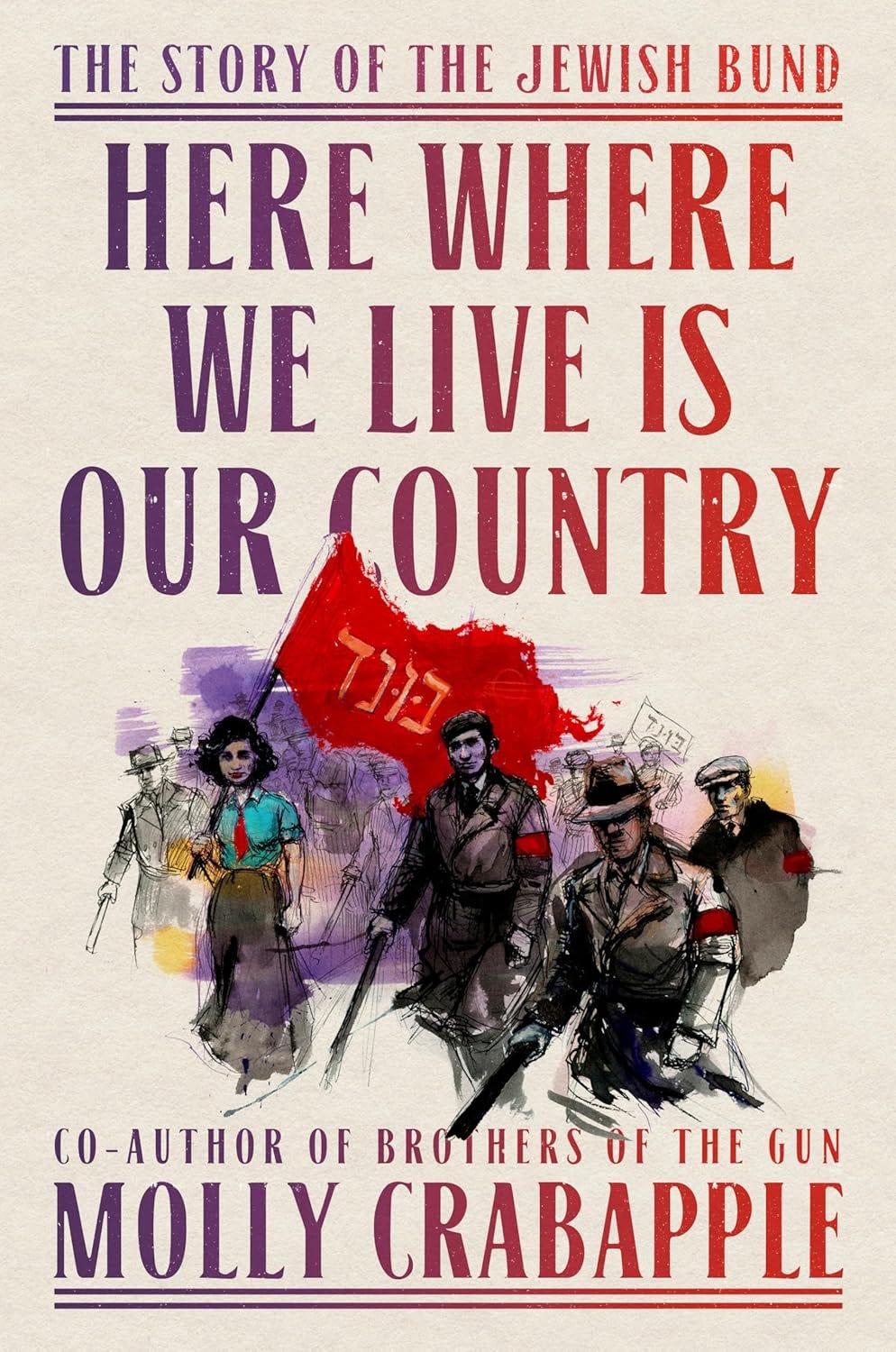
"Tradition is not the worship of ashes," the composer Gustav Mahler once wrote. "It is the preservation of fire." Molly Crabapple opens Here Where We Live Is Our Country: The Story of the Jewish Bund with that epigraph, and it sets the table with quiet precision. Crabapple tells the story of the Jewish Labour Bund, a socialist movement long pushed to the margins of common memory, and makes the case that the Bund represents a living inheritance: proof that Jewish collective life could be organized around solidarity, labour, and dignity in the diaspora, without a state, without a homeland, without the premise that Jews ultimately belong somewhere other than where they already are.
“Recent events lend the book an urgency that Crabapple does not try to deflect.”
Founded in Vilnius in October 1897, the General Jewish Labour Bund set out to unite Jewish workers across the Russian Empire under two defining principles: socialism and doikayt—Yiddish for "hereness." The Bund believed, as Crabapple puts it, that "Jews had the right to live in freedom and dignity wherever it was they stood," fighting for a better world alongside people they had been raised to see as enemies. The organization grew with remarkable speed—from 5,600 members in 1900 to 35,000 by 1905—organizing May Day rallies, general strikes throughout the Pale of Settlement, and championing Yiddish language and culture alongside its socialist program.
The Bund had a tense relationship with the broader Russian revolutionary movement. In 1903, the RSDLP rejected the Bund's demand to serve as the sole representative of Jewish workers—a rupture one Bundist leader described as tearing "a piece of flesh from a living body." When waves of anti-Semitic violence culminated in devastating pogroms in 1903 and 1905, the Bund organized armed self-defence squads that included non-Jewish workers. The Civil War marked the Bund's final crossroads in Russia. The White Armies carried out systematic massacres of Jews and, by 1920, a majority faction of the Russian Bund had joined the Bolsheviks—before being formally dissolved by them in 1921.
The Polish Bund survived and, by the mid-1930s, had become the strongest Jewish political organization in Poland, building a robust infrastructure of trade unions, schools, newspapers, and cultural institutions. When the Nazis came, Bundists eventually joined with Zionists and Communists to lead armed resistance in the Warsaw, Vilna, and Bialystok ghettos. The Holocaust killed most of the Bund's members, and postwar Communist governments suppressed what remained. That arc—from the cobblestones of Vilnius to the ruins of the Warsaw Ghetto—is what Crabapple has undertaken to memorialize.
Crabapple filters voluminous archival research through a dramatist's sensibility. Historical debates arrive not as dutiful background but as battles with real consequences. Rivals clash in meeting halls; militants smuggle pamphlets and weapons; exiles board trains; arguments carry weight because lives are visibly at stake. Crabapple weaves evocative anachronisms throughout, as when she compares the Bund's co-founder Arkady Kremer to the "mean, Derrida-quoting grad students" that her left-wing friends in New York tend to date. The book is as intimate, urgent, and alive as a novel, yet the narrative is shadowed throughout by the reader's knowledge of what history will not allow its protagonists to escape.
Recent events lend the book an urgency that Crabapple does not try to deflect. The devastation in Gaza, the campus protests, and the accusations of antisemitism levelled at Jewish anti-Zionist organizers—these are the conditions under which the Bund's story feels newly alive. For many, the Holocaust seems like an airtight case against doikayt: that mass catastrophe proved that Jewish safety could not be entrusted to solidarity with neighbours. Crabapple does not dismiss this perspective. But she argues that the questions the Bund was asking about diaspora, solidarity, and what it means to build a Jewish life in the world as it is, were never settled so much as silenced.
Here Where We Live Is Our Country does not pretend that the Bund's answers map cleanly onto the present, nor that the fundamental tension between diasporism and Zionism can be easily resolved. However, Crabapple insists the Bund is a vital model for today's leftists. They practised solidarity and doikayt in its fullest sense, fighting for justice wherever they stood. Above all, the Bund understood that resisting fascism and authoritarianism was the very ground on which liberation, shared across every line of difference, becomes possible. Crabapple's landmark book places this history in the hands of activists and creators who need it now, not as consolation but as a usable inheritance. It is, to return to Mahler's phrase, the preservation of fire.

About the Author
Molly Crabapple is an artist and writer based in New York. She is the author of two books, Drawing Blood and Brothers of the Gun (with Marwan Hisham), which was longlisted for a National Book Award. She was a 2020 New America Fellow and her reportage is the winner of the Bernhard Labor Journalism Award, and has been published in The New York Times, New York Review of Books, The Paris Review, Vanity Fair, The Guardian, Rolling Stone, The New Yorker, and elsewhere. Her animations have won two Emmys and an Edward R. Murrow Award. Her art is in the permanent collections of the Museum of Modern Art.
About the Reviewer
Chris Reed is a freelance book publicist and occasional book reviewer in Toronto.
Book Details
Publisher One World (Penguin Random House Canada)
Publication date April 7 2026
Language English
Print length 480 pages
ISBN-10 0593229452
ISBN-13 978-0593229453