

How Cormac Works: In Dialogue with Bill Hardwig
Interview Conducted by Kevin Andrew Heslop



Bill Hardwig is associate professor of English at the University of Tennessee, Knoxville, and the author of Upon Provincialism: Southern Literature and National Periodical Culture, 1870–1900.
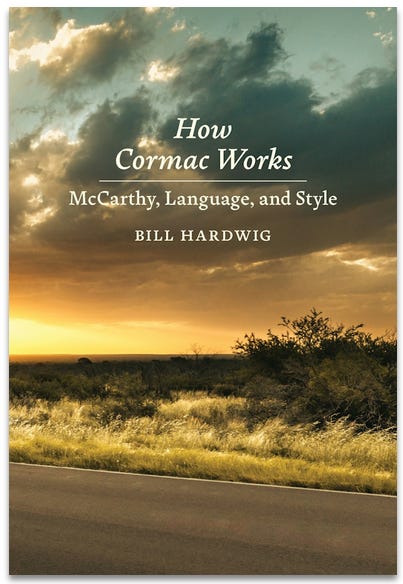
Bill and I sat down to discuss How Cormac Works: McCarthy, Language, and Style recently published with Louisiana State University Press. Edited with permission, this conversation took place on February 26, 2026.
Kevin Andrew Heslop: I’m nowhere near as fluent in McCarthy’s work as you are, but I have loved his work for a number of years and it’s a privilege to be able to talk with you about it.
Bill Hardwig: Well, the main reason I wrote this book was as a hybrid—academic and at an academic press but also for a wider reading public. I’ve had so many fruitful conversations with people who really invest in McCarthy—even if it’s just one novel—in a way that’s different from a lot of other writers.
What do you attribute that difference to?
I think some people are drawn to his interest in subject matter that is often not talked about—dark and violent themes, and his reimagining of taboo subjects. But for a lot of people, myself included, they think of a paragraph that just knocks them on the floor. “Why did he put it like this?” “Why did he use this word?” “Why is he using all this old-fashioned language?”
McCarthy has a distinctive voice and people that really like his work are attracted to it on that level, to the way he writes what might be ordinary scenes. If you think of something like The Road, which is maybe his most read book, the plot seems almost unsupportable as a novel: two people walking down a road. You know it’s not going to end well, but he’s really good at writing dialogue and he brings his characters to life. When I go on Reddit, I see people quoting their favourite passage and talking about all the things they took from it.
I wonder whether there’s an explicit connection there to be made between McCarthy’s dialogue and his interest in the sciences, both engaged in nuance and complexity without resolution.
I think that’s a really insightful idea. I think he does like dialogue because dialogue fails to resolve. You have different opinions that are left in tension or left independent of one another in some way. I think you could say his dialogue works in a very similar way as physics and math, which he turned to later in his life very seriously.
His final two books, that were published in 2022, have a lot of interest in physics. At first they felt to me like completely new books or a completely new territory; and in some ways they were, but then I came around to feeling like he’s kind of asking the same questions as he’s been asking his whole career but with a new vocabulary: What holds us together as humans? What holds the universe together? How does that dissolve?
That indeterminacy that comes out of modern physics and mathematics fits with his idea of the unresolved, as you put it, and maybe defines both human nature and the universe.
Do you feel like his interest in the sciences began in a taxonomy and kind of evolved into an interest in physics? I’m thinking of the list of hobbies the fifteen-year-old “Charlie” listed alongside the profile his high school newspaper published—“taxidermy, cartooning, painting, stamp collection, and making parts for a collection of old guns”—which you describe as being in “remarkable continuity” with those final two books published three-fourths of a century later.
Throughout his career, he had sort of a biological interest in charting the world. I think the reason that taxonomy works as a way to think about his writing is that it’s not only listing the natural elements, but it’s some sort of sense of classification and creating order out of disorder.
Right now I’m teaching his third book, Child of God. The main character, Lester Ballard, doesn’t say use this phrase but it’s sort of from his mind, that he wished there were more order in humans and in the world. In some ways I think you can see McCarthy trying to establish that order in his work, while also losing confidence that some sort of sustaining order is possible.
You compare McCarthy to Whitman, specifically “Song of Myself,” a couple of times throughout the book—as an aside, speaking of taxonomy: I recall Emerson quipping that Whitman promised to become the poet of America and contented himself with being its cataloguer—and I wonder if we could talk a little bit about Cormac’s literary ancestors. Appreciating that he shared an editor with Faulkner, who else did he consider?
I think depending on where you look you can find different ancestors. He has named Faulkner, Melville, Dostoevsky. Some people see, especially with The Road, a kind of Hemingway minimalism. Others see connections to Flannery O’Connor’s vision of the twisted, grotesque South. There are a lot of them that you could say.
You could go back to Whitman, which I don’t know if he would have considered Whitman a real ancestor, but one of the fun things that have come out is the archive in San Marcos where all his materials are. They just released a lot of personal stuff and among them are his undergraduate essays. He did write a long essay on Whitman, so I look forward to seeing what that says.
But back to your point about cataloguing, I think in some ways that can be used dismissively: maybe Emerson’s idea there was that Whitman failed on the promise of what he was doing by getting so much into listing, but I think in another way it doesn’t have to feel so reductive. He really is trying to take an encyclopedic look at the world.
When I was doing the research for this book, I went back and looked at some of the eighteenth- and nineteenth-century naturalists, and I was really struck by how important it was for them to just describe what they saw. This is pre-camera. They were trying to bring to life a world that other people were unfamiliar with.
If you think about cataloguing as giving us a really in-depth look at a different world, you could to go to The Road as a pretty remarkable imaginative feat—creating a whole new globe based off of the destruction that he imagined. All good writers bring details to life, but I do think cataloguing is an interesting way to address his interest in the natural world.
To go back to ancestors, he was very influenced by Faulkner early on. There’s not quite the same kind of documenting of the world in Faulkner, but there is a real sense of how his characters are enmeshed in place. He comes up with this fictional county in Mississippi and, similarly, I think that McCarthy is interested in how his characters inhabit the landscape, whether it’s Lester Ballad in the Appalachian mountains, or, in Blood Meridian, the group going through the Sonoran desert, or the father and son going through the ravaged, post-apocalyptic landscape of The Road.
Particularly early in his career, he was interested in Faulkner’s kind of flowery, almost excessive, exorbitant, luxurious language to describe scenes and characters. Certainly you can see McCarthy borrowing from that: the really long sentences that almost lose their modifiers and go all over the place, challenging to read at times. That doesn’t characterize all of McCarthy’s work, but that’s one place where you can see the influence of Faulkner.
On McCarthy’s relationship with the land, you mention that:
Cormac’s first novel, The Orchard Keeper, hurls towards its conclusion when John Wesley returns a dollar bounty he originally received for turning in a sparrow-hawk to the government office in the city of Knoxville. The boy wonders at the abstraction of value in the bounty system, believing hawks “must have some value of use commensurate with the dollar other than the fact of their demise.” After an unsatisfactory conversation with the woman at the bounty desk, John Wesley feels duped and states, “I can’t take no dollar. I made a mistake. He wudn’t for sale.” This attention to the abstraction of exchange calls into question the governmental and capitalist relationship to the natural world.
A scholar friend of mine, who contributed an essay to Cormac McCarthy’s Violent Destinies: The Poetics of Determinism and Fatalism, wondered how you think about the relationship between McCarthy’s language and the more-than-human world. I think we often associate an Aristotelian impulse towards taxonomy with subduing and extracting from the natural world, but in McCarthy taxonomy coexists with a reverence for a natural world not reducible to capitalist exchange.
One way of thinking about that is that his classifications or his charting or his organizational taxonomy kind of ends up failing or disintegrating. For example, Blood Meridian has all these really intense descriptions of physical places, the precise desert fauna and flora there, the precise layout of the rocks, but then there’s also moments of uncontained interactions and a violence that becomes almost surreal at some places.
Ultimately Cormac maybe feels that he wants to classify the world or catalogue it but he finds that that ultimately doesn’t capture everything. I’m thinking also of how in one of his last two books, The Passenger, he’s got this moment in there where the protagonist is thinking back to a school project he did where he studied a pond and he wrote down every single living thing he saw in that pond and drew them as part of a science project for his school. But then that doesn’t win. He says that was a foolish idea, a childish thing to be doing. And then the rest of it gets into less determinate ideas of science and mathematics, so maybe that’s another way to think about it: even as he’s charting the world, he wants to show us how it unravels or fails or doesn’t tell the whole story.
I wonder whether he seeks and finds refuge in ambiguity rather than a meticulous, comprehensive but doomed accounting that disintegrates.
I think that would describe his interest in language very well because I do think he likes those moments where you get something other than what you expect to get from the language or the description, whether it be from an ethical perspective or a moment of clarification.
As this book was coming together, I was reading Peter Mendelsen’s book What We See When We Read and I quote it. He is a cover-design artist formerly with Knopf books and he got interested in the way language gives us something other than what we expect. His example is: think of a character you know really well, one of your favourite characters, whom you know incredibly well, and then try to describe them. It often gets very hard to describe them on a physical basis. We fill in a lot of those gaps ourselves. If that’s part of language or fiction more generally I think McCarthy is intentionally sort of playing with by giving us weird descriptions of moments where we would expect clarity.
There’s a moment when he’s talking about a “molten rose” of a fire that’s exposing all these dead bodies in The Road. The idea of putting a rose there and all the things that that brings up in our head in contrast from the scene he’s creating … Of course, people have been doing that in different ways for at least a century, playing with the image of the rose, but I think he’s really interested in how language can create that ambiguity that you talked about that makes us create our own relationship to the subject being described.
From ambiguity to elusiveness, I wonder if we could look at Cormac the person. His second wife Anne DeLisle recounted how, shortly after the publication of his first novel, someone would call up and offer him two thousand dollars to come speak at a university about his work and he would tell them that everything he had to say was there on the page. “So,” she said, “we would eat beans for another week.”
I think it was very frustrating to people who were close to him in his life, particularly partners who maybe thought, Well, until you do make some money, maybe you could hold another job. But he held pretty strictly to that.
I was just talking to a person who knew him during his time in college. Apparently in college he did very well. He was in engineering for a little bit but then moved to English literature and did very well and he was about to graduate—he took some time off to go into the armed services—and he was informed that he was missing a foreign language requirement and he just kind of refused to do take it. His rationalization was, I think, partly that he didn’t want to be told by bureaucracy what counted as his education, but he also just said, “I don’t even know if I need this degree. I’m a writer. What does a writer need a degree for?”
He won some very prestigious awards that had some monetary value but he wasn’t comfortable until All The Pretty Horses and especially when No Country for Old Men turned into a film. That was in the 1990s, so he did this for decades in a very dedicated way. I think if you talk to a lot of writers, it’s hard to see yourself as a writer if the world does not see you as a writer, so many people sort of drift away from it. McCarthy, even though he was publishing, and got some nice blurbs from Ralph Ellison and famous people like that, it wasn’t until his sixth book before he was ever a best-seller, and that’s after Blood Meridian, which got a little bit of sales but not much.
With disappointing sales, he still kept that dedication to seeing himself as a writer and what that meant was staying in a back room with your legal pads and your typewriter and working. There’s a real work ethic there. He came from a fairly well-to-do family—his father was a lawyer at the Tennessee Valley Authority, so he grew up in a comfortable environment, went to private school—but I think he lived in relative poverty for a long time because of his dedication to his writing.
I recall he said that he wrote so that he didn’t have to work.
I can’t remember where it comes from but it certainly sounds like something he would say. Because work pulls you into the commercial world so often. Sometimes he gets described as a misanthrope or a recluse, and I don’t think that’s fair, but he is suspicious of certain social roles.
He did say on The Oprah Winfrey Show that he doesn’t like to talk about his fiction because “you stick to your side of the road and I stick to mine.” There are people who think about and talk about writing and there are the people who do the writing.
He did a little bit of publicity later in his life but he did almost none of that early on. He would not read in public; he would not go on book-signing tours. He just saw that that was not what a writer’s supposed to do. I think towards the end of his life, maybe with The Road, he started to think about leaving his family something, and so did a little bit more of that.
Getting on Oprah’s Book Club was a house for his kid.
Absolutely, for the first time he began thinking about a monetary legacy rather than just a literary legacy.
The actor Josh Brolin tells an anecdote about trying to get a hold of McCarthy and McCarthy eventually calls him back and says, “Sorry, I was out of town. I just got back. What do you need?” And Brolin invites him to the set of No Country and Cormac agrees and shows up and doesn’t engage with the director or the actors but just stands talking guns with the prop guy for the duration.
[Chuckles]
Then, after a screening, Brolin goes looking for McCarthy’s reaction and McCarthy says “good movie there” and nothing more.
I think he feels very uncomfortable in some of those environments. I think sometimes he seems standoffish. In interviews, to me he sort of feels shy and a little bit awkward. That’s not where he wants to be. He doesn’t want to be in the spotlight even though he realizes the value. He wants people to like his books but he doesn’t want to be going around selling them or talking them up.
I’m at the University of Tennessee at Knoxville, where he went to school and grew up; and the university tried to get him to receive an honorary degree. With that, they had in mind that he come and accept it and give a speech and he just was not interested. He didn’t hold any ill will, apparently, and a few years later Dolly Parton was given one and he said, “I think that’s great. That’s great for her image and her career and I’m so happy,” so he wasn’t opposed to the idea. It just wasn’t what he wanted to do.
You mentioned he’s sometimes perceived as being misanthropic. One might even infer arrogance from his unwillingness to speak about his work, as if it was an act of humility to attempt to sell something that you’ve made. To read his work is not to encounter a misanthrope, but where does that accusation come from? And how does one rebuff it?
I’m not quite sure where it comes from but if people want your attention and want you to explain, especially with some really bizarre fiction, they might ask, “Why did you write about necrophilia?” “What was your interest in the 1850s?” And he doesn’t want to do that.
Sometimes people are frustrated they won’t get interviews. I know a lot of McCarthy scholars were upset when he finally gave an interview and he gave it to Oprah Winfrey. They’d be like, “I’ve been wanting to ask this guy questions for twenty years and he won’t return my phone calls!” So some of it might be that: dissatisfaction with limited or exclusive access that they wish they had.
His demeanour was sort of distant sometimes and that can come across as arrogant. I don’t quite see it that way but if you look at him in the Oprah Winfrey interview he’s kind of like this [tilting his head severely with his fist on his cheek]. You could read that as he’s too good to even be there, but I tend to like to look at it as shyness or discomfort more than arrogance.
He did love to talk to people, just not about his work. About guns, he’d be very happy to talk to the prop person. He was famous in Knoxville for going around to working-class bars and sitting around and listening to and telling stories. He was a very outgoing. If you read Suttree, a lot of those experiences around the bars and the seedy side of Knoxville are things that he maybe didn’t experience quite as immediately but he enjoyed interacting with people. I think the people who knew him think of him as having been a kind, generous, warm person.
But then also I think that there’s a tenderness or preciousness to his language sometimes that just doesn’t fit that steely, arrogant image. If you can read his personality through his language—and I’m not quite sure what that would even mean, but if you can do that—there is a real sentimental tenderness, not necessarily to his characters but to the world.
I think much of his ambiguity and indeterminacy could be seen as dark nihilism but I don’t think that’s quite right either. I think he’s somebody who feels very poignantly the desire, maybe, for continuity, for order, for faith, for all those kinds of things that might orient people. He sees them at times, but he also sees the loss of those things.
You’d mentioned John Wesley returning the dollar because he didn’t like what he had done by turning in the sparrow hawk. All of his books, to one degree or another, or at least almost all of them, have to do with the modern, industrial, capitalist world encroaching on something that feels unattainable but pure. Sometimes it’s in the mountains; sometimes it’s in the desert. He’s always looking for moments that are outside of the modern world.
Especially as he goes on, those places sort of disappear. The hero of his first book moved out into the mountains and ended up in a mental institution, in governmental control. You see that a lot. The same thing with the third book: he’s certainly not a hero but Lester Ballad ends up institutionalized. I think he sees the reach of the modern world as something that is poignant but also maybe unavoidable or inevitable. Maybe that’s where some of the ambiguity of what he sort of envisions as worthwhile he also recognizes as disappearing every day.

In this respect, do you feel like The Road was a prophetic novel?
Prophetic in what way? Prophetic for him or for the world? For where we’re going in the world?
That he had a vision of some time future which is to come.
Yeah, I think so, but it was very important for him that the event that caused the destruction wasn’t specific. He didn’t want it to be read as an ecological tract. It could be a bomb, could be a meteor, could be an allegory of global warming. The world’s just not going to sustain this, I think was the spirit of it, but he wanted to keep it abstract so it didn’t become a sort of topical novel.
If you look at the very last paragraph of that book, the only one—other than the memories that aren’t in that grey world—remembering a brook trout “humming with mystery” and these mazes on their bellies. He says “it was broken and could not be put back again.” I think you could read that passage as prophetic, in part because brook trout are famous for being almost like canaries in the coal mine. They’re very sensitive to acid rain and other sorts of pollution to the water, so they’re the species that are likely early on to disappear.
I wonder if we could linger on that paragraph:
“Once there were brook trout in the streams in the mountains. You could see them standing in the amber current where the white edges of their fins wimpled softly in the flow. They smelled of moss in your hand. Polished and muscular and torsional. On their backs were vermiculate patterns that were maps of the world in its becoming. Maps and mazes. Of a thing which could not be put back. Not be made right again. In the deep glens where they lived all things were older than man and they hummed of mystery.”
Appreciating your kindred attention to Cormac’s attention to language, what do you see when you see that paragraph?
Some people feel like it’s not an appropriate ending to the book, but for me it’s such a striking image of a precious, natural scene that’s been completely absent from the entire book. The attention to creating that scene, it almost reads poetic: “They smelled of moss in your hand. Polished and muscular and torsional. On their backs were vermiculate patterns.” And then that final line, “In the deep glens where they lived all things were older than man and they hummed of mystery.”
I think “mystery” is a word that keeps coming up in his books; and they’re often connected to mysteries in the universe and that our lives can’t capture—especially our lives in society. But because it’s a mystery that cannot be put right again, we are already moved beyond that moment. And, again, such a striking image at the end of a book of trying to make it to the coast. I’m trying to think if there is a single blade of grass in that book that is growing back green. I don’t think so. Everything is gone. And to have this final image of a scene of moss and creeks and all that speaks to that idea of mystery. I think that’s really important, that last word.
I wonder whether I could muscle an analogy here with a Japanese form, the haibun, where we have a prose paragraph followed by a haiku—a longer context and then a fragmentary relational distillate or counterpoint. I wonder about McCarthy doing this often, actually, establishing a context and then providing precisely what you wouldn’t expect in reply.
That’s a very nice analogy. I’m not an expert in that form but it makes a lot of sense, creating one set of expectations and then complicating or undermining or moving beyond it or re-engaging it with something else. And I think that is something that he does quite a bit.
I don’t know if this quite fits, but one of the moments that come to my mind is from Blood Meridian: towards the end, The Kid, who is the person in the group we follow—and they’ve been on this murderous rampage for a while—and he seems unbothered by it for a while, but then he seems to want atonement, wants forgiveness, wants growth. He’s searching for something and he reaches out in a variety of ways for that and at one point sort of towards the book’s conclusion he sees an old woman sitting against a desert wall, almost like she’s sitting there praying, and he comes up behind her and he confesses everything to her. This is a real moment, potentially, of reconciliation or confession. But then we get the description that it’s the “husk” of her body. She has been dead for a long time. She’s desiccated there. So nobody was there to hear The Kid’s confession, so we’re left wondering what to make of that.
On one hand he did sort of reveal himself in a way that he hasn’t throughout the whole book, though McCarthy doesn’t even tell us what he said. But on the other hand, it’s to an audience that is dead, which sort of potentially undermines at least our conventional idea of confession. There’s nobody listening.
In some ways that reminds me of, in Child of God, the first time that Lester violates a dead body as if he were “a crazed gymnast labouring over a cold corpse,” which is a distancing language. But then the line I think right after that is that he whispered into her ears everything he ever thought of saying to a woman. Once again, we’re not told what he whispers, we’re told that he whispers everything he wanted to say, and we have no idea what that is. It could be really ugly. Everything he does say to women out loud is misogynistic and violent and usually involving slurs. But is this the moment where he speaks tenderly or admits his insecurities? We don’t know. These moments where we expect these big revelations, we don’t get ‘em.
That’s a little different than the end of The Road, but again The Road is an image of hopelessness and then something that sort of feels hopeful but it’s in the past and something that’s already gone, leading to an unresolved feeling.
Well, The Road is haunted by the mother who has committed suicide. I recall the has words to offer to the god that has forsaken him and his son to the environment and I feel like the tone of his offerings in those contexts are not dissimilar to how he feels, maybe, about his wife, the mother of his child. I wonder about this, if there is a theme in his work of dead women to whom confessions are given.
More generally Nell Sullivan has done a bunch of really nice work on what she calls “the dead girlfriend motif” about how male characters’ development and growth is so often propelled by or determined by or influenced by a dead girlfriend, or wife in this case. If you go back and think about all his books, it is kind of interesting how many. Sometimes a mother.
When his two new books were announced, we knew that one of the main characters was going to be a woman, one of his first female protagonists. We wondered if we would get a different thing. I was teaching it to my class in a semester where the book hadn’t even come out yet, so we were going to get it late in the semester, and I said, “Since we know that this female protagonist is going to be so central, maybe this will be the first one where she’s not the dead girlfriend.” And then on the very first page of the book, she’s hanging in a tree; she’s committed suicide. It didn’t even make it through the first paragraph.
So I don’t know what to say. I like the reading of The Road that her death is part of what gives him perspective in that book. I don’t know how you feel but I always felt like it’s very possible she would win the logical argument. If you remember the last thing is whether they should go on or not and she says, “I’m going to be raped. We’re going to be cannibalized. What’s the purpose? There’s no endgame for this.” The man has a sort of a ‘we have to keep going’ mentality and the book may support her claim. They don’t get cannibalized that we see; and they escape violence but only by luck and ingenuity, but you could say that her wisdom shows the limitations of his character.
Turning towards scholarship, your book makes obvious that a love of language in a way kindred to Cormac is what ultimately motivated you to write the book. But you also recognize that there was a space in the canon of McCarthy scholarship that needed to be addressed by looking at what some might dismiss as the surface of the book, the language itself, which like great masonry requires only gravity to function. I wonder when you first encountered McCarthy’s work and what so struck you in encountering it.
I came to his work when a lot of people my age or older did: it was with All the Pretty Horses, which came out in 1992. I had gone through an undergraduate degree at the University of Tennessee in Knoxville where he went to school and he lived his whole life and I got a degree in English and I don’t think his name was ever mentioned. There were people around Knoxville who really liked his work so it’s not like I hadn’t heard of him but I hadn’t heard of him in my academic career.
I discovered him in Chicago when I was interested in thinking about my time in Tennessee a little bit differently. I was on the 72nd floor of a building doing temp work. Something about being constrained by the institutional forces had a certain grab on me there.
But then I’ve always been struck by his language. I never really did that much with his writing for several years because I enjoyed reading it and I wasn’t sure I wanted to do the kind of autopsy that sometimes you do in literary scholarship of cutting up the thing you like.
But then I started to get into this idea of what we can do besides critique. There are various people in literary scholarship now who say that we’ve gone too much into relying on this kind of critique where we become these masters who see these hidden depths the authors didn’t even know about. Rita Felski is probably the most prominent one. Reading that brought me back to McCarthy.
I thought, What if I do linger on the surface of the language? At first it was really hard because I left out a whole bunch of really important academic conversations about some of the scenes and books I was talking about out of my book because they went into philosophical discussions or talked about taxonomy. You could go to Aristotle; you could go to Foucault. All of those would make perfect sense. But I was trying to do something different, so I was resisting engaging those things and trying to do something different. So I thought, What if we stayed on the level of style and language and think about what comes out of it?
It was a lot of fun to write and I appreciate all my colleagues for enduring me as I showed up at conferences and said crazy things about various moods and modes of his writing when I was experimenting with this stuff, but it ended up feeling very productive to me. I don’t see it as replacing other scholarship. I am a colleague with Brad Bannon, who’s one of the co-editors of the Destinies book that you mentioned; and that’s a lot about fatalism and philosophy. I think that book is incredibly rich, and I don’t think that they’re missing the point, but a lot of people have done great things about that.
I think we’re all drawn to him, those of us who like him, but as you mentioned we so often move through that quickly. Or because we’re trying to get the philosophical underpinnings, we kind of don’t pay attention to that.
I wonder, having sat in a classroom—if I can make the comparison, not unlike McCarthy, fleeing the academy realizing that what I needed to write wasn’t to be written there—sitting in front of a Shakespeare scholar who, before even reading a sonnet projected on a wall in front of a room of acting students, began dissecting it. As you mentioned the autopsy of criticism that the situation may be worse than that: sometimes a scholar undertakes to kill the thing in order to conduct the autopsy, directly the opposite of the writer’s undertaking.
And I wonder whether the way that critics can become desensitized to the beauty of the language through that process of habituated extraction of meaning is broadly analogous to the relationship to the natural world that Cormac seems everywhere to warn the reader of both in his work and in his behaviour.
Wow. That’s a really nice connection. Another place where I got inspiration from this book is Lee Clark Mitchell, who has a book about the poetics of wonder. He calls it “mere reading” rather than “in-depth” reading. He uses words like “joy” and “wonder” and “beauty” and that really struck me. It’s the people who most love this stuff who end up in those classes; and so often in those classes we don’t ever use those words. I thought, What if I talked about the wonder I found in the language?
This was very hard for me to write in the first draft—that this is what I loved in McCarthy—because that’s not how we’re trained as critics. We’re supposed to be the objective observer. I really was trying to break down some of those lines. So, to go back to your point about McCarthy’s connection to the natural world, there is in his work an oscillation between understanding through studying, classifying, and cataloguing, but then also, like that last word of The Road, mystery and wonder and something uncontainable and miraculous about it.

About the Interviewer
Kevin Andrew Heslop (b. 1992) is the author of several books of non-fiction and poetry, including The Writing on the Wind's Wall: Dialogues About 'Medical Assistance in Dying' (Guernica Editions, 2026), it looks like a garden but he had hurt himself by accident (Cactus Press, 2026), and the forthcoming here lies the refugee breather who drank a bowl of elsewhere (Biblioasis, 2027), Craft, Consciousness: Dialogues About the Arts - Volumes One & Two (Guernica Editions, 2027 & '28), and a co-authored memoir with intensivist Dr. Ian Ball (Guernica World Editions, 2028), as well as Canada Council for the Arts-funded works for the stage and screen. He is also a venture capital investor in the surgical robotics space. His most recent articles and poems have appeared with Amphora, The Fiddlehead, and The Walrus. Born in London, Ontario, Kevin currently divides time between Canada, Denmark, and Brazil, having recently held residencies at the Belgrade Art Studio, Arteles Creative Centre (Finland), BRAŻŻA (France), Casa Na Ilha (Brazil), Kaaysá (Brazil), Earthwise (Denmark), Ørslev Kloster (Denmark), SAIKONEON (Japan), The Mauser Ecohouse (Costa Rica), and Teat(r)o Oficina (Brazil).
How apt: " the haibun, where we have a prose paragraph followed by a haiku—a longer context and then a fragmentary relational distillate or counterpoint. "