


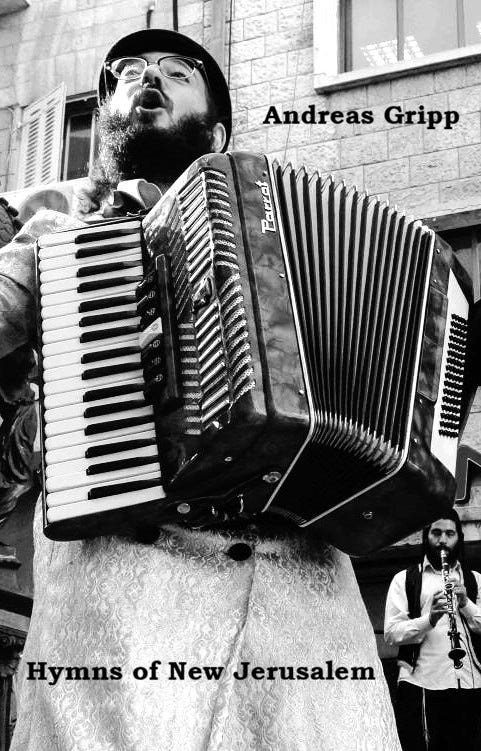
Andreas Gripp is a “people’s poet.” Over decades, he has devoted himself to a prolific practice of accessible, participatory poetry. Not only has he published 45 books of his own verse, many of which are available for free in PDF format on his website1, but he has also edited multiple literary journals and hosted a long-running reading series and open mic in London, Ontario. Hymns of New Jerusalem collects some of his most recent writing across a broad range of topics. While several of the poems address a monotheistic God, others take up both the big and little questions of life.
Gripp has quite a musical ear, which gives his poetry verve and movement. The reader is primed for music from the moment we first look at the book’s cover, where we see a black-and-white photograph of an open-mouthed man in some form of traditional dress playing the accordion, while under his armpit stands a second man, made miniature by the laws of perspective, blowing into a clarinet. These are the rollicking tunes of the street corner, not the meticulously rehearsed notes of the symphony orchestra.
“There’s a basic wonkiness to Gripp’s poetry that is both its appeal and the reason he’s perhaps remained a bit of an outsider.”
In the following excerpt from “Rewriting Androcles, or The Conversion of Theodore Nugent” I have taken the liberty of underlining “ee” sounds and bolding “ay” sounds, so that you can better hear what Gripp is doing:
Today
an earthquake will level
the suburbs of greater
LA. No one will be slain
since thoughts & prayers
will work for the very first time.
And today
the bosom of ICEwill thaw in piercing sleet,the needle in 99trillion sheaves at lastpinpointed. Mexicans will beassembled to share a cake,
provided reparations
for 1848.
You may also notice a tertiary patterning involving nasal sounds—one, slain, in, 99, pinpointed, 18. The musicality gives unity to what can at times become a diverse collection of ideas, images, and metaphors. I’m not sure how we got from thawing to needles to cake, but I’m generally happy to go along, nodding my head to the beats.
There’s a basic wonkiness to Gripp’s poetry that is both its appeal and the reason he’s perhaps remained a bit of an outsider. He might be speaking indirectly of the gatekeeping in the literary establishment when he writes, “Who decides what’s sky? / Behold the flight of worms. // Our grandson / stomps on leaves / to hear the crunching of / their bones. This is something / beauty cannot offer. … // A surface / yet to wrinkle / hasn’t lived. To wither / is to feel the / sigh of God. There / below the stratum. / Every stone a star.”
Who decides what’s sky, what’s beauty, and whether beauty is the criterion of worth? Have we been looking in the wrong direction this entire time, overlooking other forms of value?
As an example of this, the lineation in Gripp’s poems can feel haphazard, and you might notice in the selection above that some of the lines end on words like “of” or “the” which an editor might flag as “weak.” From a gendered perspective, though, and a disability perspective, I would question why line-endings need always be “strong.” In the days of abab patterned verse, a distinction used to be made between “masculine” rhyme (“man”/“can”) and “feminine” rhyme (“lady”/“shady”), with the latter considered as weaker. We no longer see this as an issue. I’d argue that ending a line on a preposition or an article maintains a forward motion in a poem, an effect more like a burbling brook that runs ahead over pebbles and logs, as opposed to a managed waterway controlled through a series of dams.
Gripp is hilarious, and often profane, even as he’s unafraid to dabble in the sacred. He’s self-deprecating (“My prof has graded / my love poem with an F”) and can be quite blunt (“Paradox is pretentious— / it’s simply either / way you’re fucked.”). And, while it’s too long to reproduce here, I dare you to go to page 57 of this collection and read the poem “Chester” without cracking a smile.
Gripp’s poems do tend to be lengthy, running two to three pages on average. Within this generous space, they may wander somewhat before circling back to view their subject anew. Canadian poetry has worked to devalue rambling, wandering, muttering, murmuring, digression and excess. There was briefly an opening for ranting and raving, but that’s closed back down over the past thirty-odd years. Whom do we silence when we insist that poetry must be “concise” or “precise” or otherwise “controlled”? What ways of being in the world are we, in fact, unable to see because we refuse them place? Thank goodness there are poets like Gripp to push back against the rules and rubrics. His is one of the multifarious voices that we absolutely need.

About the Author
Andreas Gripp (he, they) was born and raised on Treaty 6 Territory (London, Ontario) and in 2024 moved to Leamington with his wife, Carrie. He’s the author of over 40 books of poetry including his newest, Hymns of New Jerusalem (Beliveau Books, Summer 2026). His poems have been lauded for their lyrical, narrative, and literary merit as well as their blend of comic and poignant storytelling. Andreas is non-binary, neurodivergent, and is a mental health crisis survivor.
About the Reviewer
Dawn Macdonald lives in Whitehorse, Yukon, where she grew up without electricity or running water. She won the 2025 Canadian First Book Prize for her poetry collection Northerny. She posts weekly on Reviews of Books I Got for Free or Cheap (on Substack), as well as reviews for journals and The Seaboard Review of Books.
Book Details
Hymns of New Jerusalem
ISBN 978-1-927734-74-2
122 pgs. $25.00 (includes shipping).
Published in 2026 by Beliveau Books.
Love this:
"There’s a basic wonkiness to Gripp’s poetry that is both its appeal and the reason he’s perhaps remained a bit of an outsider. "