

“Look at That Sky Again:” In Dialogue with John Wall Barger
Interview Conducted by Kevin Andrew Heslop


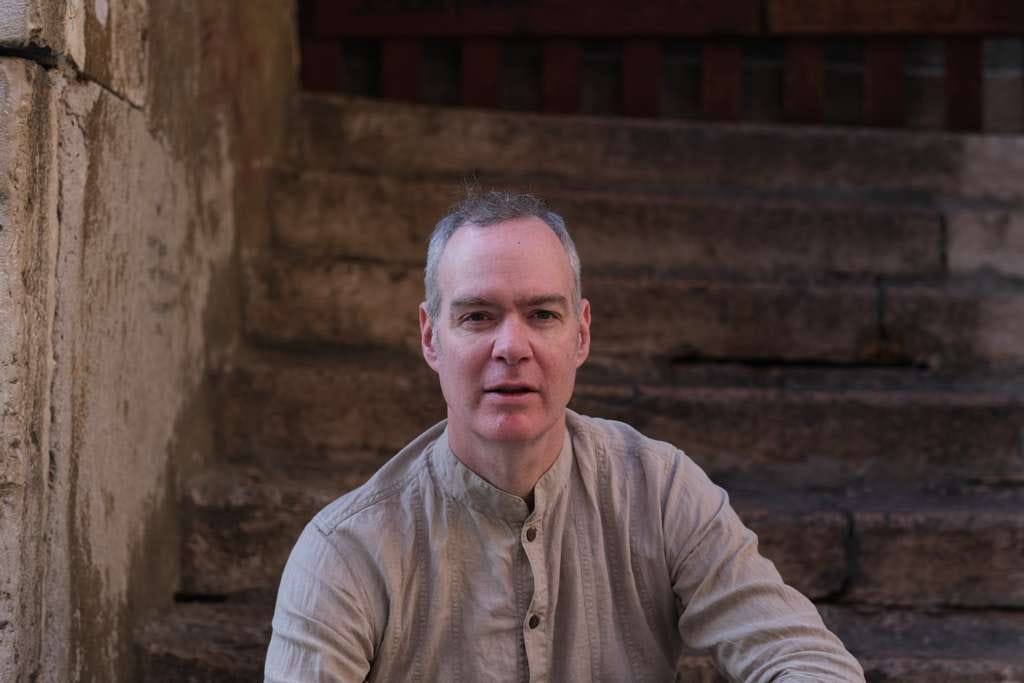
John Wall Barger is the author of six previous collections of poems and one collection of essays. He lives in Vermont and lectures in the Writing Program at Dartmouth College.
John and I met to discuss his seventh book of poems, Resurrection Pie (LSU Press, 2026), between publication day and a North American tour (dates listed below). Edited with permission, this conversation took place March 19, 2026.
The Grace of a Monday Evening
At home my wife was chopping salad, talking to herself, something about tectonic plates that rive continents and make oceans. I just came out with it. “I banged Grace,” I said, “in the baptismal font.”
My wife spun. “You mean grace,” she said, “as in gratia, from Latin, meaning good will, gratitude?”
“Yes! Grace,” I cried, “as in absolution, mercy for a life well lived.”
She held me in her arms. The sun was setting. We stood trembling in the jonquil light. We were ecstatic. She whispered in my ear: “The sun! The sun! It’s not even sinking below the rooftops, as it seems to be.”
“It’s stationary!” I yelled, perhaps too loud.
“It’s us that fly,” she said, holding my arms as if I might float off.
“Glued,” I said, “to this massive spinning rock, hurtling through space.”
“It’s unthinkable!” she said.
We kissed like babies.
Kevin Andrew Heslop: So, I wanted to start with “The Grace of a Monday Evening” because, by this point, about thirty pages in, the delight I was taking in the book, which feels fully mature and uncompromisingly self-possessed, inflected and intensified and there was a sense the book was giving itself a kind of permission and that anything that would come next would feel inevitable.
John Wall Barger: I don’t know if you do it this way, but for me, each book I put together as a kind of vibe: it’s more based on that than form or content. My book Smog Mother was made up of poems that happened in Asia, but besides that, most of my books are held together with a kind of vibe.
I was working for a while on prose poems which I was calling Amateur Escapologists. I loved that book, but it wasn’t quite working; it grew into a stitched-together story of human evolution, which then grew into this book. “Grace on a Monday Morning,” which used to be called “Grace Canticle,” is one of those—emblematic of a kind of human every-story with a kind ecstatic absurd vibe.
I’d been thinking about film and Yorgos Lanthimos’s early films in Greece—Dogtooth and Alps—that happen in a parallel reality: it looks like our reality but some of the rules seem to be different. What are those rules? Poems can do that, too. Poems that occur parallel to our world, a dream-space that comments on our world, but it isn’t exactly our world.
These poems all reach for a kind of ecstatic language, a language parallel to Buddhism, describing the Bardo (for example) but it’s a porn actor. To me it’s always some fool in the Bardo. That’s what those poems should be called, Fool in the Bardo.
I’m thinking of the fool in the Bardo and it feels like a line from the end of “Border Ballad:”
I look and look between the slats. I wake
		to the sound of mosquitoes

	electrocuted on the aluminum Pest-Rid machine.
This feels like an ancient poet who’s plopped into a very contemporary, brutal world he renders as he would render his environment of the past.
Beautiful. Yeah. When I got Shane McCrae’s blurb back, for Resurrection Pie, I was mystified but then I realized I think he’s describing something that I didn’t really understand about my own poems.
He says, “Again and again one reaches the end of the poem only to discover the floor has disappeared from beneath one’s feet.”
I was like, Oh, that’s interesting.
I remember telling a friend years ago that I want every poem to be an amnesiac at dusk, from that perspective. And he said, “You should call your book The Amnesiac at Dusk.”
I think that was the early incarnation of Amateur Escapologists.
It’s how I feel in my body while walking, especially at dusk, during the magical hours of the day. It’s July and it’s 8:20pm. You’re walking and the air is just starting to shift. Something about that hour feels like McCrae’s words: all of a sudden the floor’s disappeared from beneath your feet and everything is permissible. To me, this entire book is coming from that place. Things are so, so, so fucked up in the world, but there is this ecstatic lens, still.
Why 8:20 rather than 8:30?
Maybe it’s just a kind of private joke between my mother and me, but 8:20 has always seemed like a kind of charmed time. A poem like “Twilight in the English Department” could only happen at 8:20pm:
The student stepped in without a word and sat bolt-upright, just as I was sitting, across the swamp of papers, nodding as I did, mirroring each of my gestures. “Welcome, my boy,” I said. “Excuse my labyrinthine chamber of—”
“Please sir!” he said. “I’ve lost something crucial.”
I assumed he was referring to the “F” I’d awarded him for his last essay. “What’s wrong?” I said, leaning back in my chair, slow.
He, too, leaned back. “My son,” he said, “doesn’t know me.” We sat in silence, staring at each other in the darkening office.
“Father!” I shouted.
Do you feel like the poems have always been in a kind of dialogue with your mother? Maybe?
My mother is my greatest fan [chuckling] and my greatest supporter by far. But maybe it’s common for us poets to have one super-fan in the house? If we’re lucky. My mother is my greatest fan, and I’m an only child. For a long time, she was my first reader, too. And maybe my mother’s brain is a bit similar to mine. We both have a similar perceptual system, I think, making logical jumps, some kind of ADHD in common that makes communication between us simple.
You might say, spontaneously, “Toronto is a feral child” and she’ll say “Ex—That’s exactly what it is.”
[Laughs] Yes, that line from “How I Became a Sleepwalker.” You’ve read the book closely! That’s a crucial question: when something comes into your head, who can you say it to, who won’t judge you? Who can we share these weird thoughts with? For me as a poet, I can share them with a reader. I can follow that irrational metaphor into that place, into—I’m not saying I’m Paul Celan, but—into the Paul Celan place. Into the—
—Van Gogh place?
Into the deep Van Gogh place, yeah. I don’t claim that I am those people but in the way that art all goes toward the same place. To me this is crucial. “Toronto is a feral child” is a link between the two worlds: the conscious world of I have to the go the bank and the surreal world of “today I banged grace” which includes the forgiveness of the universe that happens in that poem. “Toronto is a feral child” is a bridge.
When we have an irrational thought that invites us deep into ourselves, what do we do? Do we lock it away? Do we think that it’s bad? Do we not share it with others? Or do we tell our mother? Do we write a poem about it? Do we talk about it to our friend Kevin who’s in Brazil, for fuck’s sakes? Maybe he can help us to lift it into the light.
Maybe she gave you a kind of permission that then the abstract reader would give you.
She definitely gave me permission. My dad did too, but he doesn’t exactly speak that language so he couldn’t really follow me. If I said, “Toronto is a feral child,” my dad would be supportive. He’d be like, “That’s neat. What are you going to do with that?” But my mother would be like, “Yes!” and enter with me under the water of that image.
That’s great. So, maybe as a consequence of my age, I’m beginning to look for some kind of totalizing explanation of things—it’s a very bad habit, but—I have been recently enchanted by a mammoth work called The Master and His Emissary, a kind of retrospective cultural analysis of the preference for the different kinds of thoughts or perceptions or consciousnesses that the left as opposed to the right hemisphere can produce, a study of the way that the world now so profoundly prefers the operations of the left hemisphere and logic and an ability to separate and categorize things from one another. I feel like your work is partaking of the recalibration of the hemispheres insofar as you’re working with logic but from a sort of right-brain relational, atemporal place. And I wonder: how do you discern the difference or boundary between the comprehensibly illogical and the incomprehensibly illogical?
What I’m trying to do is, partly, something that cracked open for me almost twenty years ago when I started reading James Tate: the sense of a poem as having a kind of entryway that invites a reader in. I think of it like an architectural façade over a New York City building that says “MARKET” and there’s a big doorway and you can see there are some fruit stands on the inside and you’re like, Oh, this is a market. And it looks like a normal market and you go in and then it’s not a market: those aren’t fruit, those are human organs on a table.
Yeah. That’s you.
You know? And then the fruit cellar starts to speak riddles or incantations. Sometimes I feel like I cater too much to a reader because I want the reader to stay in the poem. A poem is a funhouse at a fair: there’s a conveyor belt that carries you all the way through.
Certain poets will let you get lost. I respect that also, and maybe I do that sometimes: “Okay, fuck you, reader. This is my brain. This is my perceptual system, and I’m just going to bombard you.”
I think a lot about the reader, not that that implies some kind of big empathy on my part—I don’t mean that—or that I’m compromising my own perceptual system. I just think, How can I get the reader into this weird funhouse?
The façade of the poem—the “MARKET”—tells a little white lie, implying that you’re entering a space that is left-brain. Here, it promises, is a left-brain space: maybe like a memoir or a non-fiction essay. It’s a space you’ll recognize. Relax! Here’s this couple. She’s cutting vegetables. Everything is normal. But then once you’re inside of the poem, the conveyor belt of the funhouse yanks you in, and you’re like, “Oh, shit! I’m actually in this other space.”
So there’s a bit of sorcery involved, a bit of trickery in the craft. Some poets who I admire write only sonnets. They’re obsessed with the octave and the sestet. They’re obsessed with that volta after the eight lines. They spend their whole life on that hinge.
I’m obsessed with the theatre of the reader’s brain: getting the reader into a space and then immersing them into that Lanthimos doubleness of “it sure looks like our world but something else is happening.” Or David Lynch is maybe even a better example: “Oh, shit, Kyle MacLaughlin found an ear!” To me this moment in Blue Velvet where Kyle MacLaughlin finds the ear is what I’m trying to do in every poem. It looks like a normal summer day in Lumberton and then you find a fucking ear, and the ear leads you into the funhouse where—ready or not—the demon Dennis Hopper is waiting for you.
Given you mentioned banking, the market, and cutting vegetables as facades, I wonder whether you feel consumption is the mundanity that we all live in, that you’re inviting people beyond mere consumption to a food more nourishing than that.
Yeah, I am responding to capitalism specifically. We’re the fish in water, who can’t see the water, and the water is consumer capitalism. I mentioned the bank because, to me, money issues are jarring. They rupture my reverie [chuckling]. Like taxes. Even the word taxes: I can’t even use the word taxes in a file on my computer because it is just too upsetting [laughs].
I am writing disruptions of consumer capitalism. To me, poems and art have the opportunity of gently shaking the fish bowl so that the water becomes visible. That I like.
Critical thinking does a similar thing, or can. I love Roland Barthes. I think Barthes might agree (maybe?) that if we can articulate the lens that has been normalized around us, we take back a little bit of agency. It’s like, “Oh, I have choices here. This is not necessarily normal. There are other ways to think about this.” To be stuck without a bridge away from left-brain thinking would be very constricting. It feels like a little closet.
There’s an elsewhere to go to.
Isn’t that what art is trying to do? You mentioned Van Gogh. Van Gogh was like, “Look at that sky again.” With Starry Night he’s just going, “Look at that sky again.” I feel like that’s what all artists are doing. That grace poem is trying to say, “Your marriage is actually fucking potentially sublime. Look at that marriage again.”
I don’t think I’ve ever heard as concise or poignant a tribute to Van Gogh’s body of work as “look at that sky again.”
Look at those sunflowers again.
Those sunflowers you think you know as sunflowers.
You mentioned our entering into stages of development where we become dependent on classification. As artists, I feel like we’re trying to bust those open. On Twitter it’s so often just people violently responding to other people having classified or indexed each other. Can’t we fuck this up somehow?
The perennial friction between indices.
Yeah. By the way, Kevin, this is a great way to wake up. I’m just waking up now. Can we have an interview every morning of my life?
8:20am.
I’ll meet you at 8:20 every day for the rest of my life. I don’t know what you’re up to, but ...
John is currently on tour through the following locations:
USA
April 8: Philadelphia, PA (Fergie’s, Moonstone), 7pm
April 11: Rockville, MD (Beltway Editions), 6pm
April 12: Baltimore, MD (Ivy Bookshop, Hot L), 4pm
April 15. NYC (Quantam Age Poetry), 6:15pm
April 20: Birmingham, AL (O’Neal Library), 6:30pm
April 21: Birmingham, AL (film intro) TBA
April 23: Roanoke, VA (Big Lit), 6:30pm
April 30: Hanover, NH (Dartmouth), 6pm
CANADA
May 3: Toronto (Ben McNally Books), 5pm
May 4: Kingston (Novel Idea), 6pm
May 5: Kingston (Workshop) TBA
May 6: Montreal (Argo Bookshop), 5pm
May 11: Halifax (Cafe Cempoal), 6pm
May 14: Fredericton (Westminster Bookmark), 2pm
May 18: Edmonton TBA
May 19: Calgary TBA
May 20: Calgary
To keep apprised of his tour and future work, follow @johnwallbarger.

About the Interviewer
Kevin Andrew Heslop (b. 1992, London, Canada) is a theatre-trained filmmaker and the author, most recently, of a non-fiction debut, The Writing on the Wind’s Wall: Dialogues About ‘Medical Assistance in Dying’ (Guernica Editions, 2026), as well as a forthcoming sophomore poetry collection, here lies the refugee breather who drank a bowl of elsewhere (Biblioasis, 2027). He lives abroad.
 | A guest post by
|
The right brain's feral grace!
Such an insightful conversation! I love this guidance: "...it looks like our reality but some of the rules seem to be different. What are those rules?"