

In the Dark Hours by Jeremy Le Page
A Review by Steven Mayoff

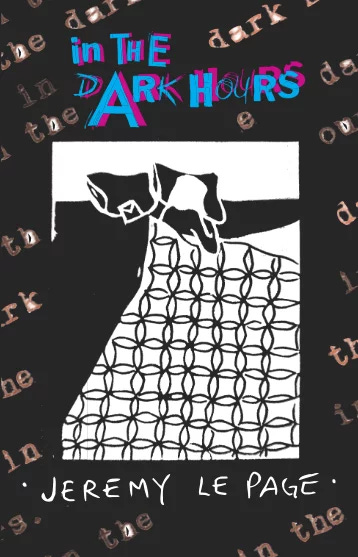
The spare poems in Jeremy Le Page’s debut collection In the Dark Hours (Lost Telegram Press, 2026) retain a cryptic stillness not unlike wildlife one might come upon in a forest, or some other natural setting of the psyche where these poems reside. Best not to make any sudden moves lest they skitter away. They seem to ask for some kind of communal respect, an oft-ignored sense of awareness that resides just beneath our collective consciousness.
“…poem after poem allows a picture of longing and regret to emerge.”
This chronicle of a dark night of the soul mourns lost love and lost youth but retains a sense of refuge in what has been lost. The strength of these poems is accumulative, rather than individual. The poems themselves often feel mundane on the surface, but this only seems to reinforce the uncharted banality of our darker side and the corrosive luxury of nostalgia. Yet, poem after poem allows a picture of longing and regret to emerge. A journey of forward-motion backtracking implies that emotional growth entails a systematic karmic progression, although a better word might be procession, a march toward reassessing the past.
“Infinity is a serpent biting its own tail.
I'm following you this way,
in an endless circle,
one foot in the future,
one in the past.”
(Serpent)
“Slowly, I'm starting to remember the last life,
reminded by your voice and the constant rain.”
(Gemini Twins)
Le Page sometimes employs Biblical imagery, or celestial beings, adding military characters to the mix to embody the rumbling conflict from within. The spiritual and the martial energies are doing battle on the field of our narrator’s conscience as he longs for the lover he left behind and is possibly returning to.
This is not as cut and dried as good versus evil, but rather the sacred in all its unattainable purity that promises to cleanse one’s soul if only it ascends to unrealistic heights, and the profane, soaked in the mud and blood of human desecration, the shadow’s spattered and grimy mirror that reveals with a disarming clarity who we really are.
“And I realized the angels
sometimes walk among us,
and that Jacob's Ladder
is a star within each brain.”
(Through a Cloud in the Sky)
“But there is a battle ensuing.
Angels have intervened.
There is a confused soldier,
and a belligerent chaplain.
All the dreamers have picked
up arms and are marching
toward the sea.”
(The Messenger)
“For a moment, I will slip away,
and for a moment, I will touch peace:
In a place where the animals know they’ll one day
reclaim the world.”
(Reclaiming the World)

“Michael slays the dragon.
Jacob wrestles the angel.
And I'm at war with myself.”
(At War)
Le Page’s narrator is a seeker and witness “as the true world / unfolds like a lotus” (Owl). The pain that comes with healing and recognizing the bitter truths that eat away at us from the inside, are all part and parcel with any dark night of the soul. And there is no rule that says it lasts only one night. Time is neutered on a journey such as this. Insight and a fresh understanding of where one has been, who one has left behind, the parts of oneself that were shed along the way can only inform where one is headed, and always with the innate knowledge that the home one returns to bears little resemblance to the one you left however long ago. And the loved one you left behind is only changed as much as your perception of them has changed.
“Trapped between intersecting circles,
waiting for rebirth,
waiting for the peace
that will lead to transformation.”
(Intersecting Circles)

“Then, without ceremony, the black-and-white returned,
Colour was chased away by grey,
And the sunflowers fell from the sky.”
(The Return of the Sunflowers)

“I was the code breaker,
interpreting everything you said.
I was the weak link,
but you needed me, somehow,
for some unknown reason.”
(Dissecting Passion)
As with pretty much all poetry, In the Dark Hours rewards the reader with repeated readings and reciting the poems out loud. Poetry, with its heightened language, has a way of making all of us objective witnesses. What Jeremy Le Page has given us is a plain-spoken invitation to unabashed subjectivity. After all, we are all on our journeys away from and circling toward the people and places that have carved out who we are and who we might still become.
“The world is realigning itself
as the days are lengthening.
The animals are searching;
their sleep has ended again.”
(New Fires)

About the Author
Jeremy Le Page is a Canadian writer and visual artist. In 1998 he self-published his first book, All Who Walk Lightly, a collection of short prose written while he was living in London, Ontario. The following year, he published Orianna, a novella. He currently resides with his family in Whitby, Ontario
About the Reviewer
Steven Mayoff (he/him/we) was born and raised in Tiohtià ke/Montreal and has made Epekwitk/Prince Edward Island his home since 2001. His fiction and poetry have appeared in journals across Canada and the US, as well as in Ireland, Algeria, France, the UK and Croatia.He has had four books published: the story collection Fatted Calf Blues (Turnstone Press, 2009), which won a 2010 PEI Book Award, the novel Our Lady Of Steerage (B&B, 2015, ) and the poetry chapbook Leonard’s Flat (Grey Borders Books, 2018), and the full-length poetry collection Swinging Between Water And Stone (Guernica Editions, 2019; revised edition, Galleon Books 2025). Steven has also written lyrics, librettos and collaborated on scripts for radio and the stage.
Book Details
ISBN: 978-1-997880-09-7
Genre: Poetry
Release date: June 13, 2026
104 p.p.