

Interposition by Kaie Kellough
Reviewed by Michael Greenstein

Scream of Consciousness
Kaie Kellough’s long poem, “Interposition,” is a run-on stream of consciousness that shreds Walt Whitman’s “Leaves of Grass” into fragments, further democratizes his I to i, and displaces America with a global diaspora. The book’s epigraph is taken from Wilson Harris: “The limbo dancer moves under a bar which is gradually lowered…” Kellough paradoxically elevates his poetry by lowering the bar, by focussing on liminal spaces between words – hence his sections of the book are “to be,” “between,” and “betweens.” After the opening ontology of “to be,” we move to liminal stages where between pluralizes to betweens, much as interposition becomes interpositions of rhapsodic rap.
The opening line, “bcuz i can’t think,” serves as a refrain for the (non-)thinking that follows, “bcuz” morphing orthographically away from causation, buzzing sound, and reducing being to b. The speaker’s “i can’t think” interposes “in this star-powered new conclusion // this streaming autobiographical noise / in which the protagonist / dissociates.” Introduction inverts to new conclusion, while star-powered could refer ironically to the poet’s new status after winning the Griffin Poetry Prize, one cause of autobiographical noise. Protagonist dissociates from “i” to enter a fugue state of pure sound, a liminal non-thinking, “& the universe rewards / w/ subscriptions.” The next stanza resumes “i can’t think / until a re- / shaped jawline / emancipates my can-do / & i transform into the wolf / of self-motivation.” The poet’s profile takes on a new shape where jawline streams and emancipates can’t think to can-do.
The speaker enters the motherboard surrounded by sounds “as the comments section seethes.” He riffs and ripples downward to sub- / comment” in a glyphic reduction and retraction of i, &, and hyphen. His minimalist rap goes against an epic elongation “stretching to the wretched / extremities of conspiracy / & truthiness.” Instead of truth, we have this interposing and inter-positioning of truthiness – a sounding of the stretch and shrink of master narratives “like the opening strain of the hero’s journey” where the space between words and lines breathes and counts. Earbuds buzz “heavy” and bracket voices in parentheses and quotation marks of possession: “(voices / in their plastic acoustic / enclosures berate: ‘to possess,’ / ‘to possess’).” These possessive parentheses lead to income brackets in the economics of Interposition: “i can’t ex- / outside income brackets & / etc / a lost no-one in the etc.” An all-encompassing et cetera is reduced to the no-one of etc, as the “ex” weaves in and out of interpositions.
Kellough’s lines glide and elide sound precision and sense evocation of truth and “metropolitan meaning.” He interpositions “rude old realities” and “rude new,” and he deconstructs identity “to spare parts & dogma belonging / to no-one belonging / nowhere, to no one.” All-inclusive lists counter-position shrinkage to the zero sum of no-one, nowhere – a postmodernist nobodaddy. On the one hand, ex expands to “exit interview” and “exchange”; on the other hand, it contracts to “x” – another person alongside “i” and “o” of zero status. As “x” drifts down and across the page, it becomes a particle among other words and sounds scattered and mattered: “x is the inverse of i.” This letter gives way to “no” on the next page in rippling reverberations “among the exospheric space junk” of outer space and inner ear. The eye and ear trace these drifting electric notes until “no wreck of counternarrative on a desert isle.”
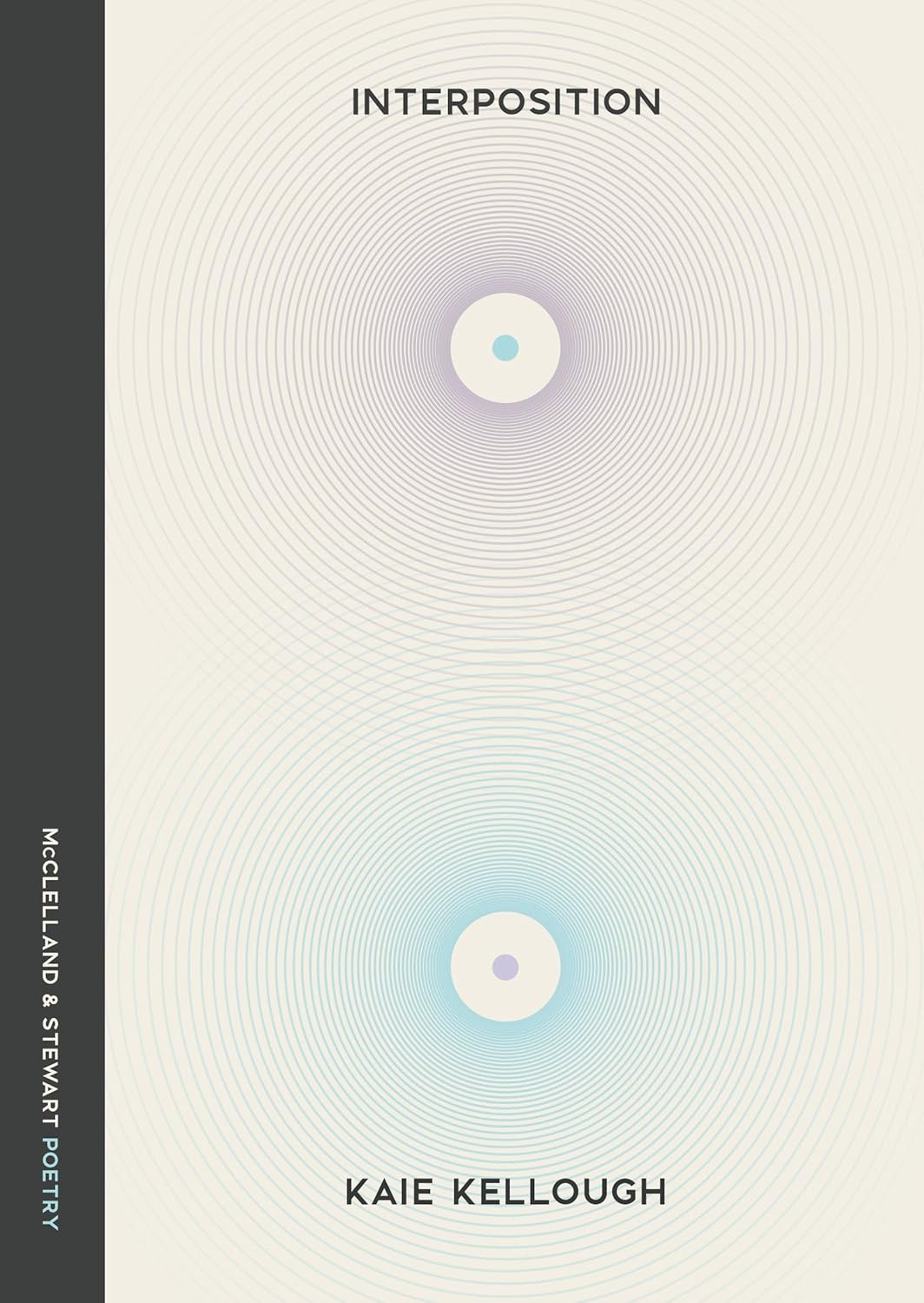
In this counternarrative where “i/x” fuses, the sonic-conic cover design of the book may be explained. Circles of sound swirl from two discs, earbuds, eye buds: “i/x stand in a circle of green that measures the / diameter of i/x denial with newspaper flowers blooming around i/x & / the circle growing smaller every minute.” Spots of sound drop down the page with ampersands, x, and “rebellious parenthesis.” Circles trope x & o of “hysterical hair”: “circles the heap … in spirals, as i/x stand and wish upon a star.” If the cover design suggests sonic symmetry, the poem delivers this symmetry through incremental clusters of imagery.
Circles and spirals heap into “curls spiral into curls as they sprout into a subaltern / grammar.” To parse this grammar is to trace the swirl of morphemes and phonemes as they splay into portmanteaux and neologisms, and split into fragments of letters, ampersands, and empty spaces – “as they spiral out from themselves, & there is always a / suggestion of turning, never a straight.” There are no digressions in his sound system, only progressions of interpositions: “some passages digress into lineality some zigzag & / some rootical.” Labyrinth and limbo weave radical roots and routes – “overlap & knot cuz they can.” The nought of zero overlaps with the cause of cuz in postcolonial lingo and limbo where Wilson Harris’s “slit of space” becomes Kellough’s spatial orientation in Interposition. Some “curls ruminate some curls refuse // … some ancestral / curls runagate.” Renegade meanings run away in Kellough’s sonic centrifuge or “unruly collection of narratives” between & betweens location and locution.
The poet acknowledges that Interposition was written during the pandemic: “This long poem is the issue of a particular social moment that interposed itself between the security of our waking routines and the abyssal unknown that yawns beneath our collective lives.” With other creative spirits he expresses the “joy to collaboratively design this language for flight.” Lester Bowie’s silver trumpet circles the background sounds of this interposed odyssey. From his cubicle and crucible, he bolts and pursues a “runaway ontology.”

About the Author
KAIE KELLOUGH is a poet, fiction writer, and sound performer living in Montreal. His previous collection, Magnetic Equator, won the 2020 Griffin Poetry Prize. He is a writer and vocalist for the group FYEAR and is pursuing graduate work in English at Queen’s University.
About the Reviewer
Michael Greenstein is a retired professor of English (Université de Sherbrooke). He is the author of Third Solitudes: Tradition and Discontinuity in Jewish-Canadian Literature and has published extensively on Victorian, Canadian, and American Jewish literature.
He has published 250 essays and reviews in books and journals across Canada, the United States, and Europe.
Book Details
Publisher : McClelland & Stewart
Publication date : March 24 2026
Language : English
Print length : 112 pages
ISBN-10 : 0771023723
ISBN-13 : 978-0771023729
 | A guest post by
|