

Throwback Thursday: January, February, June or July, by Helen Fogwill Porter
Reviewed by Robin McGrath

Young adult literature is a hard classification to define. Reference works identify it as writing aimed at readers aged 12 to 18, but in reality, more than 50% of YA readers are adults, 19 years or older. The genres can be science fiction, romance, or contemporary realism, but all usually feature a young protagonist experiencing and exploring family dysfunction, mental health, identity, relationships, and social issues, often told through a teen protagonist.
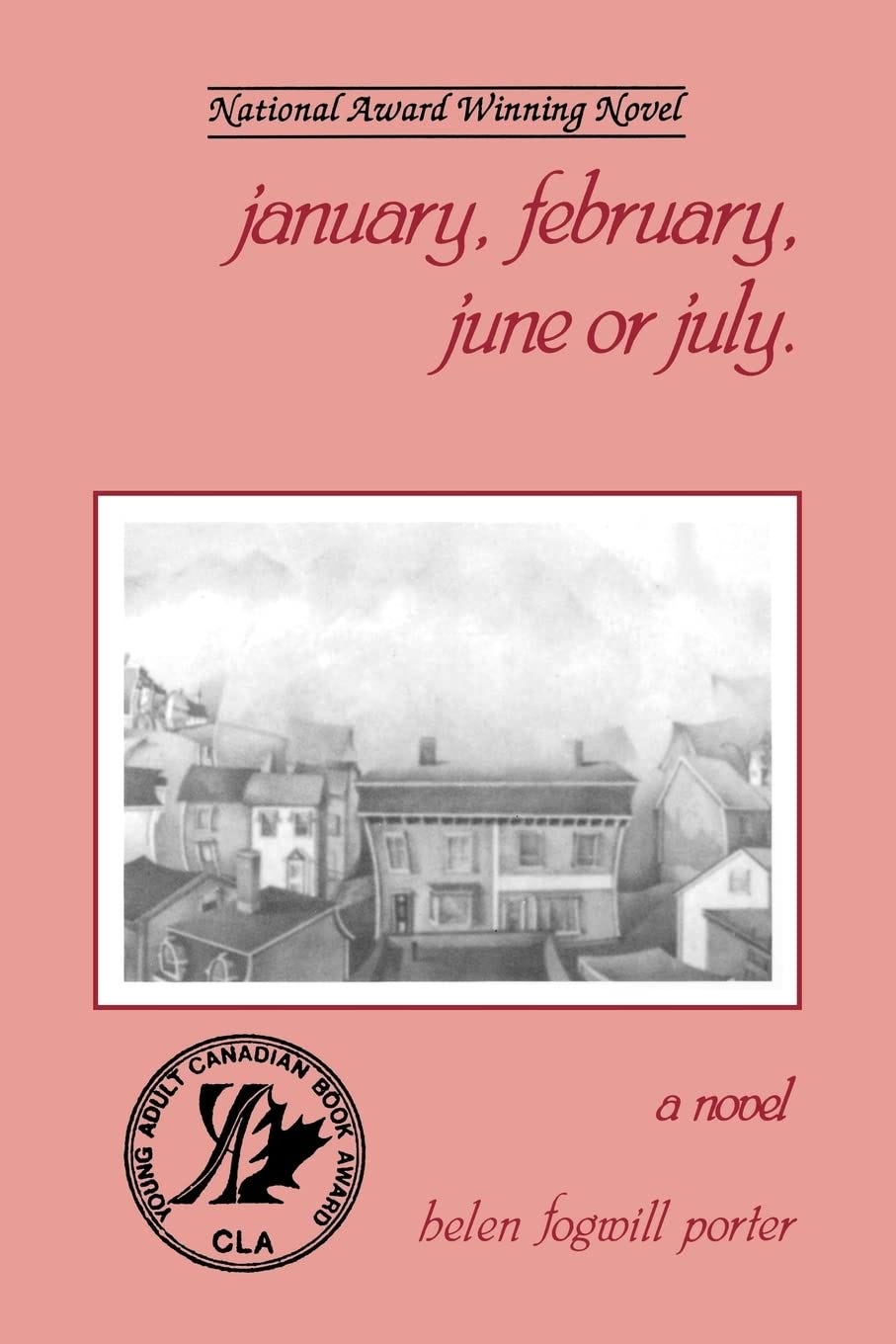
“January, February, June or July, the award-winning YA novel by Helen Fogwill Porter, was first published in 1988 and is now in its fourth printing.”
January, February, June or July, the award-winning YA novel by Helen Fogwill Porter, was first published in 1988 and is now in its fourth printing. However, the market has changed over the last 38 years, and it is hard to know how it will be received by readers nurtured on the likes of Harry Potter, The Hunger Games, and Twilight. The plot is not limited to the problems a teacher or parent may have identified as appropriate nearly 40 years ago, concerning as it does a 15-year-old girl's unexpected pregnancy and abortion, but neither does it conform to the world L. M. Montgomery depicted in Anne of Green Gables.
January, February, June or July takes place in inner-city St. John's in a working-class, single-parent family. The mother, who had been married to an American serviceman, works as a hairdresser. The mother is a bit of a tearaway, and as long as her three daughters finish high-school, she isn't ambitious for their futures. Of the three daughters, only Heather, the youngest, seems to have real academic potential. The plot of the novel is not voiced by Heather, but the narrator channels her thoughts and actions to the reader.
According to a CBC interview Porter did when she was awarded the Order of Canada in 2016, January, February aimed to present a realistic, non-judgmental, groundbreaking perspective of a young girl's experience with an unwanted pregnancy. “It was a book I really wanted to write,” she said, “And I knew it would be controversial. Even some of my friends weren't sure how they felt about it.”
The basic plot of is fairly simple. Heather, the youngest, brightest and quietest of three siblings, goes to a party one evening, meets a slightly older boy, and immediately falls in love. He is finished with school and plans to move to Alberta in two-weeks-time to find a better job than that which is available in his home province. The two immediately begin a brief sexual encounter that involves plenty of back-seat groping which stops barely short of penetration. The boy, Frank, goes off to Alberta but promises to stay in touch.
Several weeks after Frank leaves for Alberta, Heather is losing her breakfast and her period is late. A visit to a doctor and a pregnancy test confirm that she is “intact” but pregnant. She has not heard from Frank, cannot bring herself to tell her mother or anyone else about her condition, but arranges to get an abortion. The majority of the novel consists of Heather's agony over her situation, her misery, her sense of isolation, and her debate with herself about whether terminating the pregnancy is the right decision.
The day before her scheduled surgery, Heather finally tells her sister, who tells their mother. The mother is upset but supportive, and the procedure takes place. Back home, Heather slowly emerges from her paralysis, and an otherwise terrifying experience is mitigated when she finds in the Christmas mail a letter from Frank saying he's gainfully employed and hopes to get home for a visit in the summer. In the same mail is a card from her estranged father in Iowa, reestablishing contact with his daughters.
The subject of teen sex and abortion is not so taboo today as it was then —more acceptable today than it once was —but the book has other characteristics that might prove an impediment to readers. The novel's spoken English relentlessly conveys the idiosyncrasies of Newfoundland speech through spelled pronunciation. Early in the text, the characters abandon the standard use of g's, which disappear in tryin', goin', talkin', and “s” is appended needlessly as in “I gets home,” or “they turns my stomach.” Many Newfoundlanders also regularly drop their h's, but they also tend to code-switch and revert to standard English when speaking with elders, strangers, doctors or teachers, while retaining or adopting non-standard pronunciation when conversing with relatives or contemporaries.
Heather is depicted as a rather bookish girl, who reads J.D. Salinger, Judy Blume, Lewis Carroll, and of course L. M. Montgomery. One of the things that attracts Heather to Frank, however, is the way he pronounces her name: “Most of the boys on Gaspar Street called her 'Hedder,” [but] Frank had always been careful to pronounce the' th'.” When characters are in conversation with one another, there can be as many as 20 deviations from standard English in a page of text. Readers are never allowed to forget that these teenagers are members of a very specific cultural group. Porter makes no attempt to have St. John's characters speak like Upper Canadian teens, but neither does she take advantage of Newfoundland dialect. George Story's ground-breaking dictionary gets a passing mention, but only one word in the 200-page text-- “firking,” to bustle about or to move aimlessly--is Newfoundland dialect.
January, February, June or July won the YA Canadian Book Award from the Canadian Library Association, and was short-listed for the W. H. Smith Best First Novel Award. Considering how taboo the subject of abortion was in 1988, one can only assume that the target audience was closer to the 19-year-old-plus reader than to the 12-year-old. This book is listed as “contemporary romance, erotic literature, and fiction,” but how a week of clumsy back-seat necking can be called either romantic or erotic is a puzzle. There is no doubt, however, that the label “fiction” is appropriate. What this reviewer is left with is the question of how Porter managed to convince the judges and the readers of this novel that a pregnant fifteen-year-old St. John's girl could obtain a legal abortion in Newfoundland in 1988 without the involvement of a parent or guardian. Perhaps for a gifted writer, it is no more difficult than to imagine that a girl could fall down a rabbit hole and meet a Cheshire cat and a hookah-smoking caterpillar.
Helen Porter was a well-known writer, feminist, and human-rights activist, and more than one established Newfoundland writer owes their success to her support and encouragement. Porter was ahead of her time in 1988, but this novel deserves attention if only to remind us of how far we've come in the intervening years. January, February, June or July was an important influence on the development of what is now a flourishing literary scene, not just for teens but for a general adult readership.

About the Author
Helen Fogwill Porter was born and grew up in St. John’s. Her first book, Below the Bridge, was published by Breakwater in 1980. Her short stories, poetry, plays, and reviews have been published and performed across Canada. She now lives in St. John’s, NL.
About the Reviewer
Robin McGrath was born in Newfoundland. She earned a doctorate from the University of Western Ontario, taught at the University of Alberta, and for 25 years did research in the Canadian Arctic on Inuit Literature and culture before returning home to Newfoundland and Labrador. She now lives in Harbour Main and is a full-time writer. Robin has published 26 books and over 700 articles, reviews, introductions, prefaces, teaching aids, essays, conference proceedings and chapbooks. Her most recent book is Labrador, A Reader’s Guide. (2023). She is a columnist for the Northeast Avalon Times and does freelance editing.
Book Details
Publisher : Breakwater Books Ltd.
Publication date : March 1 1988
Edition : Trade PB
Language : English
Print length : 200 pages
ISBN-10 : 0920911277
ISBN-13 : 978-0920911273