
Jiménez’s Search for the Eternal Word
James Deahl Reviews Eternidades / Eternities by Juan Ramón Jiménez, Translated with an introduction by A.F. Moritz

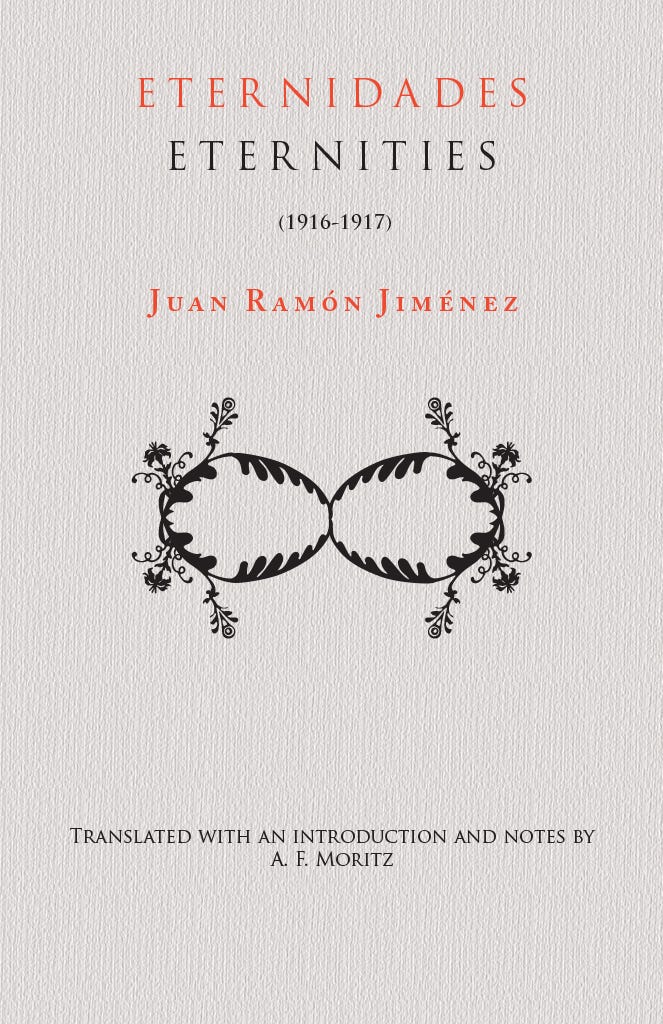
Juan Ramón Jiménez (December 23, 1881 - May 29, 1958) is among the most essential poets of the twentieth century and, indeed, of our century, too. His Eternidades, first published in 1918, remains as fresh and as relevant today as it was over a century ago. At first glance, the reader might assume that this book is comprised of one hundred and thirty-seven very brief poems, a great many of them a half-dozen lines or less. And it must be noted that some of these parts have been published as if they were stand-alone poems. A closer reading, however, reveals that this is actually one long poem, with one hundred and thirty-seven numbered sections, over half with titles (76 of 137) and the rest untitled, and with overreaching concerns and emotions.
Jiménez wrote his poem during 1916 and 1917, and it is a book-length love poem to Zenobia Camprubí Aymar, whom he married in New York on March 2, 1916. Perhaps inspired by his admiration for Dante, who is quoted in Segment 81, a section entitled “A Dante” (To Dante), Jiménez made his own poem one for the ages. The poet was very much aware that his life had changed forever. Such a profound moment — his marriage to Zenobia — sparked an entire constellation of thoughts, emotions, hopes, and fears. These are all expressed fully, and quite honestly, in Eternidades. Along with the expected feelings of ecstatic love, sensual passion, and a hope for true spiritual union, we have second thoughts, fears concerning the uncertain future of both his life and of the world situation, and not knowing if this marriage would last as happily as it began. He need not have worried for this romantic partnership did, in fact, last until Zenobia died in October of 1956. Jiménez followed his wife a year and a half later in May of 1958. It is difficult to think of a more beautiful and unfiltered love poem in English. (Perhaps the closest we can come is Sonnets from the Portuguese by Elizabeth Barrett Browning, but that is a sonnet series, not one long poem. And her book lacks the severe complexity of Eternidades.)
Eternidades came into being during 1916 and 1917; this was during the most brutal years of the First World War when Europe was being torn apart and hundreds of thousands slaughtered. While the war is not mentioned directly, there are hints of pain, sorrow, and especially death throughout the poem. Among the poet’s concerns is the uncertainty of human life when contrasted with the certainty of death. Segment 69 closes with these two lines: “¡Oh qué montón de flores mustias / toda esta vida!” (Oh what a heap of dried up flowers, / this whole life!). And this is not the only place where despair and hopelessness enter his poem.
The foregoing would be enough to mark Eternidades as a lovely and important work. But it is far more than that. Jiménez knew very well that the poem happens in the mind of the poet. It then must be turned into language. The reader takes that text to create a poem in his or her own mind. But something must be lost in this “translation” of thought to words and back to thought again. The only thing to do was to invent a new way to capture thoughts and emotions with words.
Throughout his book, Jiménez is searching for the “silent word” and the “secret word” and the “eternal word” that might set his poem free. He wants, in a manner of speaking, to have his mind connect directly to the mind of the reader with nothing lost in translation. In the very first segment, entitled “La acción final” (The Final Action), he writes: “no está hecha” (is not yet made) followed by “mi callada palabra” (my silent word). In the final segment, entitled “Nutrida por la luz” (Fed by the Light), he writes: “Palabra mía ¡eterna!” (My word, eternal!). And in the middle of his poem, Segment 48 - “El fundidor” (The Smith), he writes: “la secreta palabra!” (the secret word!). It is clear that the poet desires nothing less than “el nombre exacto” (the exact name); and he prays: “... Que mi palabra sea / la cosa misma” (... Let my word be / the thing itself), as quoted from Segment 3, “El instinto a su intelijencia” (Instinct to its Intelligence).
Of course, all poets would like to possess the real, true words (perhaps known only to God) but they generally make do with language as they find it. But not Jiménez! He decided to blow up Spanish and its long-established literary traditions and reinvent the language. When Eternidades was published in 1918, no one had ever seen anything quite like it. And its publication signaled the advent of Modernism in Spanish literature. This was before English-language Modernism became well known, as in T.S. Eliot’s The Waste Land (1922) and Ezra Pound’s A Draft of XVI Cantos (1925), which shocked the English-speaking world with their brazen originality. Jiménez, in fact, introduced Modernist poetry to Europe. And while the war was still going on.
Another abiding concern of Eternidades is the disunity between “the dream” in the mind of the poet and “the real world” of tactile things the poet’s body moves through. Jiménez is preoccupied with inventing a language to fulflesh his dream so that it can be understood to be just as “objective” as the physical world. He wants to incarnate his dream, first within his own consciousness, and later in the minds of his readers. For Jiménez, his dream — be it a nocturnal dream or a daydream — should be as valid as what most of us would call the real world. In doing so, the poet questions our common notions of reality, and his poem oscillates between his internal reality and his external reality, sometimes within a section, sometimes between different sections.
Of course, the nature of reality and how we come to understand/perceive it has been an everlasting concern of Western philosophy going back to Plato and his cave. That this has become a major part of a love poem to his wife is remarkable, and displays the complexity of Eternidades. Jiménez wishes to express his love for both his “internal” bride and his “external” bride equally. He sees no actual conflict between subjective and objective reality, or better yet, he struggles to resolve this conflict within his own mind and within his poem.
To achieve his end, to find/create the required language of secret or silent words, the poet reinvented Spanish poetry. He did this with parentheses, hyphens, ellipses, italics, and dashes. Exclamation points appear often and in unusual places, even in the middle of sentences. By placing whole lines in parentheses, Jiménez invites readers to experience each section of his poem in more than one way. For instance, a poem can be read right through or it can be read by skipping over the parts in parentheses. Due to the fact that there are one hundred and thirty-seven sections, there are more ways to read Eternidades than anyone can manage in an entire lifetime. Jiménez brilliantly created a whole new poetic syntax. Needless to say, this love poem — for it is first and foremost a love poem — will present a challenge for most readers, but a challenge well worth meeting. To read Eternidades is exhilarating.
In addition to his extremely unusual use of punctuation, Jiménez deploys various symbols/images: flowers in general often appear, and especially roses/rose bushes, the sky, the sea, gold, death quite often, blood, the earth, etc. These symbols not only release the poet’s non-verbal emotions, they can also link the different segments of the poem — which might seem disjointed at times — through their placement so as to point to overarching concerns. The goal is to express what often resists being reduced to mere words.
This poem, along with other works by Jiménez, such as his 1919 book Piedra y cielo (Stone and Sky), turned the world of Spanish poetry around. He influenced contemporary poets like the slightly older Antonio Machado (July 26, 1875 - February 22, 1939) as well as the somewhat younger Federico García Lorca (June 5, 1898 - August 18 or 19, 1936). And the innovations introduced by Jiménez via Eternidades and Piedra y cielo spread rapidly throughout European poetry. This was much the same effect that Eliot and Pound had on English-language poetry during the 1920s.
From the above, it is certain that turning the Spanish of Eternidades into an English poem would be nearly impossible without abandoning much of its complexity. This brings me to Eternities, the translation of Eternidades by A.F. Moritz. Somehow, perhaps with a bit of poetic magic, Moritz has done an admirable job. He wisely retained the weird punctuation and format of the original poem. The result is readers have a book with an excellent Spanish poem and a beautiful English version. In addition to his lucid translation, Moritz has a brilliant fifteen-page introduction that has as much to say about his own theory of poetry as it does about Jiménez and Eternidades. Moritz’s passion for poetry is clear throughout. And at the end of the book, Moritz has provided a highly informative two-page note on the text.
While Eternidades in 1918, along with Piedra y cielo, published one year later, are truly foundational works that brought Modernism to Europe, and while Jiménez remains as crucial as Eliot, Pound, W.B. Yeats, and Carl Sandburg, Eternidades is not merely valuable today as some interesting historical artifact (although it is such an artifact of the first rank); it is above all a book of superb tenderness and insight. It is a living and breathing poem, revolutionary in form and complex as a poem can be, and a joy to read in both the original Spanish and in Moritz’s lovely English version. As I write this review, there is war in Ukraine, war in the Holy Land, war in Iran, and war in parts of Africa. Our world is full of suffering and death. It is therefore essential we remember that against the savage backdrop of World War One, a Spanish poet possessed of genius created a work of everlasting beauty and hope. This new edition is cause for celebration.
NOTE: Several versions/editions of this book have been published since 1918. The text for both my review and for the English translation by A.F. Moritz is the 2007 edition prepared by Professor Emilio Ríos, Nueva y original edición de Eternidades.
I must also note that Professor Ríos has provided an Appendix of eleven poems he judges to be “pertaining to Eternidades.” I have not considered these in my review, but it is wonderful to have them because they provide additional information. These pieces have also been translated by Moritz. A real bonus.
The Bitter Oleander Press, 2026

About the Author
A prolific Spanish poet, editor, and critic, Juan Ramón Jiménez won the Nobel Prize for literature in 1956.
About the Reviewer
James Deahl was born in Pittsburgh in 1945, and grew up in that city as well as in and around the Laurel Highlands of the Appalachian Mountains. He moved to Canada in 1970 and holds Canadian citizenship. He is the author or editor of forty literary titles, recently his two prior collections from Guernica, Rooms the Wind Makes and Red Haws to Light the Field, as well as Tamaracks: Canadian poetry for the 21st century, the first major anthology of Canadian poetry published in the U.S. in three decades. His latest book is: Releasing The Wisdom Of Stone, soon to be available.
Book Details
The Bitter Oleander Press, 2026
Bilingual Edition (Spanish/Engllish)
ISBN # 979-8-9908228-2-5
336 pp.
$28.00 U.S.
$38.00 Canada
contact us at: info@bitteroleander.com
To read this review of Eternidades is exhilarating in itself: I look forward now to Eternidades itself. I wasn't clear if the Spanish were included alongside the translation: hope so.