


Synopsis
A blend of fact and fiction, Kate and the Composers follows Kate Bourke, a young girl who emigrates from Ireland with her family to make a new life in Toronto in the late nineteenth century. After leaving school in Grade 8 to help support her family, she works as a maid and then a proofreader, but harbours a secret desire to become a writer. Music is her north star, and Kate draws inspiration and consolation throughout her life from her Uncle Frederick’s popular song, “The Flight of Ages.” Her marriage to a flautist and composer who is starting a musicians’ union brings a new set of challenges while she tries to pursue her dream.
Review
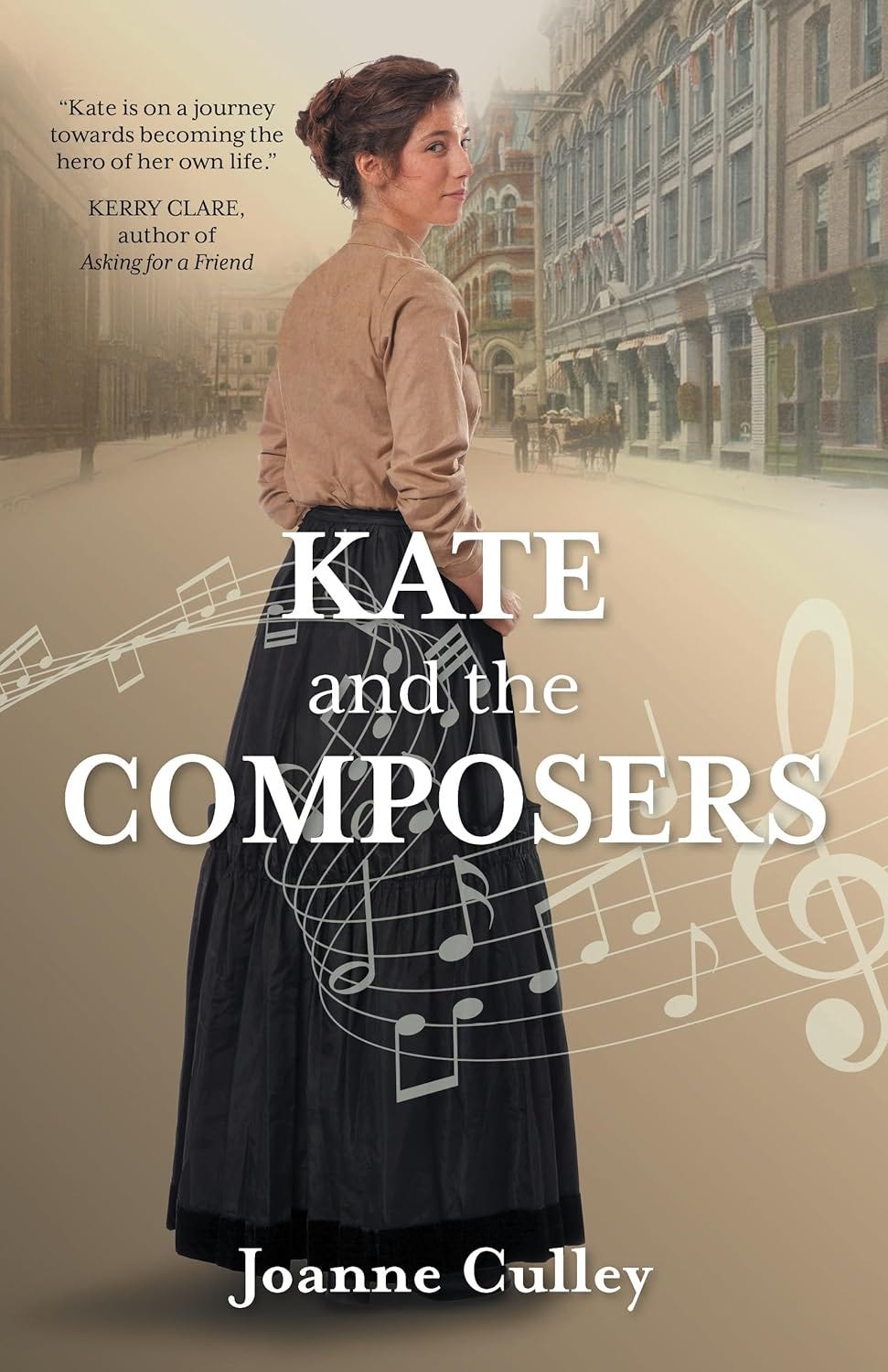
I have always enjoyed historical fiction, and Toronto author Joanne Culley has recently released a novel titled Kate and the Composers, set in Toronto during the late 1800s and early 1900s. As the synopsis suggests, it is a blend of fact and fiction, which enhances its authenticity. The story features real historical figures—Kate is based on Ms. Culley’s great-grandmother, and Teck is her great-grandfather, a renowned flautist in Toronto—along with actual music scores from that period. This book continues the musical theme that Ms. Culley established in her previous novel, Claudette on the Keys.
This period was marked by significant changes—or at least impending changes—for women, musicians, and society as a whole. Kate has a job, but if she were to marry, she would have to forfeit it, as a married woman’s role is expected to be at home rather than in the workforce. Furthermore, women are often paid less than men for performing the same work. Efforts are underway to form labour unions to improve working conditions, but progress is challenging due to resistance from employers. Class distinctions are prominent, and as the daughter of Irish immigrants, Kate can only hope to better her situation by marrying a man with good prospects. The interview below provides additional details about the book.
One of the composers of the title is Kate’s uncle (and the author’s great-great-great uncle), Frederick Bevan. Many of the songs mentioned in the book can be found on Ms. Culley’s website: http://www.joanneculley.com/kate-and-the-composers-music.html. The book includes historical notes, a bibliography, and discussion questions for book clubs, all of which are thoughtful additions.
Kate and the Composers was just as enjoyable to read as Claudette on the Keys. Ms. Culley’s writing style is straightforward and nicely detailed, which keeps the story grounded in reality. The fictional elements are nearly indistinguishable from the factual ones. While the dialogue between characters is plausible, it is wholly an invention of the author. If you appreciate a good story, musical history, and a setting in the late Gilded Age, I highly recommend Kate and the Composers.
Interview
What inspired you to write Kate and the Composers?
A few years ago, in the bottom of a box in my father’s basement, I discovered some long-lost scores of my great-grandfather, including several flute trios. Henry Teck Culley was a well-known flautist, member of the Toronto Symphony Orchestra, a teacher at the conservatory and founder of the Toronto musicians’ union in 1887, but no one knew that he was also a composer. As I learned more about that time period, I decided to write a fictional story about not only the challenges facing musicians at that time, but what life was like for women, centring on a young Irish girl making her way in the New World. (By the way, Teck’s composition, Flute Trio no. 1, was played by the Allegria Flute Trio at the book launch in October 2025.)
Tell us about Kate and what life was like for women in the late 19th century.
Kate is a 12-year-old girl who leaves her home in Ireland and all she knows behind to travel across an ocean for a new life, but faces discrimination due to her Irish heritage and being a working-class woman in a man’s world, at a time when women didn’t have the vote and were not considered persons under the law. Most women had to marry to have a decent, stable life.
But Kate looks up to some amazing women who were alive at that time. Her hero is journalist Kit Coleman, who wrote for The Toronto Mail in her Women’s Kingdom column about the “New Woman,” someone who could have a career, dress in fashionable, tailored Gibson Girl clothing, and leave the corsets and crinolines behind to be independent and to take her place beside men in the workplace. Kate reads her column and tries to adopt these attitudes.
Kate also looks up to the Irish Canadian poet Isabella Valancey Crawford, the first female poet in Canada, who had her poems published, and a novel serialized in The Globe. Crawford emigrated from Ireland as Kate did, and was described as one of the finest poets of her generation.
Kate is the most fictionalized of the characters in the book, and I gave her probably more agency than most women had at that time, a prerogative of historical fiction. Throughout the book, she works to find her own voice and power. The launch of Kate and the Composers took place on Persons Day, Oct. 18, when women were officially declared persons in 1929.
Can you tell us about the musical aspects of the book?
Kate draws strength from music, ranging from the Irish jigs and ballads of her heritage, and the classical music her mother teaches on piano, to her famous uncle’s songs and her husband’s compositions. Music keeps her going through the tough times in her life.
Kate’s uncle is a famous songwriter and composer, Frederick Bevan, an actual person at that time, who wrote a popular song, “The Flight of Ages,” which Kate sings to herself on the ship coming over, during childbirth and when her mother dies, showing the power of music to tap into a higher realm and carry us through life’s difficulties. Kate is so moved by music that she writes lyrics for a song herself.
When she marries a musician and composer who is founding the first musicians’ union in Toronto, she becomes immersed in the nitty-gritty of daily life with a musician, not getting paid for rehearsals, being usurped by changing musical styles, and having to go on tour to other places when one can’t get enough work in the city. At a time when, to hear music, you had to play it yourself or attend a concert, musicians had to stand up for their rights for getting paid for rehearsals, overtime, and a living wage.
When her husband tries to enlist other musicians to join the union, many do, but some of his colleagues at the conservatory associate it with being part of the working class, and they consider themselves above that, in the professional and upper classes. There were two actual incidents at Massey Hall, included in this book, where some union members walked off the stage, refusing to play with their non-union colleagues. In 1901, the Toronto union joined the American Federation of Musicians in the U.S., thus giving them more strength and bargaining power in dealing with the theatre and venue owners.
Tell us about Kate’s family’s emigration to Canada.
Kate Bourke and her family are part of the third wave of emigration from Ireland in 1887 (the first being the Peter Robinson emigration of 1825, the second being the potato famine refugees in the 1840s and 1850s).
Kate’s mother is an upper-class English governess, and her father a lowly Irish gardener, and they were legally not able to marry until the penal law was changed in 1871, allowing mixed marriages between Catholics and Protestants. But, despite that, they face discrimination from both sides, and decide to come to Canada searching for a better life.
Unfortunately, as with many new immigrants, they face prejudice in Toronto, among the English Protestant elite, who dominate the political scene and businesses in the city, posting signs saying “Irish Need Not Apply.”
Lastly, tell us about your previous books, Love in the Air: Second World War Letters and Claudette on the Keys.


After my father’s death, while clearing out a closet, I found an old Eaton’s box with over 600 airmail letters that my parents wrote to each other during the Second World War. My father, Harry Culley Jr., played clarinet in the RCAF No. 3 concert band, as well as playing saxophone in the smaller 12-piece dance band. They played dances for the army and air force officers, for troops on the bases, at the legions, at special events and as a backup for travelling entertainers. They accompanied popular songwriter and musician Irving Berlin when he came to the Pavilion Theatre in Bournemouth, England, in 1944. My mother, Helen Reeder, worked at jobs that would have previously been done by men, at the Department of Munitions and Supply in Ottawa and at the Toronto Transportation Commission as it was then known. In Love in the Air: Second World War Letters, I blended excerpts from the letters with a narrative inspired by the correspondence and historical background to bring to life a unique story of enduring love amidst global turmoil, providing a glimpse into what was going on on both sides of the Atlantic. It was released on the 70th anniversary of the end of the war, to much media attention.
Claudette on the Keys was inspired by the real lives of my grandparents, who were a two-piano four-hands team from the 1930s to the 1950s. The novel tells the story of Ida Fernley, whose stage name is Claudette, and her husband Harry, popular Toronto-based musicians called the Black and White Spotters. At the height of the Great Depression, the pair is hanging onto their livelihoods by their fingernails. It is the winter of 1936, with the unemployment rate at 17 percent, when they find out that they are being laid off from their live weekly radio program on CKCL due to a pullout by the sponsor, Shirriff’s Marmalade. After their home is repossessed, they and their two young sons move into Harry’s parents’ home, where they try to figure out their next steps. When Ida plays free of charge for a charity concert at Shea’s Hippodrome, she happens to meet a British talent agent, who is impressed by her virtuosic rendition of George Gershwin’s “Rhapsody in Blue.” He invites her and Harry to come to London to work, where Ida experiences firsthand the rise of fascism and becomes embroiled in pre-war intrigue. Whenever she finds herself in a tough spot, she draws inspiration from her movie-star hero Claudette Colbert.
Thanks, Joanne, for this insightful interview!

About the Author
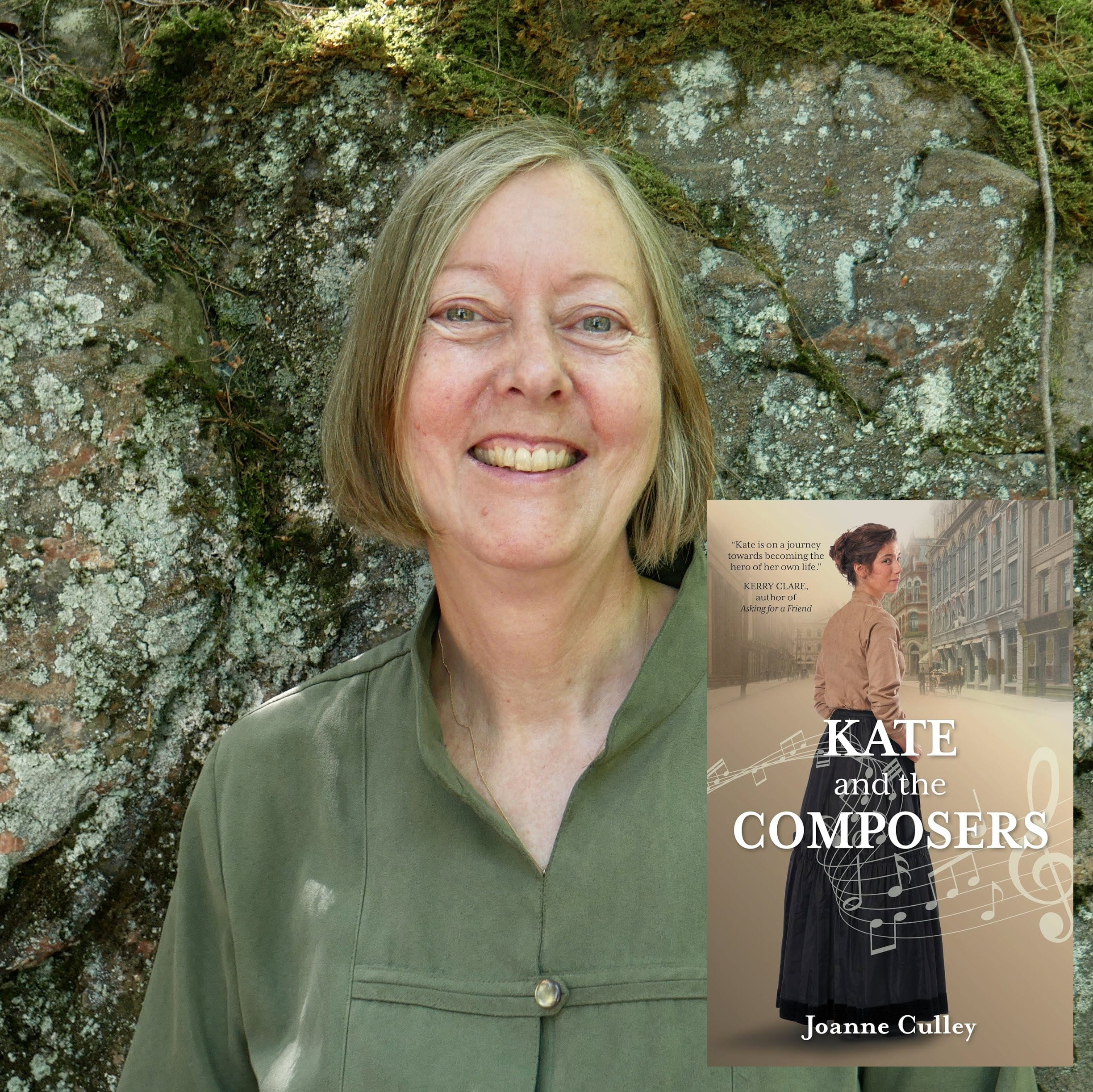
Joanne Culley is an award-winning writer and documentary producer whose previous books are Love in the Air: Second World War Letters and Claudette on the Keys. Her work has appeared in The Globe and Mail, Toronto Star, Peterborough Examiner, Legion Magazine, Canada’s History, and Our Canada, as well as on CBC and Bravo Network. She has an MA in English from the University of Toronto and a Graduate Certificate in Creative Writing from Humber College. She grew up in Toronto and now lives in Peterborough, Ontario. Visit her at joanneculley.com.
About the Reviewer
James M. Fisher is the Editor-in-Chief of The Seaboard Review of Books. He resides in Miramichi, New Brunswick, with his wife, Diane, their tabby cat, Eddie, and Buster, their Border Collie. James also works as an MRI technologist at the Miramichi Hospital.
Book Details
Publisher : FriesenPress
Publication date : Aug. 6 2025
Language : English
Print length : 282 pages
ISBN-10 : 1038347114
ISBN-13 : 978-1038347114