

Last Time Around: Essays, Reviews, Interviews by Steven Moore
A Guest Review by Jeff Bursey
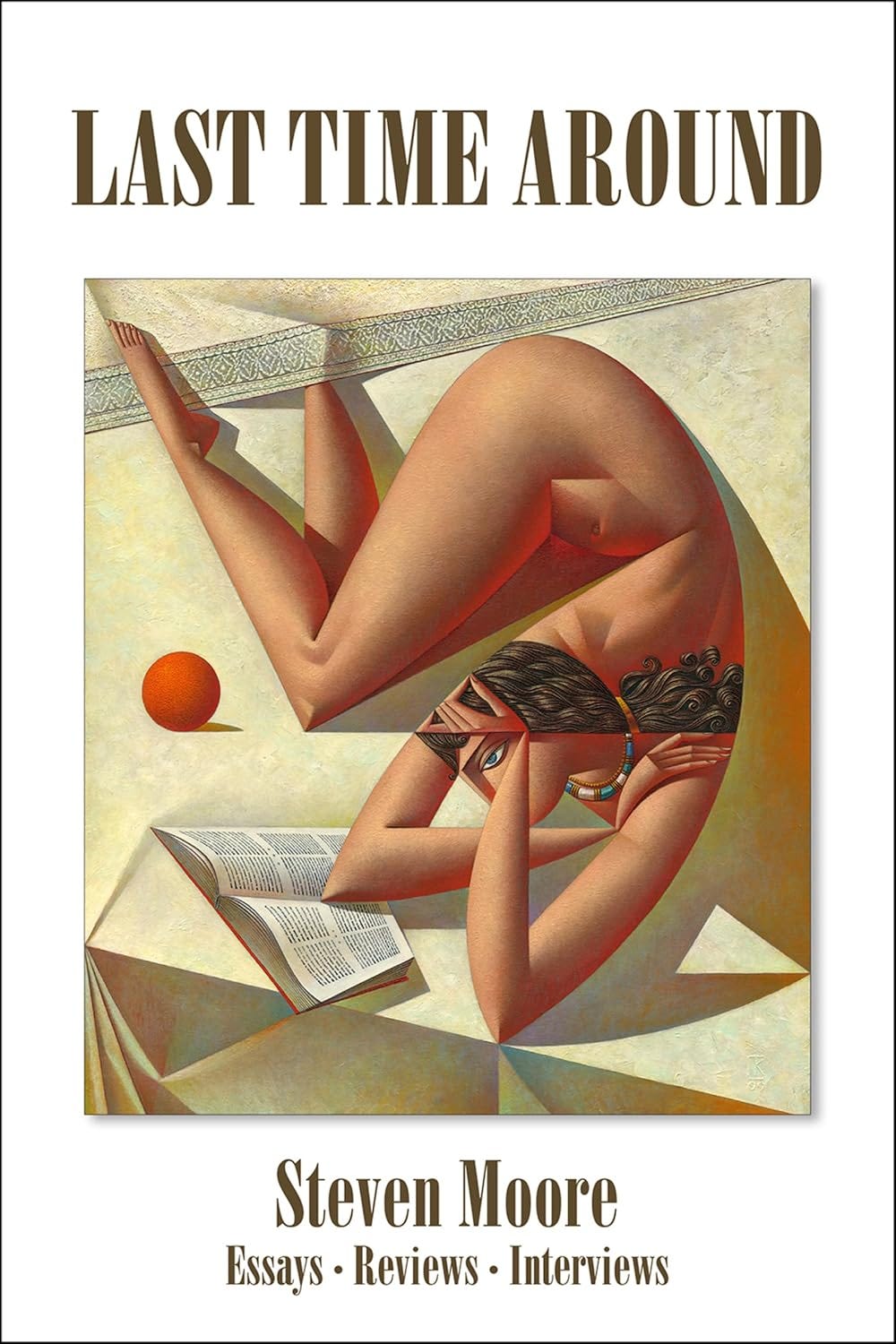
The acclaimed U.S. literary critic and editor Steven Moore helped shepherd into print works by Carole Maso, Rikki Ducornet, and David Foster Wallace, among others, and trumpeted the importance of Marguerite Young, William Gaddis, Cynthia Buchanan, and W.M. Spackman. In Last Time Around he has assembled a final collection of essays and book reviews written over 30 years, as well as interviews he’s given, devoted to those and other writers who place art above commerce in another effort to encourage readers to seek them out.
“Moore’s writing style is not of someone lecturing from a podium, theory to the fore, but someone seated at your table who’s happy to chat with you and eager to share his discoveries.”
Moore’s 1700-page dual-volume The Novel, An Alternative History (the volumes appeared in 2010 and 2013, respectively) had, as one of its purposes, defending “post-Joyce innovative fiction from charges of degrading the ‘great tradition’ of classic fiction… to establish a continuum between the innovative writers of the past and present, to demonstrate there is an ‘alternative’ great tradition, one far older, wilder, and sexier than the canonized one,” (243) as he explained in an interview published in 2015. His enthusiasm and, at times, contentious prose attacked conservative critics for censuring novelists who choose, or are compelled, to write outside the realist vein and to advocate for the long view of the development of the novel
Last Time Around is learned and transnational. Moore’s writing style is not of someone lecturing from a podium, theory to the fore, but someone seated at your table who’s happy to chat with you and eager to share his discoveries. Everyone interested in finding out about books that never made it into a reading club or on a syllabus will take something away from this collection. His thinking is the antithesis of those who believe that literature is dead or that the avant-garde is old-fashioned. In that same interview, Moore stresses, in his usual positive manner, that “the possibilities for storytelling are infinite and that writers will continue to find ways to keep the genre novel.” (250)
In the first essay of this book, on Robert Coover, Moore characterizes that author’s imaginative explorations of literary form as “no less than a rescue operation, an effort to save fiction and its readers from the predictable patterns they have fallen into…” (3) Those same words can be applied to Last Time Around as much as to any book he’s written, whether it be the history of the novel or more tightly focused works examining William Gaddis or Alexander Theroux. He disrupts our notions of who’s important to read and brings us evidence of neglected, overlooked, or emerging talent (such as fresh writers like Greg Gerke and Carol Hart). A writer of his easy-going erudition who, as the expression goes, wears his learning lightly doesn’t come along every day. If you know of the writers mentioned above, then you’ll want to read this book to see what Steven Moore says; if you don’t, then this book is essential to learn what books excite him, for they may excite you also.


About the Author
STEVEN MOORE (PhD Rutgers, 1988) is the author of the two-volume survey The Novel: An Alternative History, the second volume of which won the Christian Gauss Award for excellence in literary scholarship. He has written widely on William Gaddis and other modern authors, and for decades reviewed new books for the Washington Post, Chicago Tribune, and other periodicals. Between 1988 and 1996 he was managing editor of Dalkey Archive Press /Review of Contemporary Fiction, the subject of his memoir Dalkey Days, also available from Zerogram Press.
About the Reviewer
Jeff Bursey is the author of several books of fiction and non-fiction. He lives in Edmonton.
Book Details
Zerogram Press, 2026;
paperback,
$24.00;
310 pages