


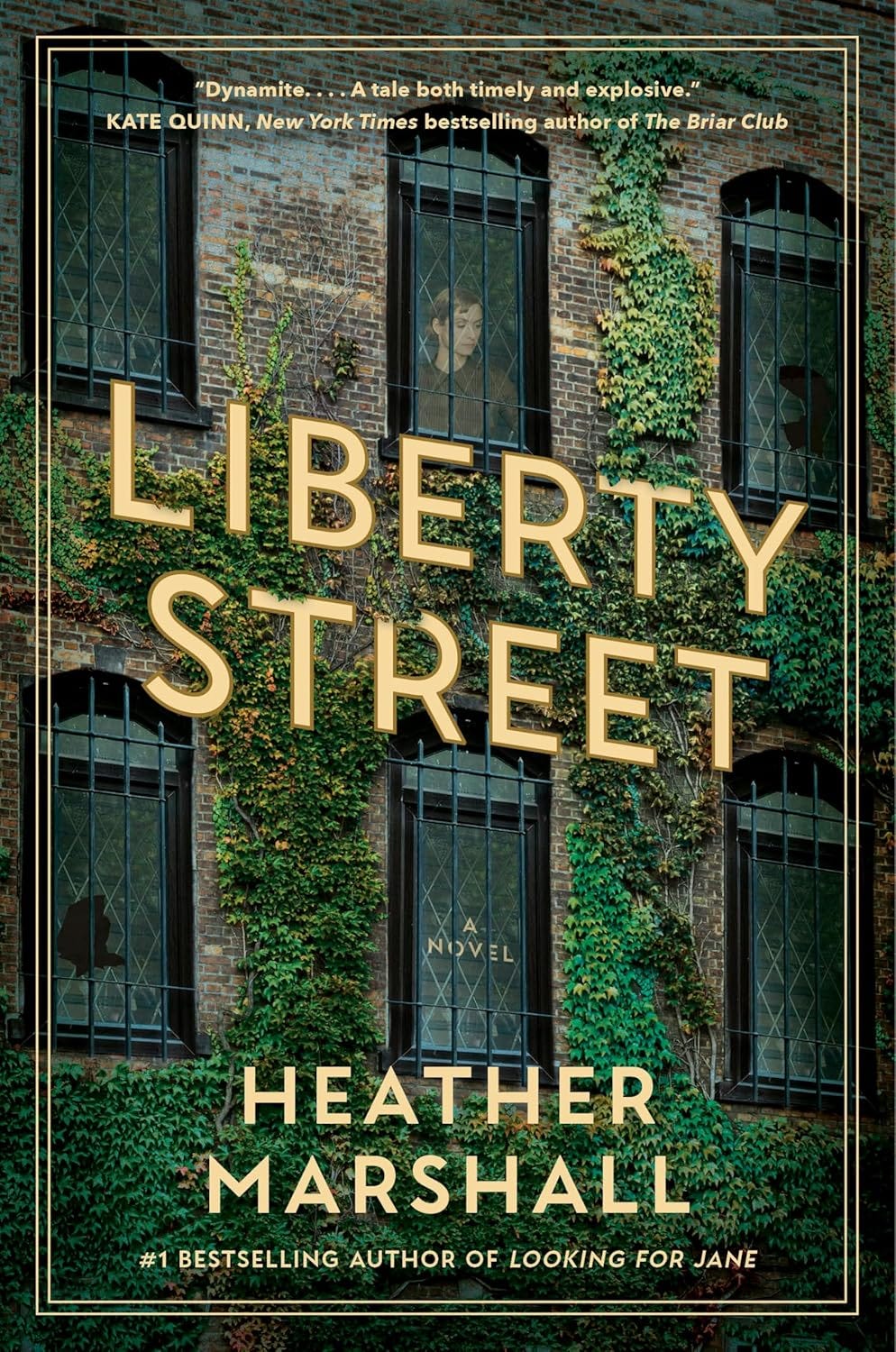
Emily Radcliffe is a lowly editorial assistant at Chatelaine magazine in 1961, working out of what she suspects was a janitor’s closet. She has dreamt all her life of making a name for herself as her war journalist father did in the 1940s. When she intercepts a shocking letter outlining horrific conditions at Toronto’s Mercer Women’s Prison, Emily is faced with a choice: accept that a pending engagement to her boyfriend will mean an end to her career aspirations and this story, or risk everything by going undercover into one of Canada’s most infamous prisons. While getting into Mercer is alarmingly easy, she soon learns getting out again is far more difficult.
“With Liberty Street, Marshall has once again penned a riveting and heartrending story of women’s struggles in the 1960s, following in the thematic footsteps of her first novel, Looking for Jane.”
More than 30 years later, Detective Rachel Mackenzie is called to a small-town cemetery, where the remains of an unidentified woman are found in an unmarked grave. A small detail leads Rachel into an investigation of what happened at Mercer Women’s Prison in the winter of 1961 and the fate of five women unaccounted for in prison records. What she learns raises the ghosts of her own traumatic past.
With Liberty Street, Marshall has once again penned a riveting and heartrending story of women’s struggles in the 1960s, following in the thematic footsteps of her first novel, Looking for Jane. While the labours of motherhood and the fight for women’s bodily autonomy also sit firmly at centre stage in Liberty Street, Marshall has brought forward a fresh story of a little-known Ontario law, the Female Refuges Act of 1927.
This law allowed husbands and fathers to incarcerate their wives or daughters for reasons ranging from “insanity” aka postpartum depression, to staying out past their curfew once too often. Once sentenced by a judge, often rubber-stamping a male relative’s request, their release depended more on the whims of the prison doctor than court ordered sentence limitations. In the prison, the women were at the mercy — or lack thereof — of staff matrons and prison doctors, and there was little the women or their families could do to combat cruelty or secure their release.
Emily begins her journey as a young woman eager to make a break in journalism and get her name on the byline. Following in the footsteps of her idol, Nellie Bly who famously entered New York’s Blackwell’s Island asylum to expose its vile conditions, Emily is determined to repeat this feat. What starts as a career launching stunt soon turns into a crusade to expose corruption and abuse, and to save a new friend, but Emily’s increasing fury only gets her and fellow inmates deeper into trouble. Marshall has so deftly crafted Emily as a character, that the reader can’t help feeling anxious for her safety, pacing the story so that the sensation of her plunging down a slippery slope toward danger, is inexorable.
Woven into this is the story of Rachel, a driven detective wounded by her own past, her tumultuous relationship with her absent, casually uncaring mother, and the grandmother who raised her, a woman with secrets of her own. Has Rachel truly faced up to her past and won free of self-destructive practices? Emily and Rachel are vastly different people; Emily is naïve, enthusiastic, and idealistic as only the very young tend to be, while Rachel is deeply jaded, a hurt and wounded woman whose tough exterior hides her pain. Both, however, are strong-willed women actively choosing not to be shackled by marriage and motherhood. Yet, motherhood weaves a tight web through this book. What does it mean to be a mother? What separates a good mother from a bad one? How deep is our need for our mothers? How does motherhood define us as women?
Heather Marshall has managed to brilliantly combine thought-provoking and timely viewpoints with tightly paced, suspenseful action, and a conclusion that will leave you with a lump in your throat. Liberty Street is an exposé of how the law failed women in Canada not so very long ago, a testament to the women (including real life editor of Chatelaine magazine, Doris Anderson) who fought for women’s rights, and a warning of the fragility today, of all that was won. It is unflinching, disturbing, gut-wrenching and deeply moving. This is a book you could read in one sitting but won’t want to finish.

About the Author
HEATHER MARSHALL lives with her family near Toronto. She worked in politics and communications before turning her attention to her true passion: storytelling. Her debut novel Looking for Jane was an instant #1 bestseller.
About the Reviewer
Heather McBriarty is the author of the non-fiction account of the First World War, Somewhere in Flanders: Letters from the Front and a novel of the “Great War” Amid the Splintered Trees. She is a blogger, reviewer and served as a juror for the 2023 Atlantic Book Awards. She is a retired Medical Radiation Technologist, doting grandmother, and avid sailor. She lives by the sea in historic Saint John, New Brunswick, Canada.
Book Details
Publisher : Doubleday Canada
Publication date : Feb. 24 2026
Language : English
Print length : 448 pages
ISBN-10 : 0385700512
ISBN-13 : 978-0385700511