

Library of Brothel by Anakana Schofield
A Michael Greenstein Review

Caveat Lecher
The subtitle of Anakana Schofield’s previous book, Bina, is “a novel in warnings,” and any reader of her fiction should be forewarned not to expect traditional plot or character development. Instead, her fiction interrogates an entirely different terrain where originality and inventiveness bend any genre to surprise her reader at every turn of phrase and imaginative leap of direction. A celebrant of strangeness, Schofield has more up her sleeve than tricks turned in her latest novel, Library of Brothel, which displaces the Library of Congress in a different set of categories and classifications. The Library of Brothel has its own house rules, controls, and hierarchies, despite its avowed egalitarian freedom of expression.
“Enter the Library of Brothel and stay for wit, sense of humour, and wiser cracks.”
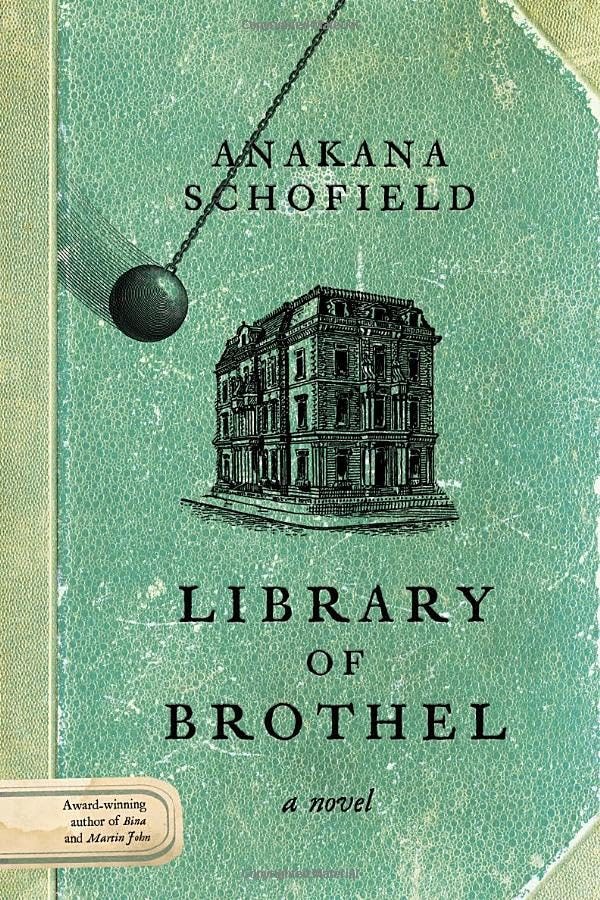
At the centre of the book’s worn-looking cover, a four-storey building appears with its many windows of fiction. A pendulum which doubles as a wrecking-ball angles across it to hint at its dilapidation and deconstruction. On the back cover one of its keys in the shape of an E begins the word Enter as the novel invites the reader into its fantasies and absurdities: “Do you want to come in? … Come in …. And in you come.” Her library and brothel are states of mind as much as any physical building or sexual experiences. The novel is structured around three categories – generated, develops, and dies – which appear in its epigraph taken from Roland Barthes’ “A Lover’s Discourse: Fragments”: “Every amorous episode can be, of course, endowed with a meaning; it is generated, develops and dies; it follows a path which is always possible to interpret according to a causality or a finality – even, if need be, which can be moralized…” And Schofield’s fragmented paths call for interpretation.
First she sets down “House Rules”: “We will kill you before you kill us so conduct yourself accordingly.” Schofield’s wit and humour rely on her rhetorical uses of paraprosdokian – unexpected endings to a sentence’s train of thought. “Do not anticipate anything except intellectual stimulation. Physical contact is at the discretion of your Host. The only thing that’s compulsory for stimulation is the intellect.” And Schofield stimulates the reader’s intellect in each of her rooms and fragments of discourse. “English is not tolerated in the Polyglot Room” – fair enough in this polyphonic bordello with its multilingual Tower of Babel. Pay and play by the rules in her funhouse of fiction: “Pay on arrival. Credit card remains at the Front Desk.”
Although eye contact by Hosts or clients is optional, no hugging is allowed. “No right-handers in the Left-Handed Room” and “No unpublished poetry.” The final forbidden: “No disobeying and no Styrofoam penises in the Dungeon.” This descent into the dungeon of bathos is followed by “An Important Note on Rooms”: “Everyone at the Library of Brothel is inside a room. If you find yourself fambling in our building, please report to the Front Desk or remove yourself via the nearest exit. Random unsanctioned walkers with no booking will be expelled in a most aggressive and painful manner.” Rooms and people are interchangeable, and a footnote to “fambling” explains that it means fannying about or ambling, a portmanteau that applies equally to reader, writer, and client or guest. “Supplication for Curious Minds” also uses a footnote and paraprosdokian: “We beseech you, have the ears open, fists unclenched, and mind ductile when you make inclination towards us. This we ask in the name of the mother, the daughter, the sister and our elderly, erratic furnace.” Under the influence of Borges, Beckett, James Joyce, Lewis Carroll, and the surrealism of Luis Bunuel and Salvador Dali, the ductile mind is led to a footnote about father before erratic furnace.
“Generated” begins with an etching from Piranesi’s “The Round Tower” in “Imaginary Prisons” – gothic structures that comment on the Library of Brothel and suggest Escher’s surreal stairways. Built in 1898, this Vancouver building is an example of Foucault’s heterotopia – the other space that lies outside of society’s structures and challenges its norms through its strange ceremonies. The Round Tower in the Library of Brothel is both a place of ironic incarceration and a point of observation or panopticon. Another beginning with “Front Step,” for the reader has to hopscotch along a chessboard of false steps and strangeness: “It’s February, a month that has given the city strange and unusual snowfall.” Schofield exploits this strange atmosphere indoors and outdoors. “Inside: Sources say there are workers, furniture, windows, a toilet or two, poor wiring, a bounty of towels, and a particularly difficult-to-find lightbulb that requires bulk import from Argentina.” In her random order of singular and plurals she concludes with imported lightbulbs. “Outside: Rumours.” Between rooms and rumours the reader is caught off guard. “Reputed to be a bawdy house once operated by a short, plumpy woman with surprisingly large feet and a deceased fluffy-necked dog.” Just as we may be surprised by these dimensions and details, so the narrative chess match becomes more complicated, the rhetorical hopscotch more demanding so that it’s not only lightbulbs that are difficult to find: “We don’t care about Short and Plumpy. Not yet. Though she’s still to be found in here.” “Front Step” concludes: “There are the hard-to-shed, and the shedding so hard they are going to be impossible to miss.”
Amid all the digressions and diversions, the novel is also structured around forty-four “cantos” scattered through this Rabelaisian romp. “First Canto” begins: “Let us call it the Library. The Library of Brothel. Our Brothel of Library.” This reversal is indicative of textual instability or arbitrariness: “We’re still deciding which name to give it for you. It doesn’t need to be set, does it?” Once you’ve entered you may peruse Front Desk; Department of Thinking, Dreaming & Recollecting; Main Floor Library; Department of Service, Vigour, Smell & Sample; or Scrabble Room with its metonymy of person and place. “Her name is Scrabble Room. Or Scrabble Woman, for she is a woman, and she is the Scrabble Room compatriot.” The novel does raise questions of gender, and personal pronouns are scattered accordingly. With proper ironic distance Schofield cares about her characters: “We do care about Scrabble Room because without her the Library would have been shuttered years ago.”
Security demonstrates the same level of commitment as Scrabble Room. “There are usually one or two people who keep a place ticking. Remove them and you remove it. Tick, tick, tick.” Schofield keeps place and pace ticking with her linguistic tics and tricks. Amid various classifications sits the Baptismal Font, which allows the novelist to exhibit her humour: “the Baptismal Font was gifted because a priest or two hadn’t settled their bill when the parish church closed at Main and 12th and as they were relocated to Cape Breton and a suburb of Winnipeg, respectively, they supplied the Baptismal Font in lieu of owed cash for faithfully rendered orgasms, allegedly of the intellect, but more likely it included the nether regions.” Schofield’s satire plays on “faithfully,” and covers east and west coasts as well as nether regions in her roving library.
Paint is another comic character who amends Henry George Room’s hairless lip and gives him a Dali-looking moustache. Outdoor, back-alley escalators ascend to the top floor where Plunkett Snutch lives. In this absurd universe Giraffe Room has vertebrae that are linked to banister and staircase in the building where Schofield is the architect by design. The John Keats Room and Virginia Woolf Room speak for themselves. “Intercourse had become, as usual, surreal and unrelated discourse.” In this Library of Babel, a footnote explains that the word “intercourse” should be “upgraded to twenty-five-person orgies.” Enter the Library of Brothel and stay for wit, sense of humour, and wiser cracks.

About the Author
ANAKANA SCHOFIELD is the author of three acclaimed novels: Bina, Martin John and Malarky. She has been described as “one of Canada’s most stylistically provocative and innovative wordsmiths.” Her novels have won numerous literary awards including the Kerry Group Irish Novel of the Year and the Amazon.ca Debut Novel Award. She’s been twice shortlisted for the UK Goldsmiths Prize for innovative fiction and the Ethel Wilson Fiction Prize. Martin John was also shortlisted for the Giller Prize in 2015.
Her essays and columns appear regularly in The Globe and Mail, and the Toronto Star. She’s written for The Guardian, The New York Times The Irish Times and Book Post. She lives in Vancouver, BC.
About the Reviewer
Michael Greenstein is a retired professor of English (Université de Sherbrooke). He is the author of Third Solitudes: Tradition and Discontinuity in Jewish-Canadian Literature and has published extensively on Victorian, Canadian, and American Jewish literature. He has published 250 essays and reviews in books and journals across Canada, the United States, and Europe.
Book Details
Publisher : Knopf Canada
Publication date : May 26 2026
Language : English
Print length : 272 pages
ISBN-10 : 0735273243
ISBN-13 : 978-0735273245
 | A guest post by
|
Thank you v much for this reading!