

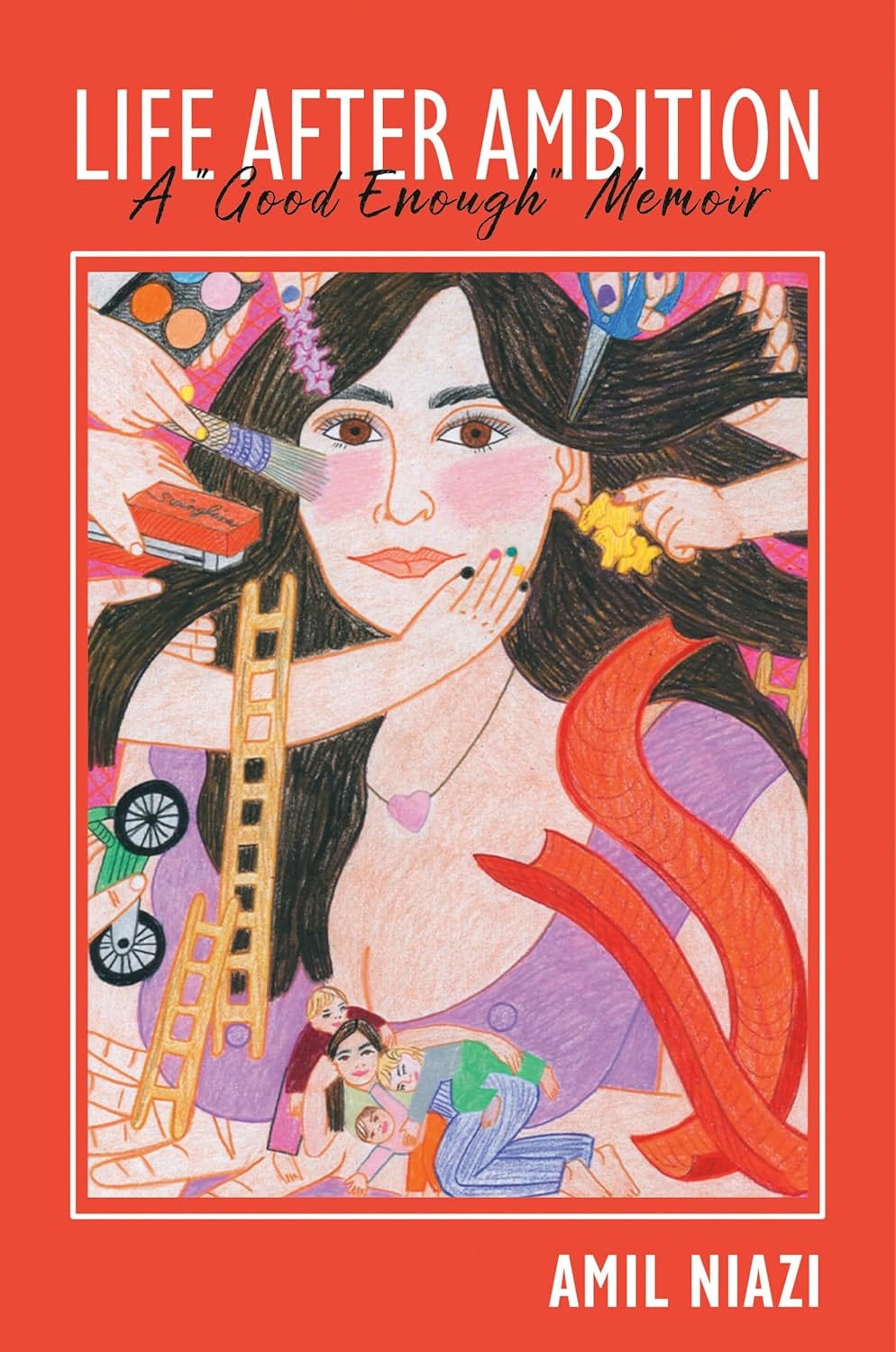
Life After Ambition: A “Good Enough” Memoir by Amil Niazi
Reviewed by Chris Reed

Thanks for Being Good Enough
Why don’t Mother’s Day cards ever say: Thanks for being good enough?
The commercial language of the holiday favours certainty—mothers have inexhaustible patience and offer unconditional love. It leaves little room for ambivalence, fatigue, or the ordinary limits that childcare imposes. For anyone who has raised a toddler, or even watched someone do so while holding down a job, telling a mother she’s “perfect” can sound less like gratitude than another obligation to fulfill.
Amil Niazi’s Life After Ambition: A “Good Enough” Memoir uproots such expectations. A CBC producer, broadcaster, and writer known for her incisive columns in The Cut, Niazi examines how ambition migrates from personal drive to moral requirement, and how motherhood exposes the costs of that shift. Her proposition is straightforward: “enough,” she suggests, may offer a more accurate and humane measure of accomplishment than “excellence” in a culture that equates striving with virtue.
“Good enough” is rarely offered as praise, particularly in discussions of mothering, where it tends to register as a concession rather than a choice. Niazi confronts that implication directly. “I have embraced the idea of mediocrity and let go of a compulsion for exceptionalism,” she writes. The word embraced signals intention. What she claims is not mediocrity as a condition, but the wisdom it allows—the ability to recognize when striving hardens into self-surveillance. In this sense, “good enough” does not abandon care or effort; it names a recalibration of what those demands are permitted to cost.
The memoir traces Niazi’s path from a childhood shaped by instability, economic anxiety, and the pressures of immigrant aspiration into an adulthood organized around work, fertility struggles, marriage, and parenting. Achievement once functioned as protection. Success promised escape. Over time, ambition hardened into obligation. Motherhood sharpened the reckoning. The demands of constant care made the price of sustaining professional aspiration increasingly visible.
Niazi lays bare the daily performance required of many working parents. Competence at work often coexists with a sense of neglect at home; attentiveness to children carries an undercurrent of calculation. Most parents recognize these tensions, but women remain subject to greater scrutiny—as employees and as caregivers. Niazi draws attention to the gender inequities that persist in plain sight, embedded in expectations widely shared and rarely named aloud.
The memoir touches on poverty, addiction, violence, class, race, and family history while keeping its focus trained on ambition as lived experience. That discipline gives the book momentum and coherence. Certain questions remain tacit. When success is redefined, who absorbs the risk? When ambition loosens its hold, what replaces its guarantees? These tensions hover at the margins without unbalancing the narrative.
Life After Ambition builds its argument through accumulation. Short scenes—workplace negotiations, moments of exhaustion, recalibrated expectations—cohere into a sustained examination of how worth is measured. Niazi’s prose remains controlled and unsentimental. A current of sardonic humour runs throughout, sharpening insights that surface through anecdote rather than declaration.
Few Mother’s Day cards acknowledge what it takes simply to get through the day. Life After Ambition fills that silence with clarity and respect. Niazi gives name and shape to the effort required to meet competing demands without illusion or applause, and she invites readers to reconsider what counts as success. Her memoir asks us to see being “good enough” not as a concession, but as an honest achievement.

About the Author
AMIL NIAZI was born in London, U.K. to Pakistani parents before the family moved to Canada. She studied journalism in Vancouver, founded her own print magazine, and then moved to Toronto, where she worked at CBC and Vice. She moved back to the UK to work for the BBC and The Guardian, and then, when the pandemic hit, returned to Toronto to go freelance. She’s published essays in the New York Times, The Cut, The Guardian, Romper, the Washington Post, Hazlitt, Elle, Vice and Refinery29.
About the Reviewer
CHRIS REED is a freelance book publicist and occasional book reviewer living in Toronto.
Book Details
Publisher : McClelland & Stewart
Publication date : Jan. 6 2026
Language : English
Print length : 224 pages
ISBN-10 : 0771005210
ISBN-13 : 978-0771005213
 | A guest post by
|