

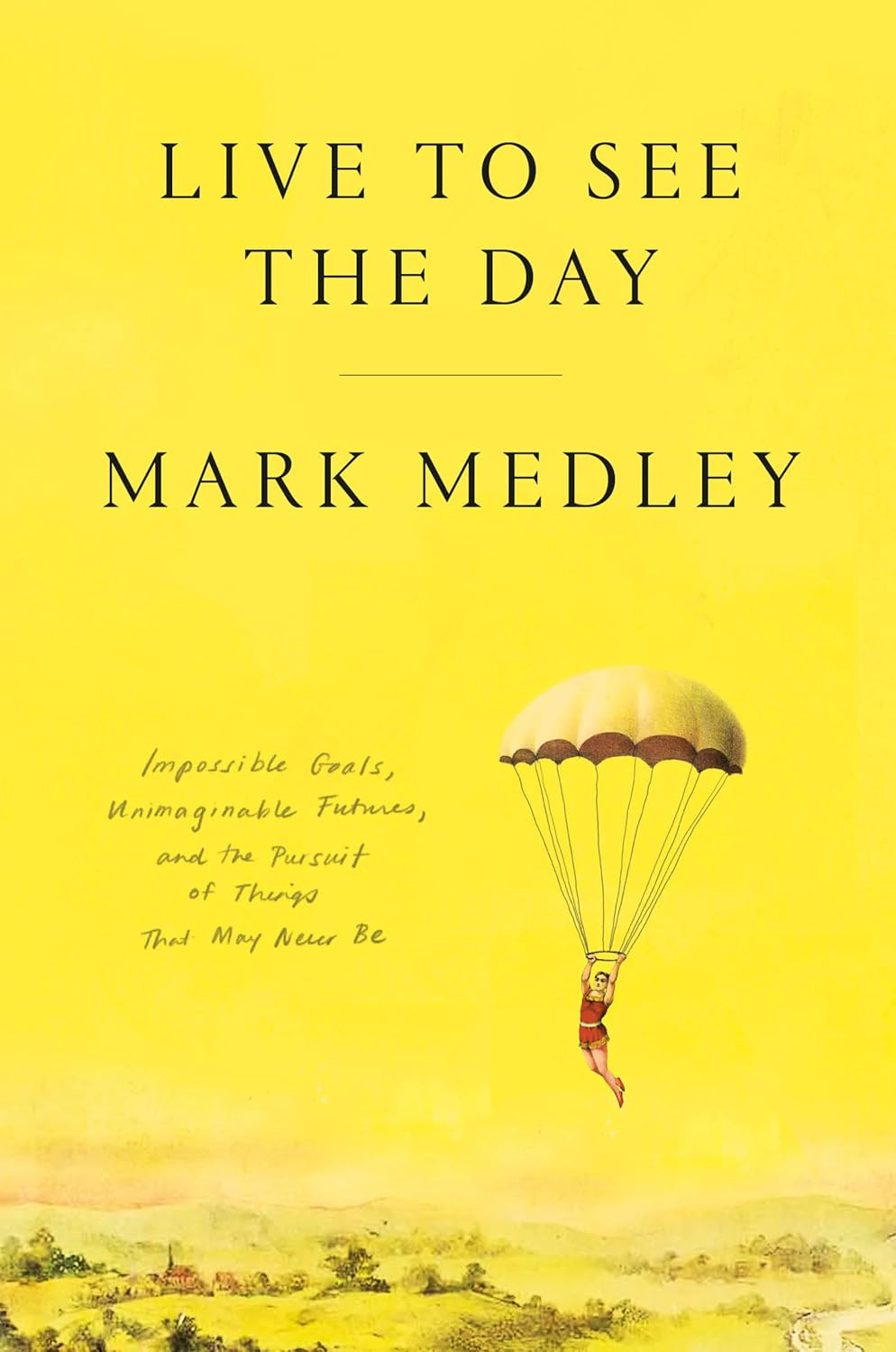
Live to See the Day: Impossible Goals, Unimaginable Futures, and the Pursuit of Things That May Never Be by Mark Medley
Reviewed by Chris Reed

IN PRAISE OF THE LONG SHOT
Why do people chase seemingly impossible goals? In Live to See the Day: Impossible Goals, Unimaginable Futures, and the Pursuit of Things That May Never Be, Mark Medley follows the lives of individuals dedicated to pursuits that seem to defy logic, reward, and sometimes even time itself. Medley illuminates what it means to hold on to faith in an outcome that is unlikely, distant, or likely to stay unfinished.
Medley, a journalist with a sharp eye for scene and character, travels widely searching for people who have committed themselves to outcomes they may never see. He meets seekers of lost treasure, inventors extending the basic human life span, and thinkers bent on projects whose payoff belongs to posterity. While the settings often have a cinematic feel, most of the people Medley profiles appear sensible at first glance. However, all seem to live at a distance from the ordinary measures of prudence and reward.
“The concepts of time and completion anchor Medley’s narrative. Live to See the Day, at its core, is a meditation on mortality. Human life is limited by time, yet people are oddly reluctant to restrict their ambitions within its bounds.”
Donning his reporter’s cap, Medley approaches these unusual folks with a clear-eyed curiosity, concentrating on what makes them tick. Why do they keep going when evidence is thin, recognition uncertain, money limited, and success unlikely? Is it vanity, obsession, faith, integrity, or some shifting mix of all four? Medley resists the lure of a single answer. What unites them is not a shared psychology so much as a similar relation to time: they have accepted, in one form or another, that meaning need not depend on completion.
The concepts of time and completion anchor Medley’s narrative. Live to See the Day, at its core, is a meditation on mortality. Human life is limited by time, yet people are oddly reluctant to restrict their ambitions within its bounds. We build, restore, protect, write, teach, and imagine toward futures we may never see. The cathedral serves as a clear metaphor, and Medley references it more than once: those who laid the foundation knew they would not live to see the spires rise. But they laid the stones anyway.
Once that thought takes hold, Medley’s subjects begin to seem less extraordinary. Their projects may be grand, but the motivation behind them is quite ordinary. Most of us, in some way, work toward outcomes we may never see. We raise children into a future we will not control. We plant trees whose shade we will never sit beneath. We create art in the hope that some part of us will endure. The gap between the treasure hunter and the rest of us turns out to be smaller than it initially appears.
If impossible goals are not so alien after all, why do we speak as though rational life should be organized only around achievable ones? Why do we assume that a pursuit must promise visible results to count as serious? In a culture impatient for payoff—where effort is constantly measured, optimized, and made legible—Medley builds a solid case for the long shot, the slow burn, the task whose value cannot be captured by immediate success.
The line between delusion and devotion is not always easy to draw. Medley suggests that much of what we value in human life relies on people willing to embrace that uncertainty. Scientific inquiry, artistic creation, preservation, and political struggle: none of these are guaranteed. To stop because the finish line appears too far would, in many cases, mean abandoning the most meaningful forms of human effort.
By the end of Live to See the Day, Medley has moved beyond his initial concern about what drives people to pursue seemingly impossible dreams. He leaves us with a more subtle question: why are we surprised by them at all? After all, perseverance without guarantees is not a deviation from human nature but one of its clearest expressions. We know our lives are short. Still, we dedicate ourselves. That may not always be rational. However, it is deeply human.

About the Author
MARK MEDLEY is a journalist who works for The Globe and Mail. He lives in Toronto.
About the Reviewer
CHRIS REED is a freelance book publicist and occasional book reviewer living in Toronto.
Book Details
Publisher : McClelland & Stewart
Publication date : Jan. 6 2026
Language : English
Print length : 368 pages
ISBN-10 : 0771062265
ISBN-13 : 978-0771062261
 | A guest post by
|
That's a really interesting review by Chris Reed. I knew of Mark Medley from his byline when he was involved with book coverage at the Globe & Mail, it's interesting he's embarked on being an author himself. He seems to have chosen a good topic for this book, aptly titled Live to See the Day