

Living History: Essays on A.F. Moritz
A Michael Greenstein Review

The Word Garden
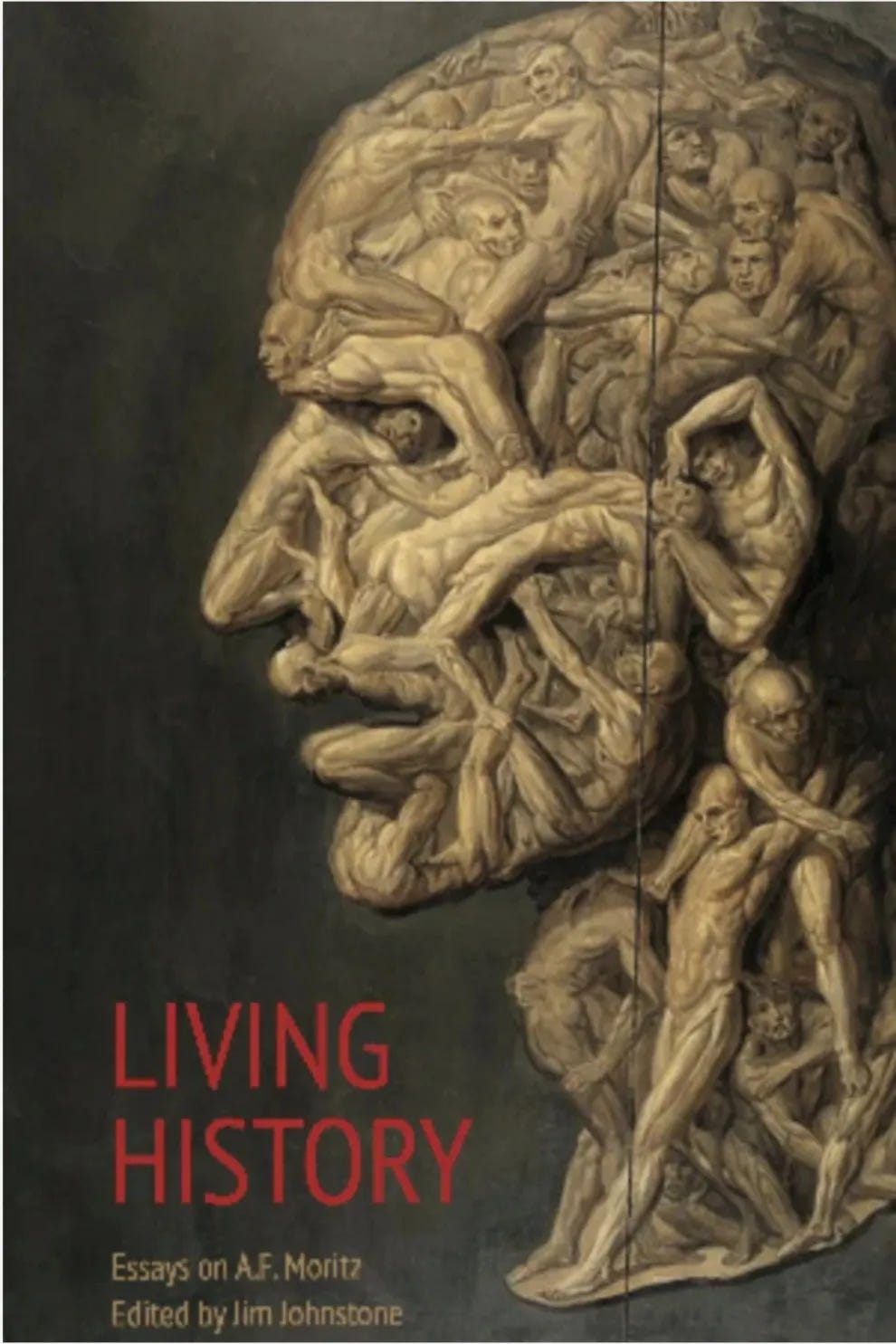
In Living History Jim Johnstone has brought together a who’s who of Canadian poets to honour A.F. Moritz in a thought-filled Festschrift. The cover of this handsomely produced book of essays features a grotesque face of contorted bodies grasping the grey matter of thinking man, an immanence of bodies in the brain. One twisted figure forms the ear, while another bends in the shape of a mouth. The ear in the head listens to John Ashbery’s words quoted at the back of the book: “An ancient voice, mournful like the wind, speaks to itself yet means to be overhead [sic] in A.F. Moritz’s amazing poems.” The typo points to what is overheard and over-read in these essays that respond to and correspond with Moritz’s remarkable oeuvre.
Johnstone’s “Introduction,” like most of the essays in this collection, demonstrates his own poetic sensibility as he moves from Moritz’s “ark” to “an arc that probes the whole of Moritz’s over fifty-year career.” From words to gardens, ecology, and surgery, Johnstone introduces his chorus of a dozen essayists who cover most of Moritz’s work. He bookends this volume with his conversation that highlights a revival of Romanticism, stillness in motion, relativizing and revitalizing.
Robyn Sarah’s “Signs and Certainties” revisits Moritz’s early publishing career which overlaps with the birth of her own children. In his early verse she recognizes a voice that is portentous, lyrical and meditative. In “Thrown Down into Strangeness” Brian Bartlett examines words as subjects in the poems, which are characterized by action, mood, and uncertainty rather than monuments. He analyzes the long lines of “Maybe”:
“They want to erase you, little married couple of words, but it’s not so easy
to form a perfect, direct style, without vacillations
……………………………………. Maybe tomorrow
the general strike will be called ….
Maybe someone will translate into words hard and definite
……………………………………… the vague suggestion
of the man ……..
You, vacant adverb, aside from a full stomach are what we have.”
The title’s tentativeness hints at vacillations of vagueness and oscillations of vacant adverbs where v’s insert themselves into the married couple of words. Just as his ridge breaks down into “rrr” and “dge,” so the consonant “v” vanishes and quivers in voice and verse.
Moritz’s coupling of words, ideas, and thinking echoes into a fugue-like refrain, as noted by Micheline Maylor. Indeed, Moritz’s lines progress through a negative dialectics whereby thought and counterthought yield to an unresolved synthesis that moves on to the next stage and stanza without closure. This negative dialectics developed by Theodor Adorno and the Frankfurt School may be part of their dislocation from Germany to New York. In the same way Moritz’s moving garden belongs to his translation from his American childhood around the Mahoning River to Toronto, echoed in the flight of wren, sparrow, and Egyptian departure.
Anita Lahey’s “Read This Poem to Exist” studies the sexuality of gardens, flowers, and fountains in her subject’s poems and essays that occasionally accompany them. One of her lines contains telling typos when she examines the house that “Mortiz” spots “from a bock away” – a Freudian slip with intimations of mortality.
George Elliott Clarke reminds us of Moritz’s surrealism as he ambles through gardens of verse from Joni Mitchell to Blake, Coleridge, and Whitman. He also includes a discussion of Martin Luther King and Rodney King. Clarke’s familiarization of Bill Blake and Sammy Taylor Coleridge points to the shift from Albert Frank to A.F. and Al in Moritz’s ambling identity from Robyn Sarah’s opening essay to Kirby’s final tribute of Al in “Always” and A.F. in affirmation and affability.
Karen Solie hauls Moritz’s long poem “Sequence” by linking it to mourning. Like the process of mourning, the form of the long poem “runs many of the same risks – repetitiveness, excess, a general unmanageability.” In her running commentary she turns to Freud: “In Freud’s theory mourning runs its course, runs up against the geography of a respect for reality.” Her repetition of run echoes Moritz’s fugue-like refrains before she moves on to Derrida’s “hauntology.” Like other poets in this collection, she demonstrates a scholarly range of references.
Ben Meyerson links fountain and flamenco, reminding us of Moritz’s connection to Octavio Paz and Juan Ramón Jiménez. Paul Franz traces the influence of Jacques Ellul on Moritz and concludes by quoting the poem, “Naked to All Interpretation.” This poem, like so many others, mirrors the book’s cover. It begins with an echo of T.S. Eliot: “There is a speaking in tongues by the dead, / like the anaesthetic babble / of a patient held down in death-likeness by his drugs.” It continues to the cover’s image: “The voice of the dead through another / head, another voice.” Examples of “apophrades” or return of the dead suggest why Harold Bloom and John Hollander have paid attention to Moritz.
In contrast to Karen Solie’s study of the long poem, Alexandra Oliver analyzes shorter lyrics for their themes of uprootedness, sites of transformation, and fragmentation. In contrast to Oliver’s essay, Shane Neilson pens the longest essay in the book that focuses on “Mahoning”(1994) to support his environmental reading. He distinguishes between “Energy Humanities” and “Health Humanities,” noting that as autistic, he reserves the right to mint neologisms. His densely packed argument demonstrates “immanence” in Canadian Literature and his bibliography is as long as some of the other essays in Living History.
Ross Leckie explores the Romantic Sublime in “The Death of Francisco Franco.” He walks us through Lorca, Blake, Keats, Coleridge, Wordsworth, and Emerson to arrive at the sublime grotesque: “The graveyard literally covers over the sublime grotesque; it is a repression of the sublime.” That, in response to Moritz’s dramatic monologue, “The Undertaker”; that, in response to the book’s cover, a still feather, “open-mouthed, legs splayed thoughtlessly.” Yet, the poet’s mouth opens, and his legs carry him thoughtfully through landscapes of living history. Living History may be greater than the sum of its parts, but each part demonstrates considerable strength in its tribute to Moritz’s achievement and influence.


About the Author
Jim Johnstone is a Toronto-based poet, editor, and critic. He is the author of seven collections of poetry, including Infinity Network (Véhicule Press, 2022) and The King of Terrors (Coach House Books, 2023). Jim curates the Anstruther Books imprint at Palimpsest Press, where he published The Next Wave: An Anthology of 21st Century Canadian Poetry (2018). His most recent book is Bait & Switch: Essays, Reviews, Conversations, and Views on Canadian Poetry (Porcupine's Quill, 2024).
About the Reviewer
Michael Greenstein is a retired professor of English (Université de Sherbrooke). He is the author of Third Solitudes: Tradition and Discontinuity in Jewish-Canadian Literature and has published extensively on Victorian, Canadian, and American Jewish literature.
He has published over 300 essays and reviews in books and journals across Canada, the United States, and Europe.
Book Details
Publisher : The Porcupine's Quill
Publication date : April 1 2026
Language : English
Print length : 100 pages
ISBN-10 : 1774221799
ISBN-13 : 978-1774221792
 | A guest post by
|