

Mobilizing Data for Justice by Chris Hurl, Elena Rowen, Marius Senneville, and Kevin Walby
A guide to activism in the digital age

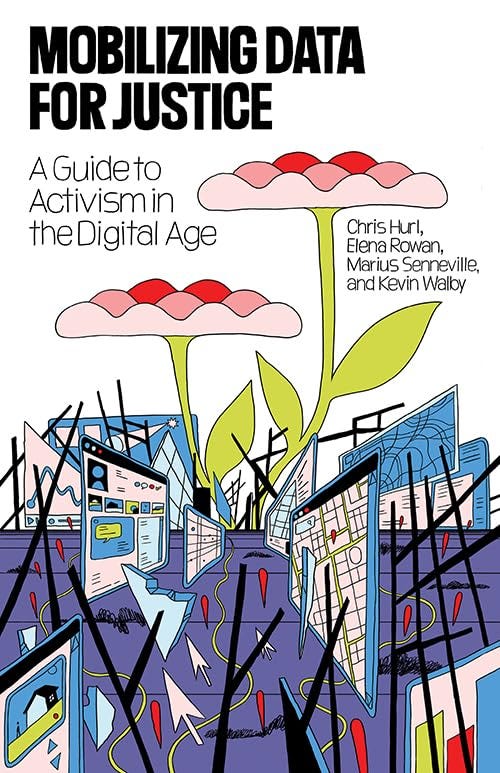
Ownership of data, and control over interpretation of data, represents power in today’s digitized landscape. Data activists seek to wrest some of this ownership and control away from the powerful, in service to their own communities and struggles. As the authors of Mobilizing Data for Justice are careful to note, the techniques of data activism are politically neutral. Activists may align to the right as well as to the left. Being themselves of a left-leaning disposition, the authors choose to focus on similarly aligned groups and to call this “data justice” in analogy with the terminology of “social justice.”
As part of a four-year, multi-institutional research project based out of Concordia University, the research team interviewed representatives of approximately fifty groups engaged in data activism across Canada, the United Kingdom, the United States, South Africa, and Germany. These interviews form the basis of the book.
“Overall, this is a really intriguing project that attempts, if not entirely successfully, to assemble and corral a lot of disparate information and resources in an under-researched field.”
The authors classify data-related activities of activist groups as involving access, archiving, or visualization. The predominant tool for activist organizations seeking access to state-level data is the Freedom of Information request (FOI), or Access to Information and Privacy (ATIP) request as we would say in Canada. Activists interviewed by the authors discuss some of the challenges and setbacks they experience in navigating the cumbersome process of filing such requests and interpreting the responses. Technological tools can be useful to assist with filing simultaneous requests across different jurisdictions, and generative AI can help to organize and summarize unwieldy response sets. In some cases, the data being accessed is one’s own. For example, apps can be built to log gig workers’ activities separately from the company’s systems so that individual workers can see their own information.
The importance of archiving has been highlighted recently as individuals and organizations have scrambled to download and store information being removed from US government websites pertaining to topics deemed out-of-favour by the current administration. This problem is hardly unique to the United States, though. Mobilizing Data for Justice shines a spotlight on an organization called SUCHO (Saving Ukrainian Cultural Heritage Online), which has been working to archive Ukrainian websites in danger of going dark due to infrastructural and cyberstructural impacts of warfare in the region. The Wayback Machine is another example of archivist activity, preserving data that would otherwise be lost as websites go offline or change their content.
The chapter on data visualization concerns itself more with critiquing the objectivist underpinnings of the field, and the “occularcentrism” of visual representation, than with guidance on how activists might develop data visualization skills. The authors focus heavily on mapping, and on the augmentation of maps with different layers of information such as oral histories and videography.
It’s a little unclear just who this book is for. The authors have academic affiliations, and the book reads a bit like a monograph reporting on their qualitative research project. The tone seems to aim at a broader audience, but retains a substantially academic flavour. Activists seeking a how-to guide will not find one here—they may take ideas and inspiration from the case study examples shown, but won’t learn how to organize and analyze data for themselves, nor are they pointed in the direction of the multitudinous open resources for learning the skills of data visualization. The main text is interspersed with explainers on techniques like collective mapping, or OCAP principles for working with Indigenous communities, which could be useful for people looking to undertake projects in this space. These sections would be even more useful if they were listed in the table of contents or in a separate index; they are differentiated by font but cannot be easily referenced within the chapters where they occur.
Those looking for actionable resources should visit the project website at datajusticehub.ca where one can find webinars, podcasts, and links to books and documents by other authors. The organization and presentation of information on this website is a little glitchy; for example, the “Guidebook on Guidebooks” that purports to help readers navigate this section of the site is shown within a window that’s smaller than the page size, so it requires constant clicking and scrolling. The guidebooks themselves are then hidden under obscure tiles that only show their names on mouse-hover, and several of these link out to books that must be purchased elsewhere rather than being available open-access online.
Overall, this is a really intriguing project that attempts, if not entirely successfully, to assemble and corral a lot of disparate information and resources in an under-researched field. The work is commendable. The challenge for readers like myself, who may feel frustrated by gaps in the presentation and who may have some relevant expertise to bring to the table, is to ask: What am I doing? How can I help?

About the Authors
Chris Hurl is an associate professor in the Department of Sociology and Anthropology at Concordia University. His research examines the politics of knowledge production in public sector restructuring. He is the coauthor of The Consulting Trap and coeditor of Professional Service Firms and Politics in a Global Era and Corporatizing Canada.
Elena Rowan is a graduate student and researcher in the Department of Sociology and Anthropology and the Department of Psychology at Concordia University. Her research explores the intersections of culture and community in sociology, anthropology, and clinical psychology. Her graduate research looked at questions of community, copyright, and advocacy within libraries, published in Platform Power and Libraries. She produces the Data Justice Hub podcast.
Marius Senneville is a Montreal-based researcher trained in STS and political economy. His academic works have touched upon the AI innovation ecosystems in Montreal and Toronto and the changing forms of partnerships being developed between university and industry laboratories. He also investigated the way AI governance emerged as a strategic sector of management consulting and the different actors vying for market credibility. He currently works as an applied researcher at CÉRSÉ, where he is developing the research programs on the digital sectors and renewable energies.
Kevin Walby is a professor of Criminal Justice at the University of Winnipeg. He is coauthor of Police Funding, Dark Money, and the Greedy Institution. He is coeditor of Disarm, Defund, Dismantle and Changing of the Guards. He is the director of the Centre for Access to Information and Justice (CAIJ) and coeditor of the Journal of Prisoners on Prisons.
About the Reviewer
Dawn Macdonald lives in Whitehorse, Yukon, where she grew up without electricity or running water. She won the 2025 Canadian First Book Prize for her poetry collection Northerny. She posts weekly on Reviews of Books I Got for Free or Cheap (on Substack), as well as reviews for journals and The Seaboard Review of Books.
Book Details
Publisher : Between the Lines
Publication date : March 17 2026
Language : English
Print length : 288 pages
ISBN-10 : 1771136812
ISBN-13 : 978-1771136815
 | A guest post by
|