

Mouths, Squares, Rooms: Review of Gillian Sze’s An Orange, A Syllable
Reviewed by Olga Stein


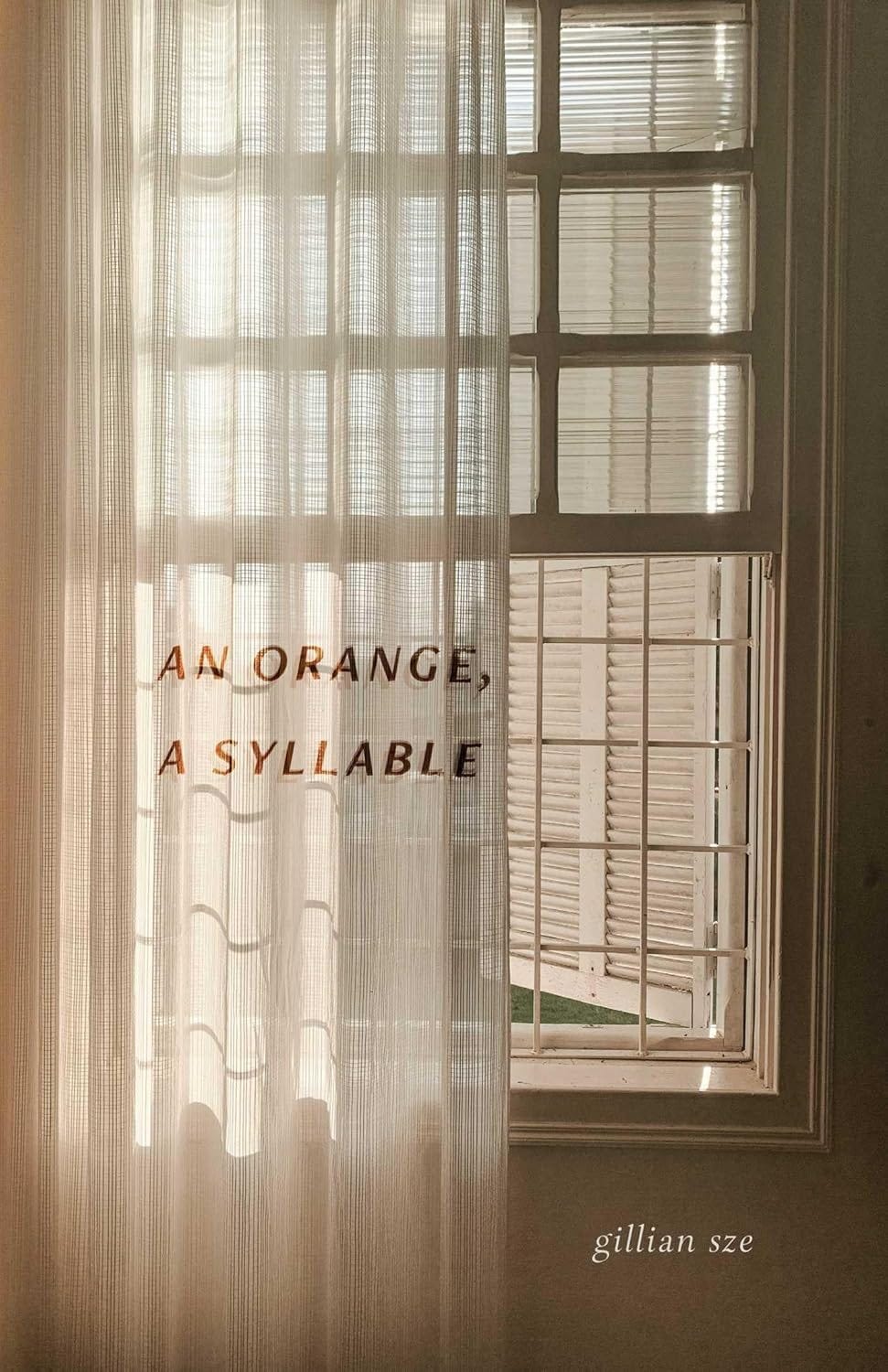
Gillian Sze’s An Orange, A Syllable is a cycle of lyric prose poems in a collection so distilled yet supple and lustrous, in terms of its language, thematic matter, intra- and intertextuality, that one can’t but come away convinced of Sze’s prodigious gifts. This book is seemingly about the exhausting experience of caring for an infant, later a toddler, in the context of an uncertain domestic partnership; some of the poems allude to the physical and emotional toll this child-raising phase exacts, others examine the discord that periodically threatens to undo the narrator’s relationship. Yet the essence and beauty of this collection lies in the ways Sze’s poems turn language itself, its verbal and representational components, its figures and devices, into an elegant and piquant object of study. In addition, since many of the pieces highlight the precariousness of attempts at communication — between child and mother, the narrator and her lover/partner, and the poet-narrator and her imagined readers, as well as between artists and audiences more generally — An Orange, A Syllable also plumbs the limits of poetry and other forms of artistic composition as mediums tasked with transmitting meaning.
Sze lays open the etymology, phonology, and associative significations of words and phrases in poems whose effect is cumulative. Some pieces capture a child’s incoherent vocalizations and early language acquisition; others portray speech gone awry or having failed its purpose: “Our once wooing words became words misquoted, words sabotaged, words held hostage and again, always again, misunderstood” (26). A passage that touches on the narrator’s efforts to connect with her partner evokes another poet’s nettled awareness of the inadequacies of words: “Words are always hungry for that fullness of sense, a phenomenon Simic describes as impoverishments, splendid poverties” (20). Further on in the collection, the narrator recalls attending a poetry reading where the audience is cued to recognize that a poem, despite its innocuous title, is “about sex.” She wonders afterwards, “how much of reality leaks into the space of a poem” (49). There’s artifice in all art, Sze reminds us metapoetically, an observation that draws our attention to instances in An Orange, A Syllable where, paradoxically, unalloyed reality leaks into poems (or merely appears to) via relayed fragments of acrimonious conversation between the narrator and her partner.
An Orange, A Syllable offers variations on the potential of words as purveyors of thought and feeling. Even when absent, as with the “[p]ostcards written from outside the country with nothing on them,” which the narrator’s partner brings back from his trip, the omission of words is a silence that pains the speaker: “This blankness, you insisted, was pure potential. I could write and imagine anything I wanted you to say, Anything, you repeated, like you were selling me land….” (40). In a subsequent poem, we learn that the postcards (designed to contain words, but not used that way by the narrator’s partner) reproduced Vilhelm Hammershøi’s paintings. The closing section of An Orange, A Syllable makes exquisite use of “blankness” and “pure potential” as conceptual motifs. In a series of ekphrastic poems, Sze offers meditations on abstract art, painted squares, and their ostensible blankness or blackness. The narrator’s ekphrasis includes analysis of Hammershøi’s paintings, whose austerity is redolent of certain feelings for the narrator. She reads into one of the paintings featuring Hammershøi’s wife, Ida, emotions she herself is struggling to contain: “A woman stands in a room and becomes as inert as a table corner. You call her rage impotent but it streams through and lights up the whole space” (73).
Sze builds out her inspired anatomy of communicative acts in An Orange, A Syllable from the English and Chinese words for mouth (kou in Chinese), and the corresponding symbol in modern Chinese, “written as a square.” Importantly, the mouth/kou/square functions as symbol and variable, recurring image, spatial figure, and extended metaphor. As the organ enabling speech, the mouth gives voice to the entire range of human experience. It can be a source of order, clarity, harmony, and amity, but also their opposites. One of the first poems in An Orange, A Syllable references the “the total chaos of all existence” glimpsed in Krishna’s mouth. This myth or fable is an intercultural reminder that the mouth is universally both revered and feared.
A number of pieces riff on the word “fit,” a perturbation to which the mouth gives expression. Here we find the narrator reacting to her partner’s outbursts of anger (“I probe each of your words to feel the sting of your fit….” [38]) or the child’s inarticulate tantrums, as in the following, where the reader is invited to be another witness to the child’s and mother’s distress:
The child has her first fit….The fit stuns everyone off their humdrum pathways….The fit eventually meets the short of their judgement. The fit is virtuosic. It lazes on a plinth and holds everyone’s gaze. The sheen is undeniable. A fit needs an audience. It wants, most of all, me….I witness the fit, but then no longer know if it is a performance for or from me. (44)
Recurring “fit” poems, in form and content, limn the breakdown of order and reintroduce the collection’s dominant leitmotif. The fit begins and ends with the mouth.
he fit is all 	mouth	….
			the mouth is brightness		upon
brightness		the fit is blinding	the fit		and the mouth
are one….							the mouth
always shapes itself to the fit….(46)
Literally and figuratively, as word or logogram (i.e., a visual stand-in), the mouth operates as the basis for Sze’s poetics on the many ways human beings construe/construct their lives. For instance, the narrator describes her sense of being “encased” in the space of the home, a space seized, defined, and constrained, like the square’s geometry, by the demands of the small child, to whom she’s attuned on a visceral level.
So I divided my page into squares. Among its many meanings, kou refers to both entrance and exit—fitting on those days when the child’s wails patterned themselves on the intake and outtake of air and sound and air and sound. Encased, I wished only for a single thought to fill the space and make a square that came out even on all sides. (13)
In another gracefully rendered passage, the square morphs into the calendrical day and the tedium of a childcare routine that confines the narrator to her home, and where the passage of time/days becomes excruciatingly slow: “I grid the page and step into the square of the day. The calendar on the wall enforces sameness…I turn the bend at this meal, that meal, this hour, that hour. Night arrives at an angle; I step over the line into the square of the next day” (27). Sze’s variations on different kinds of spaces delineated by lines, light and shadows, appear even when she’s merely observing a wintery scene through her window: “Birds don’t dive so much as swoon from roof to roof. The wings are open and lock. For a second, birds appear as paper cut-outs….Everything is planar: wingspan against blue ether, time against space. At the last minute, their wings wink alive in unison. Birds are animated from shadows in that interlude between going and arriving” (53). Other poems in the middle section of An Orange, A Syllable frame the narrator’s agoraphobia, perhaps due to lingering postpartum anxiety, as a reluctance to leave her doorway: “The open door and its straight lines swing past the threshold. It is one step to cross over, into the light and the heat, but until then it is impossible….I’m afraid of getting trampled by the space separating us” (57).
Another poem begins with the narrator’s irrational fear of black holes, cosmic phenomena from which even light can’t escape, then fuses with her awareness of the strain on her relationship. Here again, outer space, its inhospitable darkness and unnavigable distances measured in light years, becomes a plangent trope. In their domestic space, the pair is restive but unable to separate.
Another night, another history: the sky showed signs of collapse….I told you I was afraid of black holes. You were amused by the distance between us and those unseeable things light years away. How fear still occupied the length that overtook even my own life….You and I circled each other then, love like the darkest surface. Languid before the lance. We did it for years even when we hated the other. Leave, one would say. Go, the other replied. What kept us pinioned to the dark? What gravity? Black holes can come in pairs, the scientists discover…. The pull of one hole on the other prevents the other from havering…. (63)
Sze’s squares evolve, as suggested above, in the book’s latter part with luminous descriptions of abstract paintings of squares by artists Kazimir Malevich, Joseph Albers, and Robert Rauschenberg. The narrator, now an observer, gives us Kazimir’s Black Square as “the black void [that] could be anything,…and quite possibly everything” (65). Considered by critics the “zero point of painting,” the black square of Malevich’s painting is analogous to the mouth, which makes the mouth the zero point of speech. Indeed, in one instance, the child’s fit is the “solid black of incoherence and anger” (68).
Malevich’s Black Square, it turns out, isn’t monochromatic; close inspection by art historians, the narrator informs us, revealed that his canvas contained other layers: “They discover another painting, one more colourful and complex. Patches of primary colours that emerge like the stained glass of a church” (66). Strategic use of layers of colour in painting simulates the appearance of emptiness or blackness — in effect, a matter of visible light being reflected or absorbed, but also a matter of perception. On first viewing Malevich’s painting, the narrator sees “too much black, too much nothing,” which strikes her at the time as a representation of her own failed relationship: “Everything is falling apart,” she tells her partner (66). Later, however, the narrator learns to adjust her perspective, see and experience the “blackness” as “a mixture of non-black colours.” She realizes, too, that when she “soften[s]” herself against her crying child, “the fit crackles open, recedes. The beguiling peach of exposure, whipping bright the holy dark” (68).
Sze plays on the aforementioned “pure potential” in poems where the narrator ponders Hammershøi’s stark paintings of apartment interiors, featuring “spaces between open doors…Lines blow[n] open: a room into another room, into another” (74). Rooms (note, square-like spaces) proliferate in these ekphrastic passages, each laden with potential for light or darkness, love or resentment. Each is also a mirror of Hammershøi’s and the narrator’s inner states (a doubling of interiority): “What spasms most in Hammershøi’s interiors are those reaching spaces between open doors. Openings that fit me, a past me, a maybe me. The uncertain lines and ruts. A shadow swoons itself over a door. This light is conditional….The here and there of me” (74). Hammershøi’s statements about the importance of lines and light in his work, deftly inserted into passages that come after a lyrical contemplation of light, reinforce the mise en abyme function of this closing portion of An Orange, A Syllable.
The Hammershøi section has the poet-narrator examine another artist’s use of lines and light to convey an inward sense of longed-for solitude or — because “anything” is possible in these spare spaces — an inescapable loneliness and isolation instead. Importantly, Hammershøi’s moods, and the mood of his sole human subject, his wife Ida, are conditioned by the volume and quality of light:
In one interior, [Ida] is, as usual, seen from the back wearing her long black dress. One hand rests on the doorknob. She looks ready to walk through, and yet her head is turned to look at another open door on the adjacent wall. The twist of her body shows us a split desire. Her dress picks up the shadows. A sliver of light comes at odds, through a window two rooms away. (81)
The narrator and Sze’s readers are left to interpret the paintings for themselves, always in relation to these works’ light and their own dispositions.
There’s an admirable subtlety to most of these poems. Hammershøi’s “austere walls awash with absence” (77) hold no sign of a child. The narrator thinks when perusing the painted rooms: “Wherever I am the child is. I can only look form a doorway that was never painted. I am diminished to an accent.” In another passage, Sze’s narrator, ruminates on what is known about Ida: “In the rare painting where she is seen from the front, viewers remark on how dolorous she appears. Some say she yearned for the child that was never to be. Some say she suffered from fits….Maybe she is always seen from the back so this pain remains private” (83). The meaning of the absent child is unclear, perhaps an expression of the narrator’s ambivalence about her capacity to mother.
The narrator describes herself watching Ida, the way Hammershøi painted her: “Oh, all those backs. I know more of…Ida, from behind, standing back here out of frame….What does she read?….Is that letter even for her? When the light hits the floor, we know that it never moves again” (75). Yet in the ode to light passage that comes immediately after, we read, “The light speaks its own language” (76). Both narrator and reader must decipher it.
On the very last page, the import of this language is clarified, the tension between light and dark resolved. The narrator says: “So let me linger in these rooms, these mouths, I failed to fill. One moment I saw all the syllables, precious alphabet, full of meaning, cliffing around me. Then it shone out of you and the child, sharpened glints I could not refuse….” (84). This epiphany is preceded by another keen apperception: each of Hammershøi’s “isolated” interiors “is a lesson in beauty. Or love” (79). In the same way, each of Sze’s blocks of text and splendidly bedded poetics attest to beauty and love.

About the Author
Gillian Sze is the author of multiple poetry books and picture books. Her book of poems and essays, Quiet Night Think, received the Pat Lowther Memorial Award. She lives in Montreal, QC, where she teaches creative writing and literature at Concordia University. Gillian Sze was awarded A. M. Klein Prize for Poetry in 2025.
About the Reviewer
Olga Stein is an academic, writer, editor, and university and college instructor. She was born in Moscow, the capital city of the former Soviet Union. She immigrated to Canada with her parents as a child, and has lived in Toronto her entire adult life. Stein earned her BA and MA at the University of Toronto. She studied philosophy, political science, literature, and languages. After serving for two decades in medical and literary publishing, including as chief editor of the literary book review magazine, Books in Canada, she returned to academe, and completed a PhD in contemporary Canadian literature and cultural institutions.
Stein has been writing literary essays and cultural commentary for nearly two decades. Since completing her PhD, she has also been writing short fiction and poetry. She has three children. Love Songs: Prayers to gods, not men is her debut collection of poems.
Book Details
Publisher : a misFit book (ECW Press)
Publication date : Sept. 2 2025
Language : English
Print length : 88 pages
ISBN-10 : 1770418512
ISBN-13 : 978-1770418516
 | A guest post by
|
Thank you for sharing. It's very well written. I think I understand how the poet "compensates" for his inexpressible anger and longing by analyzing Hammershøi's paintings.