

Moving Beyond Neat Endings: A Review of Audrey Hyams Romoff’s memoir, The Ripple Eclipse: Turning the Tide of Inherited Trauma
A Guest Review by Ezra Anderson

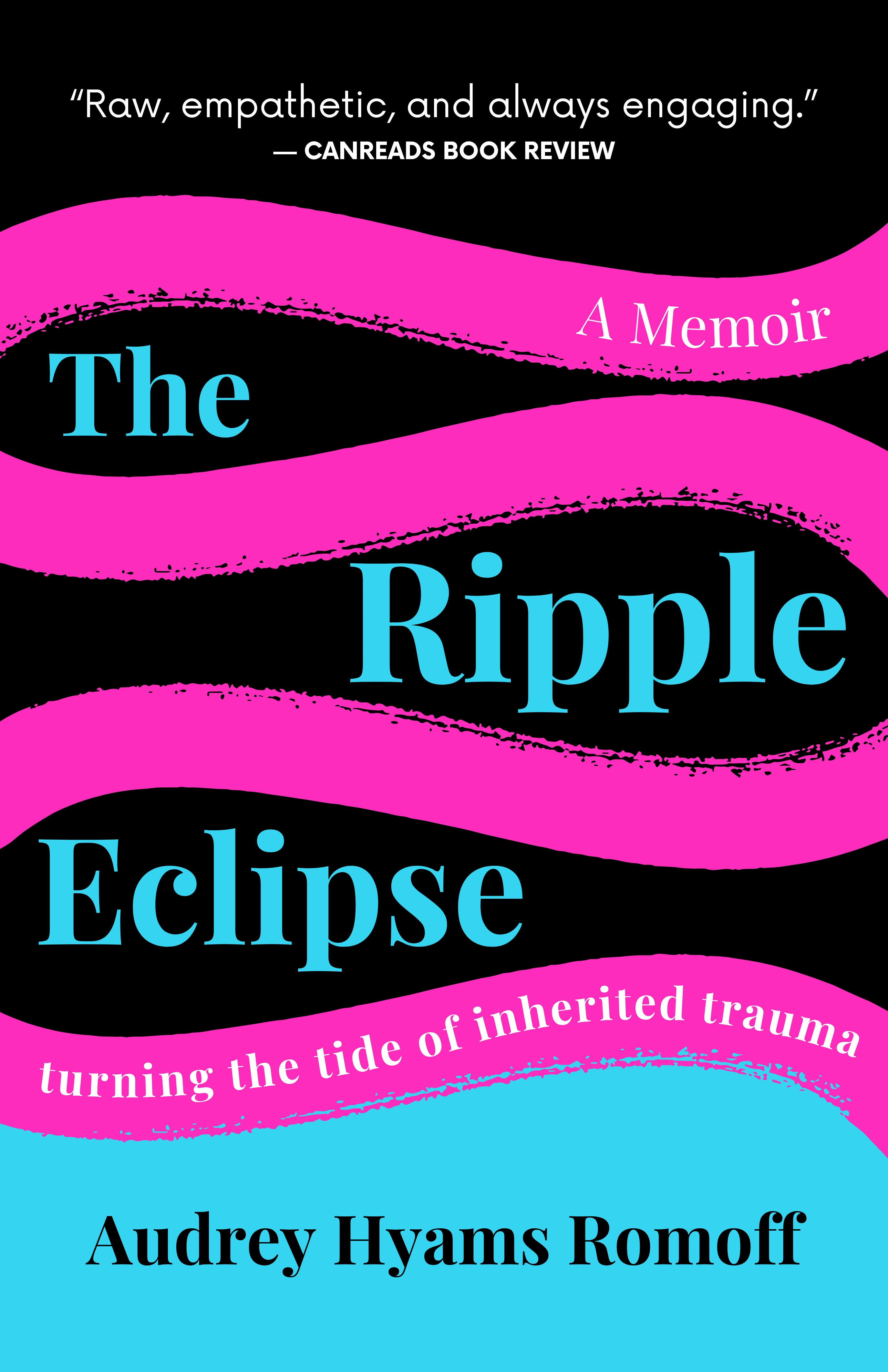
Holocaust memoirs and celebrity memoirs usually serve different functions. One asks us to remember; the other asks us to look. Audrey Hyams Romoff’s The Ripple Eclipse: Turning the Tide of Inherited Trauma invites us to do both at once. A veteran publicist who has spent decades crafting stories for stars like Timothée Chalamet and Sarah Jessica Parker, she turns to the one narrative she could never shape: a family marked by the Holocaust and the silence that followed.
For more than thirty years, Hyams Romoff has run OverCat Communications, honing public images with care and control. At home, she grew up with questions that were never safe to ask. The Holocaust was never mentioned, but it was always present. Her mother and grandmother survived Auschwitz; her mother was one of its youngest survivors. The memoir follows the emotional aftershocks of that history: how love works when a parent cannot articulate the wound at the centre of their life.
The book’s axis is the death of Hyams Romoff’s parents, found together in their garage when she was forty-five. Her mother’s suicide is clear; her father’s death remains shadowed. The loss forces her to confront not only grief but also the long inheritance of silence that shaped her. After years spent refining other people’s stories, she is finally left with the consequences of inheriting a family narrative that was never told.
The often-hilarious backstage scenes with A-list celebrities are a welcome counterpoint to the dark moments of domestic reckoning. It also sharpens the core tension: public life as performance, private life as legacy. In her professional world, Hyams Romoff was an expert in narrative control. In her family, the defining story was untouchable. That friction powers the memoir.
Her refusal of “closure” is the book’s strength. The Ripple Eclipse rejects the familiar memoir arc in which naming trauma is treated as a cure. Instead, Hyams Romoff shows what it looks like to move forward without pretending the past has been resolved—a more honest and ultimately more powerful portrait of life beyond grief. Her aim is not redemption but interruption: to keep longstanding silence from becoming her daughter’s inheritance.
Her central metaphor—the “ripple eclipse”—captures how trauma extends outward, dimming lives far from the original event. The image clarifies something many families feel but rarely name: the subtle darkening of ordinary life. Yet the book is sharpest when it allows moments to stay complicated, not neatly explained by any single concept.
Running beneath the memoir is a quiet argument about memory. With survivors dwindling, the danger is that the Holocaust will be treated as “history” in the safest, least demanding sense. Hyams Romoff pushes against that drift by showing how the past is alive today; not only in archives but in households, habits, and the emotional weather of families.
The Ripple Eclipse doesn’t aim for closure. It insists on holding catastrophe in full view, resisting the cultural urge to sand it down into abstraction. Hyams Romoff’s achievement is to show that remembrance is not only an act of looking back, but a way of moving forward.

About the Author
AUDREY HYAMS ROMOFF is president of OverCat, a highly respected communications agency specializing in luxury clients. She is an adequate wife, fiercely devoted mother, and over-the-top animal lover. Audrey expertly manages a complex, multifaceted existence wearing a fabulous array of designer outfits. She holds a PhD in compartmentalization and excels at creating the illusion of living a perfectly manicured life.
About the Reviewer
Ezra Anderson is a writer and independent bookseller in Toronto.
Book Details
Title: The Ripple Eclipse: Turning the Tide of Inherited Trauma
Author: Audrey Hyams Romoff
Publisher: RE:Books
Publication Date: November 2025
ISBN: 978-1-998206-490 | Paperback | $24.95 CAN