

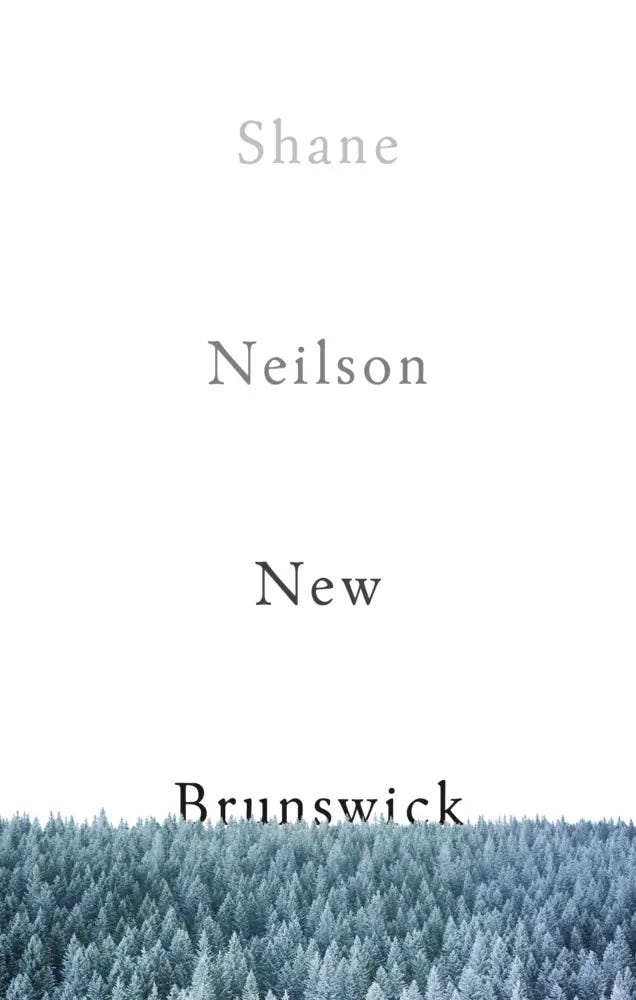
New Brunswick by Shane Neilson
A Throwback Thursday Review by Dawn Macdonald

There are two kinds of books I find difficult to review: those I don’t like, and those that I do. New Brunswick is the latter. It’s intimidating to corrall a response within a rhetorical framework of 900 rather feeble words. I had the same problem with Shane Neilson’s more recent book-length poem The Reign. It’s obviously freakin’ fantastic—now, how to say more than, “This is freakin’ fantastic?”
New Brunswick, Neilson’s fifth poetry collection which was released in 2019, spans 87 pages. Within those pages is contained some vast phenomenon, like the sky. How would you review the sky? How would you review the actual province of New Brunswick?
Of course, people are happy to review the province of New Brunswick. I turn to Reddit for assistance, where I learn that New Brunswick is beautiful but dead, that it’s “life in the slow lane” with shitty healthcare and “nice but somewhat judgy” locals , that it’s underrated and “the best kept secret in Canada.” The “beautiful but dead” part suits a discussion of Shane Neilson’s New Brunswick, because the man can turn a gorgeous phrase, and he directs this poetic skill towards a dialogue with his own dead—his mother, buried where “mustard seed got choked / by conglomerate needs that punished the small,” and his father, an old-school patriarch of the fist-thumping variety.
“…the man can turn a gorgeous phrase.”
“First / principle: there is no end to life if life consists / of conversations with the dead,” writes Neilson in the long poem “Broken Crown on the Neilson Family Table”. And, later in the piece:
“Pain was a process meant for use. Ab is Semitic for father.

Ab          use

use

use

less

The tabletop focuses on fields fronting rusted-out

cars that sink into differgreening earth. I know

this place, but in case, I cross myself—the sign

a marker of my displacement.”
This curious formation, “differgreen”, also occurs near the end of the poem about his mother’s gravesite: “But look— / in the field, see wounds the mortgage / might heal. Land remains, awaiting the farmer / of future nostalgias. Mom, I miss you. / This differgreen is slow, wild, beautiful assertion.”
In quoting these parallel passages I would draw attention to formal features that texture Neilson’s poems. Firstly, there is his use of rhyme within or across lines, as in “this place, but in case” or “in the field … / might heal.” Secondly, the enjambment that turns a phrase two ways at once, which we see in the transformation of “abuse” into “useless”, and in “the farmer / of future nostalgias.” These two techniques embellish the text with focal points and beats additional to the punctuation and line endings. A third feature, perhaps not a technique per se, is in lines like “This differgreen is slow, wild, beautiful assertion,” a line that seems to mean something, but does not pin down to an obvious, literal rendering as a thing in the world. What’s a differgreen? What is the action of differgreening? How is differgreen assertion? What does it mean to be assertion, as opposed to the active verb form of making an assertion? How might an assertion be slow, wild, beautiful?
This slipperiness is risky; certainly there is much bad poetry out there where meaning remains elusive and vaguely “poetic” diction runs rampant. It’s my feeling, though, that Neilson manages to stay just this side of the meaning-meaninglessness divide. I don’t know what he means, but I feel confident that meaning is there, not to be teased out necessarily, because this is meaning of the kind that doesn’t fit into words and sentences—the kind that can only be gestured at, evoked, made visible though not defined. Neilson tackles questions of saying and sensemaking directly in a shorter poem titled “Edmundston” wherein he states, “Sens, the sense of the poem / is to feel,” and concludes, “For years, I’ve made no sense, / taking pleasure where and when / it comes. The mouth bleeds / through its words, but it speaks.”
Turning back to matters of form, the poems in New Brunswick take a variety of shapes. The opening piece is a three-page timeline of New Brunswick’s history, from 1534 through 2015, listing not the usual names and events but instead marking the years with comments like, “We never knew what we wanted to be,” or simply, “Want:”. This is followed by a historical document, an excerpt from Mascarene’s Treaty of 1725, also known as “Mascarene’s Promises.” Then comes a long poem, followed by a set of shorter, lyric poems, and another long poem broken into shorter numbered sections. The final segment of the book is headed “Loss Sonnets” and is almost but not quite a sonnet cycle. The last line of each of these twelve poems reappears in the first line of the next. Poems average around fourteen lines, but range from twelve to eighteen lines (or twenty-one, depending how you count lines in one of the more sprawling pieces). The sonnet form calls back to history, while its broad reimagining places it in the present.
New Brunswick does this wonderfully, bridging the historical and the present moment within a singular life. It repays attentive reading yet it’s rewarding even without quite understanding everything. I have to stop here so I can be done with this review, but I’m not even close to being done with this book.

About the Author
Shane Neilson was born in New Brunswick. He attended the University of New Brunswick, where he completed his BSc. He obtained his MD from Dalhousie University, his MFA from the University of Guelph, and is currently a PhD candidate at McMaster University. Neilson is the author of five collections of poetry, a two-time winner of the Arc Poetry Magazine Poem of the Year Award, and the 2017 winner of The Walrus Poetry Prize.
About the Reviewer
Dawn Macdonald lives in Whitehorse, Yukon, where she grew up without electricity or running water. She won the 2025 Canadian First Book Prize for her poetry collection Northerny. She posts weekly on Reviews of Books I Got for Free or Cheap (on Substack), as well as reviews for journals and The Seaboard Review of Books.
Book Details
Publisher : Biblioasis
Publication date : May 21 2019
Edition : Illustrated
Language : English
Print length : 80 pages
ISBN-10 : 1771963050
ISBN-13 : 978-1771963053
 | A guest post by
|
A fine review