

New-Fangled Rose by Sue Sinclair
Reviewed by Michael Greenstein

Hyphenated Horizons
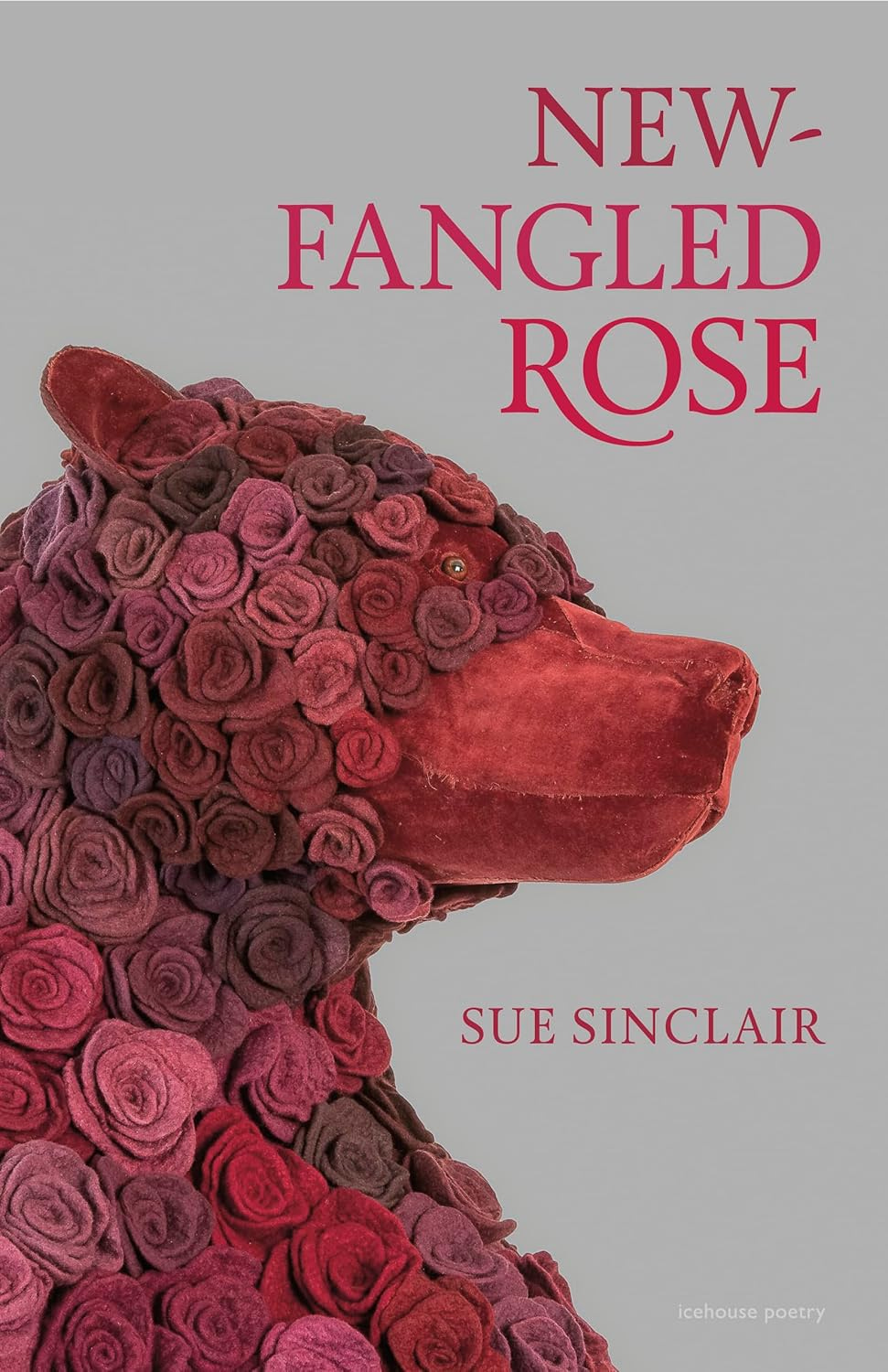
The hyphen in Sue Sinclair’s title New-Fangled Rose appears significantly in the four sections of her latest collection – “Cyborg Angels,” “One More Ark,” “Like a Hand Finding a Hand,” and “How Long Before Happiness Appears?” She hyphenates poetry and philosophy, lyricism and ecosystems, sky and earth, ethics and aesthetics, William Shakespeare and Wallace Stevens, and the hybrid “cyborg” with its combination of organic and artificial elements. Her first poem, “Hospital Bed,” joins nature’s bed of roses with an institutional hospital bed for two types of healing. The rose fits into the book’s cover with its fusion of flora and fauna – an abundance of roses covering an animal whose tiny eye is barely visible, yet whose powers of observation are poetically keen.
The poem’s opening sentence hyphenates olfactory and visual senses for synaesthetic effect: “The scent of rose climbs into the sky, / unrolls itself like wallpaper.” In its singular form the rose represents a collective family clustered into scent. A secondary sense of “sent” and past tenses of rise are part of the poem’s unfolding and reappears in its final sentence: “Because there’s the scent, / and then there’s the feeling of rising to meet it.” Sinclair further heightens the visual and olfactory experience with sounds – rose and unrolls, climbs and sky. The second sentence unrolls more sounds through alliterated sibilance and alternating long and short i’s together with assonance: “Wild roses, a spillage / surprising in a garden otherwise so contained, / so much under the gardener’s thumb.” “Under” contrasts with everything above in the climbing scene, while the gardener’s containing thumb hints at the surgeon’s hands, the seizing meaning of “fangled,” “perfume unclenched,” and thorns in the garden.
The poem hyphenates and mediates between garden and hospital: “An attempt to say something about the institution, about health / perhaps, or happiness.” Attempt rhymes with scent, just as the h in perhaps hyphenates health to happiness, in the rigorous planting of the poem that is equidistant between garden and bed. Two questions at the poem’s centre highlight the linkage of nature and hospital: “That these depend / on certain strictures? That order – good order, / impartial order, an order of the right kind – / can save a life?” (Does this question the relationship between Wallace Stevens’s “The Idea of Order at Key West” with its fragrant portals and the odour of rose-hospital?) Syntax is one order in the orderly strictures of medical healing and gardening. Sinclair’s dashes are extensions of her hyphens that unfurl nature’s freedom in the second half of the poem. “But the roses, / their perfume unclenched and roaming – / they suggest the life unseen in its comings / and goings, the something-more we feel inside things.”
That hyphenated something-more meets the surplus of the long dash after roaming to grant a freedom beyond order. In the opposition between odour and order, the final sentence repeats the opening scent climbing and unrolling in modulated meaning:
Because there’s the scent,
and then there’s that feeling of rising to meet it –
of unrolling ourselves on its trellis, of climbing
above where we are and looking down
like we imagine the sky might if it loved us
like we love the sky, like we love the roses.
In the aura of aroma, something-more strives for a quintessence between an elevating garden and lowering heaven in the angels’ descent. The poet hyphenates and horizons a surfeit under the thumb and above where we are.
Hyphenation resumes in “Round-Leaf Sundews,” exposing the relationship between predator plant and innocent insects in Sinclair’s cosmic garden. The first sentence relies on long i’s and monosyllables to attract the reader until the multiple syllables in tentacles: “They eat flies, not light, rely on / the light only as a mirror / does to let them gleam, / luring flies to their red / tentacles.” The second sentence lures the reader through sounds of tar and tarnished, bug gunk, and satisfying grime: “The lucky ones / convince an insect to land, / their coronas tarnished / by a smear of bug gunk – / beautiful tar, satisfying grime.” The dash smears the line towards oxymorons. The final sentence turns to another dash and concludes wisely and wittily: “the spitting image of the sun / until they aren’t.” Round-leafing these splitting images, the sundews in turn reflect the preceding poem, “Plato and the Poets,” which ends with dashes: “—then turned / and saw the sun swallow him whole.” The poet-philosopher scopes the moon with the cover’s piercing and penetrating eye: “How it hesitates between here and there, / quivers in the depth of the pupil / as the sun never can.”
“Sea Change” focusses on pollution, the roses on the book’s cover, its animal’s head, and a spying eye. After a summer shiver, “It was like we’d opened our parched eyes” on a city that is now “an eyesore” in its postcolonial history. The mayor gives roses to tourists from the cruise ship who then litter the streets with their petals. The old statues now have “the heads of animals.” From the shipbuilding in the first stanza, the second stanza turns to “A healthy pressure is building – like the roses / before they were handed out, like the petals / crammed inside the buds.” The tiny eye or pinhole periscopes thorns in the marine garden: “Sometimes it takes a minute for your eyes to adjust.”
Like Moby-Dick, the hyphen in “Self-Portrait with Cetaceans” stretches to a dash to capture the length of a whale: “I dream of whales – humpbacks mostly.” Elongated lines swim through this oneiric horizon. “In a poem you can sometimes blurt out a fact or two, but even here / I have to be cautious. In dreams, on the other hand, anything goes.” The poet’s blurt aligns with the whale’s blow or spout caught in the eye of a dream: “I never feel more fortunate than when my subconscious glimpses a whale.”
“The View from Nowhere” probes Sinclair’s horizon through maternal and material links. “A mother now, I’ve become the horizon, / the demarcation of a ghostly limit.” She then questions her ghostly horizon or vanishing point “—or am I more like sugar in water, / a fully soluble presence?” Covering and questioning the generations, the poet hyphenates domestic and cosmic spheres as her new daughter looks over her blurry shoulder in a spotless kitchen to “peer into the brightly lit blank we call ‘the sky’.” Her fully soluble presence, like sugar in water, turns to the “Great Everything from which we are poured.” Sinclair’s Sublime oscillates between the sky’s limits and the kitchen sink. Similarly, “Notes on Emancipation” progresses from “high-school gymnasium” to diagonals of “what I mean / an explanation,” and “the church / school / store closed.” Whereas her mother remains in a domestic sphere, a daughter seizes her new-fangled emancipation: “My mother stared into space when ironing, but she didn’t complain. / I converted her silence into a boat and seized the oars.”
A cyborg angel appears in “Pfeilstorch,” a poem about the endangered white stork injured by an arrow while wintering in Africa. This arrow stork is thus an example of hyphenation in a thorn-bird, its hybrid invoked in an apostrophe: “O cyborg angel, I see the marvel!” The arrow’s shaft looks like one of nature’s aberrations, but for the poet it represents survival and immortality. “I know I can stare into your glass eye in a way most / animals won’t tolerate.” Taxidermy and immortality turn to the singular eye on the book’s cover, as Sinclair empathizes with nature and scrutinizes the pain of a thorn.
“NewBees” features another hybrid form of cyborg angels hyphenated as “Robo-bees” with “sub-millimetre anatomies.” They are part of “an agro-miracle” and “soon-to-be archaic concern” in the ontology of “be-bots”. “Gleaning” continues the hyphenation and hybridization of bee and ontological being: “They’ve evolved a rapport so binding and distinctive they’re like one creature, a flower-bee or bee-flower.” In her ring cycle she reads “bemoans” as “bemoons” – an accurate misreading of lament and lunar cycles. Sinclair gleans nature and humanity in pollenating dreams and welded rings to encompass hyphens and dashes.
“In the Wild” probes eyes through religious tears that have therapeutic value in a cathartic garden of recognizable tropes: “If you drizzle them over a flower it will swell, push out an extra / ring of petals, then grow just too Edenic for words.” Added to the sound of drizzle are rhymes of over flower and will swell in an expulsion of words from garden to wilderness. The next sentence lands on a hyphen: “It’s like that here sometimes, crazy-beautiful / but with a catch.” The poem catches beauty in tears that hyphenate God and the domestic realm of slicing onions. The final sentence includes a dash to connect the opposite meanings of pharmakon: “in the wild, the poison and the cure often grow together – and you’re in the world now, or you’d have no need of these tears.” In her many-tiered verse Sinclair eyes the horizon from kitchen sink to sublime wilderness, each of her liquid l’s in the poem adding to her lachrymal flow and flower.
“Inedible” examines indelible crab-apples with their rosy skins and bitterness. “The crabapples / take their sweet time, drown leisurely / in the brown muck of their kin, spurn / the eye of an unwanted heaven.” The poet’s eye horizons seasons between heaven and brown muck, her ear attuned to hard muck, kin, crabapple, and heavy rhymes of drown, brown, spurn, heaven.
Nature is hyphenated to photosynthesis in “Waste Light” with its focus on a lower world: “It’s too easy to fall under the spell, / sink to the bottom of summer in a stupor.” Her second sentence repeats “It’s too easy” to complicate the hyphenating process of photosynthesis: “plant-garbage, a kind of aporia, the undigestible / frequency.” Then a long sentence carries through photosynthesis in a philosophic sense:
A leaf’s inability to completely
photosynthesize looks like beauty to me,
a conversion as wondrous as photosynthesis
itself: the leaf reconstituted in me as a site
of not-just-beauty, its strange-ified
relation to light carrying me past the thrill
of at-first-sight, draining off the buzz just enough
for the green sway to get a little more real,
matter a little more, come a little closer.
All those long e’s from beauty carry through to green and real. The transition from site to sight underscores the visual field, while repeated “just” conveys a sense of justice. Multiple hyphens connect the stages of photosynthetic beauty, while “little more” adds to this mix of excess. From fall to feel, the final couplet returns to ground levels in the anatomy of ecstasy: “Just enough to let me feel my own letdowns worm / their way through the marrow of my green bones.”
“Luna Moth” concludes the first section of the book with the flutter of a hyphen on the garden’s horizon: “The gilt-edge markings shiver / on the very edge of presence” – a shiver at the edges of guilt and gifted presents. “A pair of moon-eyed wing spots on absinthe green” – a double vision of poet and moth in a vacant look. Hyphens extend to dashes surrounding “ – I know it well – “ before alighting on the final stanza: “If seeing is my mother tongue, / the moth speaks it as strangely as I do.” Just as the section begins with conjoining the olfactory sense, so it ends in the synaesthesia of seeing and tongue tasting words in slanted syntax (moth, mouth, month). From cyborg angels to earth worms, Sinclair wings her wilderness through new-fangled photosynthesis and metamorphosis.
II
Section II, “One More Ark,” contains laments and elegies for a world whose ecosystems are broken. “The Black Box Says Goodbye” bids farewell in dashes and hyphens of destruction. “I’m not really black – more rusted steel – but even the so-called black boxes on planes are actually orange.” These marks continue in a valedictory address that conjoins Sinclair to Wallace Stevens. “Steel – as in nerves-of, man-of, still trying to save the day. // A rhomboid vault, I ooze end-of-the-world loneliness.” That loneliness finds company in Stevens’s jar in Tennessee: “Like the anecdotal jar, I am ‘placed upon a hill’.” This apocalyptic box is “just one more ark,” trying to save the species on an alpine heath or hill instead of Ararat’s mountain along Sinclair’s horizon.
The eponymous “New-Fangled Rose” grows from Shakespeare’s “Love’s Labour’s Lost,” where “new-fangled shows” highlight seasonal changes. She takes Shakespeare’s “like of each thing” to liken her experience to hear and to assimilate nature’s unseasonal offerings. “I like of this blueberry bush’s cinched bells, / like their break with dormancy, breach of October’s / norms.” She appends sound effects to her visuals, as a multitude of b’s ring the bells, line breaks, and pentameter rhythms. The initial “like” morphs into “It almost feels / like I’ve forced them into bloom.” A winter’s rose is a miracle that doesn’t face the facts. The poet’s joy partakes of the bloom, but “It too is baffled and quickly recedes.” This withdrawal gets planted in the re-seeding of seasons and rose gardens.
Section III, “Like a Hand Finding a Hand,” underscores the ethics of empathy in beauty. The section begins with “Let’s say beauty is a voice,” and Sinclair voices homophones of “even though what I hear is almost nothing – // here we are –.” She hands and hears the horizon in a sonnet, “Eye-Dust.” “I back out of the driveway one-handed” turns to the ambidextrous, eponymous “Like a hand finding a hand, a swift interlacing.” In her rear-view mirror she alludes to Empedocles who thought our eyes were made of fire. She interlaces senses and her relationship to her beloved in her pinhole eye: “As though some minute part of you had hooked onto my skin / like moths’ feet, almost imperceptibly, now along for the ride. / As though you were a pollen, now lingering in my eye.” Deftly, she pins pollen to poem.
The final section, “How Long Before Happiness Appears?”, begins with the rhymed and hyphenated “Not-a-Thought-Fox.” She stares into corners with “fox-seeking eyes,” strolls through woods, and waits for “the dreamed-of / encounter.” Her eyes return in “Return,” where she presses her fists to them to view “patterns I’d learned to see under my eyelids.” While her eyes scan horizons, her ears hear prescient, precipitate, patterns, pressed, pretending, perceptible, presided, and preverbal. That listening ends with “the preverbal landscape pressing up against language / in the days before I felt so pressed.” Sinclair hooks language to landscape in impressive ways with her multitude of eyes, roses, and thorns of thought. From horizon to horizon she cultivates the Maritime Sublime.

About the Author
Sue Sinclair (she/her) grew up in Newfoundland on the ancestral homelands of the Beothuk. She is the author of six previous collections of poetry, including most recently Almost Beauty: New and Selected Poems (Goose Lane Editions, 2022), winner of New Brunswick’s Fiddlehead Poetry Book Prize. Heaven’s Thieves (Brick Books, 2016) won the Pat Lowther Award for the best book of poetry by a Canadian woman. Sue teaches creative writing at the University of New Brunswick on Wəlastəkwey territory, land of the “beautiful and bountiful river.”
About the Reviewer
Michael Greenstein is a retired professor of English (Université de Sherbrooke). He is the author of Third Solitudes: Tradition and Discontinuity in Jewish-Canadian Literature and has published extensively on Victorian, Canadian, and American Jewish literature.
He has published 250 essays and reviews in books and journals across Canada, the United States, and Europe.
Book Details
Publisher : icehouse poetry
Publication date : March 24 2026
Language : English
Print length : 100 pages
ISBN-10 : 1773104640
ISBN-13 : 978-1773104645
 | A guest post by
|
Love how hyphen expands into the bridge of metaphor, connecting.