

Night Terminus by Ellis Scott
Reviewed by Steven Mayoff

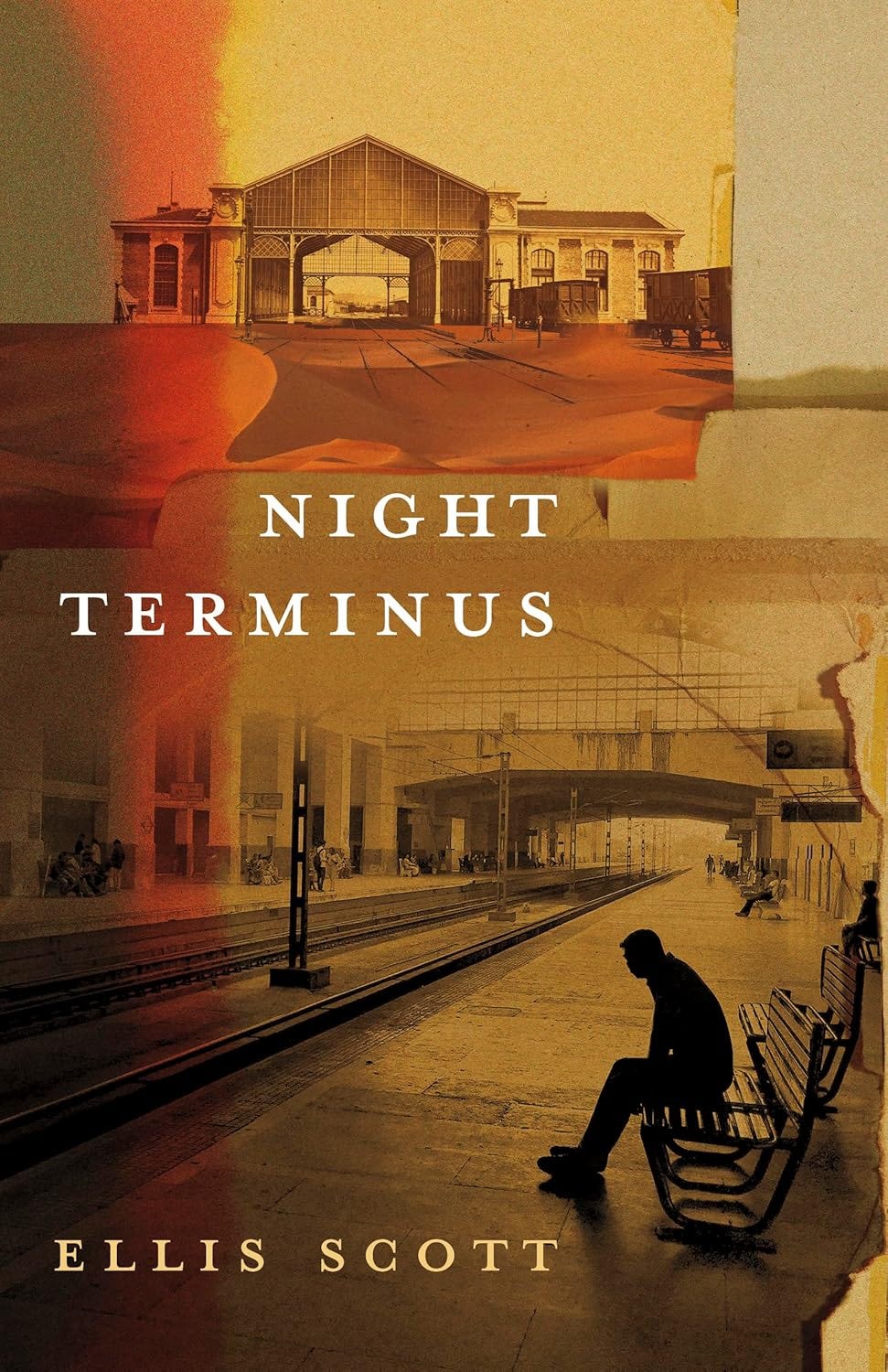
At first blush the title of Ellis Scott’s debut novel Night Terminus (Rare Machines, an imprint of Dundurn Press, 2026) suggests an ending. But in the first chapter, one character gives this facile perspective far more depth and resonance.
“Sitting at the station today, I lived my father’s life over again. Unconsciously, I had completed the circle. Back to his arrival here, before my birth, his exile ending where mine begins.”
This is a novel of multiple endings and beginnings, exiles and arrivals, sometimes segueing inevitably if not neatly into each other. Mostly set during the latter half of the twentieth century, but also early in this century, chapters jump between various points in time, geographical locations and political situations. Each chapter is titled with the name of the person around which that moment in time is centered. Sometimes they are the narrator’s brief travelling companions, at other times they are new acquaintances who become long-term friends. Sometimes they become lovers, or the love remains unrequited. The only constant is that they are all struggling with illness, usually complications from AIDs, and all of them become mentors in one way or another to the narrator.
The novel is a celebration of those mentors whose struggles have informed, stirred hope and despair, and in many ways enriched the narrator’s own struggles, as well as forcing him to nakedly confront the eternal puzzle of mortality with equal measures of frustration and compassion. Personal histories are exchanged in various locales, cheap hotel rooms, old houses or war-torn villas. At all times love and death seem to dog the others’ steps, occasionally butting heads unexpectedly, as in this gritty confession by one companion of how he euthanized his lover.
“At first, I didn’t think I could do it, but it’s strange what the heart can bear. When I strangled him, it was like squeezing a balloon in the middle; the top and bottom of the neck expanded, and the skin was raw and red. That’s the image that stays with me. A balloon. I washed his body and stayed with him until the evening. His throat was turning purple when I finally left. I hoped there would be spiritual relief, at least. I wanted to feel something moral. But I was wrong.”
The writing has the first-person immediacy of a travelogue diary, giving the novel an edgy restlessness. Scott’s clear prose is rich in detail –
“The horizon squeezed the pink sun as it descended into the cleft between two distant shaded bluffs. From that vantage point, the sky seemed vertical. Long wisps of cirrus clouds like tree branches reached up from the earth. At noon, under a film of pearl light, the dunes appeared distant, yet in the ember glow of sunset, it was as if you sat under them.”
– with the occasional wry turn of phrase, as in this terse description:
“His most distinguishing trait was his anonymity.”
The search for meaning through political activism during and following the AIDs pandemic and personal care for many of the disease’s sufferers, making connections through art, science, economics, the interweaving filaments of cultural diversity, and exploring the mysteries of faith (or the lack of it) give Night Terminus its main thrust, summed up succinctly in this description of one of the narrator’s mentors.
“Despite a lifetime of study, he remained uncertain about what awaited him. There lay his folly, his fall from grace. The closer he came to the centre, the more he was repelled. The nothingness at the core of everything, the empty random awe, held no peace for him, only turmoil. He feared becoming a small, solitary figure again, a child alone with his terror. This was a feature of quantum mathematics, he explained, that only chaos exists in the marrow.”
But at the heart of Night Terminus is a yearning for freedom through transience. Never staying in one place, never being satisfied with one version of truth. The tacit understanding that nothingness is the only form of permanence we can ever know, the only hope we have of ever feeling comfortable in our own skins. Ellis Scott has given us an intimate guidebook for these uncertain times by wisely marrying existential angst with unwavering empathy.

About the Author
Ellis Scott was born in the U.K. and grew up in Canada. He has published nine stories in literary journals, including The Iowa Review, Yolk, and The Fiddlehead. His first short story was nominated for a 2020 Pushcart Prize. Night Terminus is his first novel.
About the Reviewer
Steven Mayoff is a Canadian novelist, poet and lyricist living on Prince Edward Island. His most recent book is the revised edition of his poetry collection Swinging Between Water and Stone (Galleon Books, 2025). Upcoming are the novel Poor Man’s Opera to be published by Galleon Books later this year, and the two thematically linked novellas At the Mercy of Our Muses from Lost telegram Press in 2027. His website is www.stevenmayoff.ca
Book Details
Publisher : Rare Machines
Publication date : Feb. 3 2026
Language : English
Print length : 192 pages
ISBN-10 : 1459756150
ISBN-13 : 978-1459756151