
No More Fridays by Lesley Choyce
Reviewed by Laura Patterson

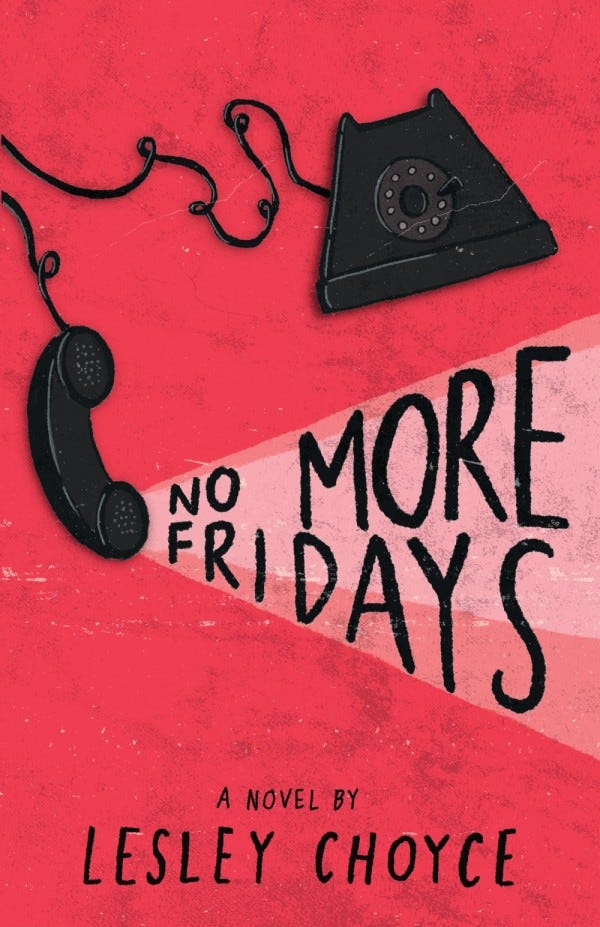
Lesley Choyce came into my life a couple of years ago when I read his novel The Second Season of Jonas MacPherson. When I finished reading that novel, I thought how amazing it was that an author could pack so much emotion and such a strong message into so few pages. Choyce is talented beyond words, and No More Fridays is further proof of that. His writing is fluid, well-paced, to the point and overflowing with wisdom. His characters are you and me and the guy down the road; familiar and relatable. On top of all that, there is a magic stitched throughout the letters and between the lines of his work that I have yet to find elsewhere. This type of writing forces the reader to become the characters, to see life through their lens, to feel their hearts beat, to feel their hearts break.
“No More Fridays chronicles Elliott’s journey through grief after losing his mother to ALS.”
No More Fridays chronicles Elliott’s journey through grief after losing his mother to ALS. His last year of high school should have been a time of celebration, but after watching his mother slowly slip away before his eyes, Elliott lives in a sort of limbo as he processes all that he and his family have lost. His father and brother fare no better as they each feel the loss of that missing piece of their family puzzle. Elliott, not much of a social butterfly, turns to his one friend Riley for support but, having her own personal issues, she must step away from Elliott’s grief for a time, setting boundaries to protect herself from overwhelm. When Elliott must face his pain alone, some inexplicable, perhaps even paranormal things start to happen that begin to change the way he sees the world and to realize that his mother’s free-spirited beliefs might not have been so strange after all. A secret cabin, the wilderness, a dark tunnel, a hurricane, a well, and one antique rotary phone turn this heartfelt tale of grief into an epic quest towards the light, towards healing.
The opening chapter of this novel makes my eyes well up every time I read it, and I have read it often while constructing this review. Titled “Special Abilities”, chapter one introduces us to Elliott as he remembers his mother and her death. These two and a half pages sum up what the story will revolve around, and only later will you realize how important this chapter is. This idea of “special abilities” is one I find is not discussed often anymore, but was always a topic at my grandmother’s table. The gift, the sight, the sense, the shining – all terms used to describe an inexplicable, innate knowing of “things”. It is obvious from right here in chapter one that Elliott and his mother had a special connection, and her belief in his abilities was strong. Even though Elliott was torn between his mother’s free-spirited ideas and his father’s sensible approach to life, in the end it would be the ability his mother saw in him which would give him the strength to overcome.
Each character in this story plays a special role, each showing how varied friendships can be and how those friendships evolve over time. Elliott’s best friend Riley is a very important character to this story, one that I too easily became frustrated with. Disappearing on Elliott in his greatest time of need didn’t sound like something a good friend, let alone a best friend, should do, but as the story developed, I began to understand why she had to step away. Riley, described as “a girl who was all hard science, logic, and critical thinking”, struggled with social interaction, needing to research everything to prepare herself for any and every situation she may encounter. Her act of pulling away from Elliott’s grief meant that she had to fully understand that grief and learn how to best help him before stepping back into the picture. Riley’s way of thinking didn’t always jive with Elliott’s, but early on in their friendship, they had agreed to disagree on certain subjects, both willing to let the other have their own belief system. This great understanding between two friends brought them closer together, creating the type of friendship that allows for comfort in silence and respect during times of conflict, while demonstrating how each individual deals with grief and crisis in their own way.
Every kid needs a place to run away to, a place to escape the “grown-up” world. When I was a kid, it seemed that everyone had a playhouse, a treehouse, or a fort of some kind. We had a mostly fallen down shack in the woods just outside the boundary of my babysitter’s property. It was a place all the kids who lived down that dead-end road would hang out. It was a place we knew we shouldn’t be, a place with an unknown history and our minds went crazy over the possibilities. Going there together, we formed a bond, holding that secret close to our hearts, revelling in that shared experience. The cabin in No More Fridays was Elliott and Riley’s place of refuge, and it brought all those childhood memories of our shack in the woods back to the surface. For Elliott and Riley, the cabin was a place where time seemed to stand still, a place of peace, acceptance, and change. They respected the space, cleaning it and fixing it, and in return, the cabin took care of them. The other characters who visited the cabin throughout the story were all searching for something and no matter who they were, they seemed to find what they were looking for or at least found comfort in the fact that they were not alone. So many pivotal moments took place at the cabin that one could consider it some sort of bridge, offering a connection between one phase of life to another. No matter how you perceive the cabin, it is clear that it plays a crucial role in this story.
Grief is a very personal thing which everyone deals with in their own way. Sometimes that means closing oneself off, sometimes it means leaning on others and other times people just give up, never able to pull themselves out of that rut. No More Fridays does an exemplary job of showing the differences between how each character is affected by loss and how they deal with the aftermath. Elliott’s grief really hit me hard in chapter five when he explains why there will be no more Fridays. As he remembers life before his mother’s illness and then realizes he must say goodbye to the way things once were, a switch flicked inside of me and I felt completely devastated. Reading this novel as a parent was difficult because it details a teenage child’s grief and the unfairness of having the anchor of your existence taken away too soon, but it also made me think about how I would feel as a mother not getting to see my children’s accomplishments throughout their lives. Just thinking about it and all those who have lived through this is crushing. Although unbelievably sad, this story gives a beautifully creative example of how to help those you love deal with their pain – an antique rotary phone. As much as I want to talk about this rotary phone I can’t because I would rather not ruin the story for you. You’ll just have to read the book and see how this all fits together.
I think we can all agree that there are things in this world that cannot be explained. We all see and sense things that don’t really make sense. When someone in our circle dies, sometimes inexplicable events happen because we become more vulnerable and long to have that connection just one more time or maybe they really do come back to guide us. No More Fridays is an important story because it tells us all that it is ok to grieve and it’s ok to believe and to hope that love exists beyond the grave. This novel will expand your mind, open your senses, and fuel your soul. Watching the characters grow and develop throughout this story is magical and will give you a sense of peace in knowing that death is not the end, not by a long stretch. No More Fridays shows us that no matter how your days may change or how far you drift, love will always bring you back. You just need to believe.


About the Author
Lesley Choyce is the author of more than 100 books of literary fiction, poetry, creative nonfiction and young adult novels. He runs Pottersfield Press and has worked as editor with a wide range of Canadian authors. Choyce has been teaching English and creative writing at Dalhousie and other universities for over forty years. He has won the Dartmouth Book Award, Atlantic Poetry Prize and Ann Connor Brimer Award and has been short-listed for the Governor-General’s Award. His books have been published in Danish, German, Spanish, French, Swedish and Slovenian. He was the founding member of the Canadian poetry-rock band, The SurfPoets. In 2022 he was awarded the Atlantic Legacy Award for his “lasting contribution to the development of the literary arts in Atlantic Canada.” He surfs year-round in the North Atlantic.
About the Reviewer
Laura Patterson is a Registered Acupuncturist and a Food Inspector from rural New Brunswick, where she lives with her husband and twin boys. When she’s not busy with life’s craziness, you’ll find her with a warm drink in hand and her nose in a book.
Book Details
Fernwood Publications
April 2026
ISBN: 9781773638041
126 pages
Thanks for sharing Laura's review, Lesley!