

Numb: The Politics of Overwhelm by Mark Abley
Reviewed by Bryn Robinson

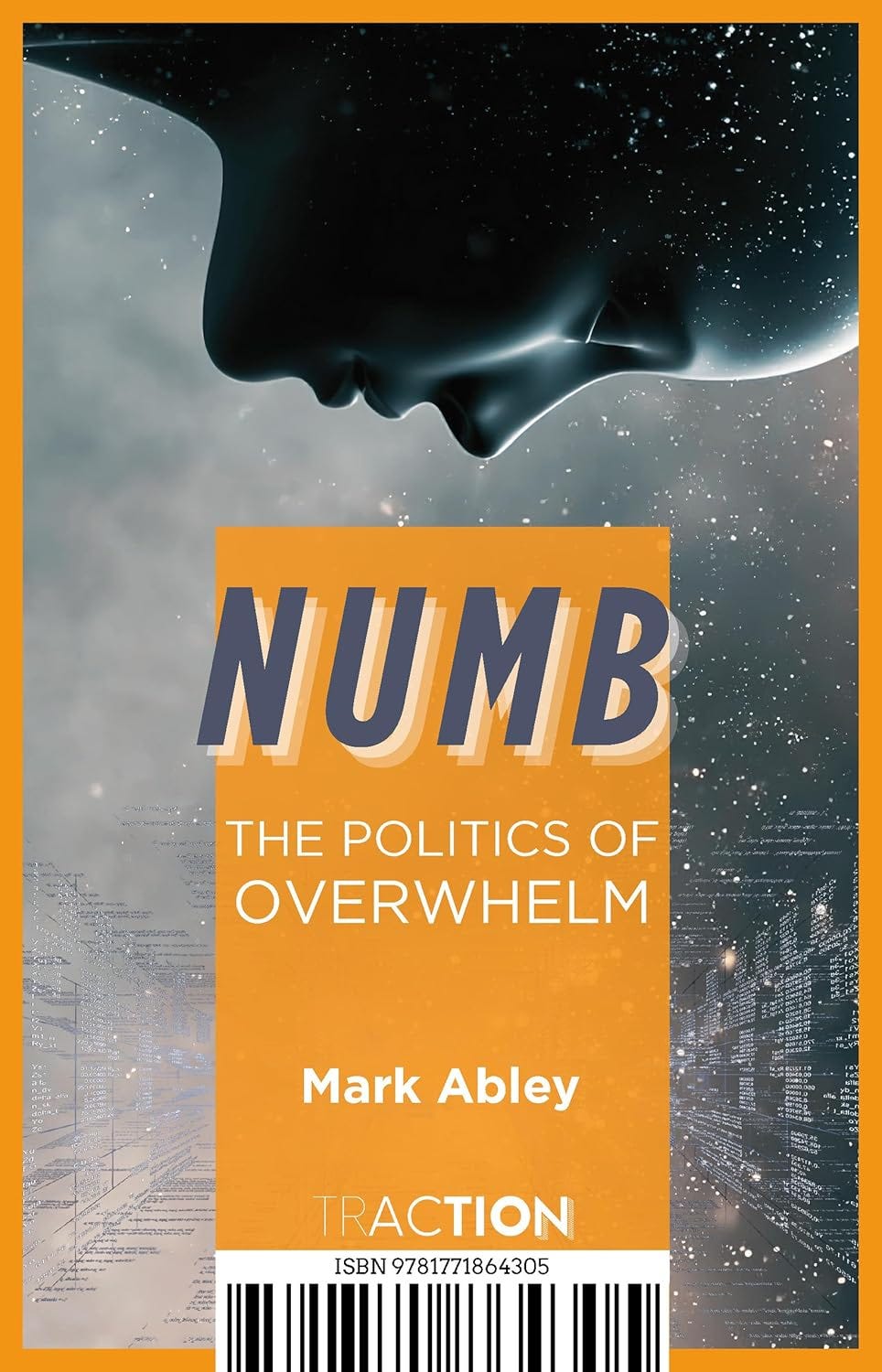
“If you’re distracted, if you’re burned out, if you’re emotionally numb, you won’t see or feel the world rushing by. You won’t hear it, either.”
Under the Traction imprint at Baraka Books — which publishes “small, accessible, affordable and relevant” titles that “address current and contemporary issues and are written by authorities on the subject”— the latest from Mark Abley explores feelings (or lack thereof?) that are not unfamiliar in the age of 24-hour news cycles and social media feeds fuelled on engagement at all costs.
Contrary to its title, Numb begins with deeply affecting imagery of an animal in a zoo enclosure. The last of its kind, a female quagga spends its life in isolation and loneliness, blankly staring at the patrons in (one imagines) despair. One could imagine that this is merely a heartbreaking analogy until the reader quickly sees through the text that we are the quagga, too: Existing, but not really living — not hearing the tall tundra grasses sway in the breeze, smelling the perfume of red dust, running with abandon. We are not free but rather have one foot in the quicksand of learned helplessness, unable to muster much of a response anymore to what feels like unavoidable, unending shocks.
From here, the author lays out the case for the reader that numbness perverts a natural psychological response into a political strategy. Sure, in the short term, allowing oneself to feel numb is adaptive coping; sometimes, a situation requires time to digest. Relying on a wealth of personal experience and global events, Abley notes when and how numbness morphs, from a method of protection, to the avoidance of unprocessed trauma. If one is fortunate, something — a small gesture from a stranger, perhaps — breaks through the shell and allows healing to begin (“I was, at last, getting over the numbness that had ambushed me…a numbness that had lasted through the ensuing weeks and months even while I wrote articles designed to make other people feel.”), but the prospect of and progression to institutionalized hopelessness looms near.
And, Abley argues, that is by design. The politics of “numbness” thrives on the trauma it induces and in the spaces where we feel like the news and rhetoric are unavoidable. (Which news and rhetoric induces this state, he notes, depends on one’s political position) The politicians in question are largely faceless, but numerous examples are handily drawn from our neighbours to the south “‘… What we want to do is to create in the minds…this Shock and Awe, so they are intimidated, …that they have no choice but to do what we want them to do.’” In reading this and other examples in the book, it’s difficult not to consider how an errant government (and by extension, the media that is helpless but to report on them) holds its own population in the same regard as the “enemy”.
A credit to the author, he manages to keep the reader engaged — without being relentless or “almost pornographic” in sharing numbing historical examples to make his point (e.g., pandemics, colonization, genocide, war), and without inducing the very state of withdrawal he is documenting. To that last point, I mused that the format — bite-size, conversational chapters, rather than a deeper academic treatise on the psychology and sociology of numbness — may have been by design to permeate our attention in an age of overwhelm and distraction.
“[WWII] movies tell stories of resistance, of men and women who played a role, small or large, in salvaging goodness from the abyss. Those stories give us hope. They encourage us to believe that, confronted by fascism, we too could rise to the challenge.”
While the book ends with this call to rise to the challenge of resistance, Numb is primarily a quick read documentary that makes the case for taking action and lets you know that you are not alone in your feelings — or lack thereof. Resistance is not futile.

About the Author
Mark Abley is a nonfiction writer, journalist, editor and poet. His most recent books are Strange Bewildering Time: Istanbul to Kathmandu in the Last Year of the Hippie Trail and an updated edition of the ground-breaking Conversations with a Dead Man: Indigenous Rights and the Legacy of Duncan Campbell Scott. One of his earlier books, Spoken Here: Travels Among Threatened Languages, was shortlisted for the Writers’ Trust Nonfiction Prize and the Grand Prix du Livre de Montréal; it has been translated into French, Spanish, Japanese and Latvian. A long-time Montrealer, Abley now lives in Gananoque, Ontario.
About the Reviewer
Bryn Robinson (she/her) lives in New Brunswick, Canada, where she uses her PhD in experimental psychology to support mental health programming in the province. She prefers contemporary fiction, narrative non-fiction, graphic novels and poetry that is emotional, reflective, and if it can do it with humour, all the better. Bryn also writes on Campfire Notebook, where she regularly features her original poetry, photography, and other art. When not reading, she’s searching for birds in the New Brunswick forests and seascapes, camera in hand.
Book Details
Publisher : Baraka Books (June 1, 2026)
Contact & Ordering Information:
Language : English
Paperback : 90 pages
ISBN : 9781771864305