
Nurse Fortescue and Doctor Paddon by Dave Paddon
Reviewed by Robin McGrath

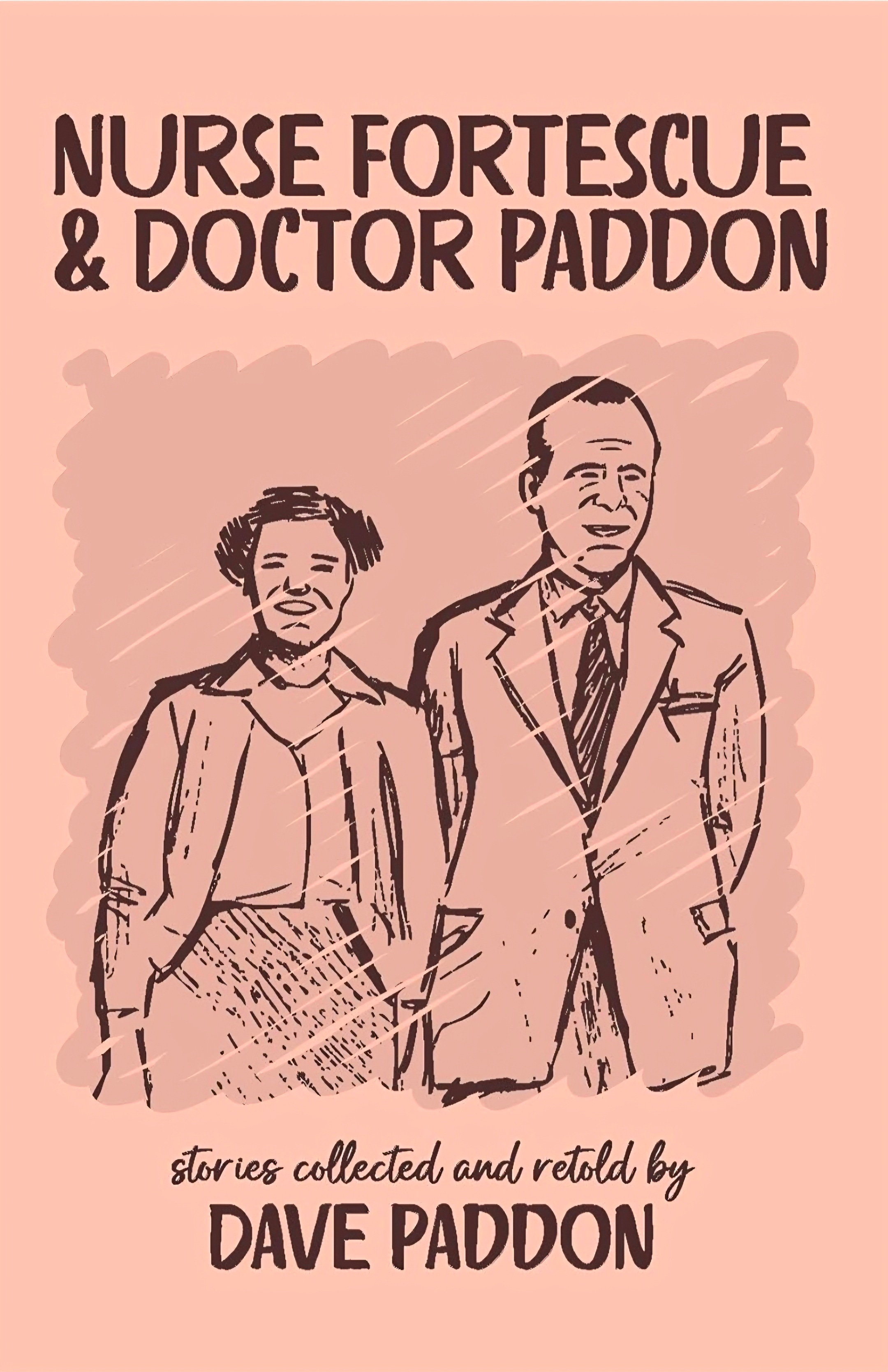
Dr. Tony Paddon was a household name in Labrador, where he practiced medicine for decades, travelling first by boat and dog team, and later by airplane. Known for his medical skills, his compassion, his sense of humour, and his magic tricks, he was the first Labradorian to be appointed Lieutenant Governor of the province after he retired. Much of his life history is covered in his autobiography, Labrador Doctor: My Life with the Grenfell Mission, but his experiences were so unusual and varied that there was a lot that wasn't covered in that book. His son, Dave Paddon, felt that his mother's life with the mission was also worthy of notice, if only to enrich his father's record. Sheila Paddon was essential to her husband's work, but was not inclined to write about her life because “nobody wants to hear that old stuff.” Fortunately, Dave coaxed her into tape-recording two interviews about her life in Labrador before she married, and it is a transcript of these recordings that opens the book Nurse Fortescue and Doctor Paddon.
Readers who didn't know Mrs. Paddon might think that a lengthy description of her training as a nurse and her early years in various Labrador communities would not be compelling, but even without the good doctor's presence, it makes for a very satisfying tale. As a young woman in England, Mrs. Paddon was training to be a farmer, but when the Second World War broke out, she felt that her time would be better used nursing. She enjoyed medicine, and in later years felt that the training she received in England was excellent, but she didn't particularly see the antiquated uniforms and the rigid hierarchy demanded in the profession as necessary. When she went to Labrador to work for the Grenfell medical mission, she found a society that allowed her greater leeway, and that used her skills to greater advantage.
Back in the early days, the Grenfell mission was run on a shoestring, so there was very little money for staff, and simply getting to Labrador from England required imagination, flexibility, and patience. Once there, she quickly adapted to the challenging weather, the Inuit, and Settler helpers, the uncertain travel, and the primitive accommodations. Unlike Tony Paddon, who was born in Labrador, she saw the country and the people with fresh eyes and quickly came to appreciate both. Once she married, her early interest in farming was very useful to her, as it was necessary to be as self-sufficient as possible. The mission in North West River grew enough vegetables to supply the hospital, dormitories, and the coastal nursing stations, and they also kept pigs, chickens, and cows. She even assisted her husband do a Caesarian section on one of the cows. Her primary job, however, was raising her children and running the hospital when her husband was on one of his many journeys along the coast.
The rest of this book focuses on Tony Paddon's naval and medical career. It is a delightful pastiche of extracts from letters, pieces that originally appeared in the Grenfell Mission magazine Among the Deep Sea Fishers, the logs of the Mission ship Maravel, Dr. Paddon's personal-papers and Dave Paddon's conversations with family and friends. It opens with a ten-page letter from Dr. Paddon to the Director of St. Luke's Hospital in New York, where he trained. In it, he recounts several stories of his wartime service aboard the H.M.C.S. Kitchener in 1942. The details of various shipboard emergencies, patients he treated, amusements he encountered, are all conveyed with the humour and detail that Paddon was known for. Paddon also makes reference to several of the verses he composed for the entertainment of his shipmates, including “The Barber Pole Song,” about the escort group he worked with, which has been reproduced in any number of books about the war.
An undated wartime letter opens with the observation that “Events which otherwise might have been quite frightening sometimes seemed to invest themselves in a comforting cloak of broad farce.” The particular story that follows involves an abdominal operation off the coast of Gibraltar. A large bluebottle fly that had hitched a ride from shore landed on the sterile field of the patient's abdomen just as the doctor was about to cut into him. When the Commanding Officer paid an unexpected visit to the O R, and saw “two masked maniacs” dancing around making “wild swipes with towels into thin air,” he was horrified at their behaviour. Other stories involve Paddon's time in Labrador as a student volunteer aboard the Grenfell supply ship Cluett.
By 1946, Paddon had been discharged from the navy and was serving on the Mission ship Maravel for most of the summer. Although this section is labelled a “log,” the account is an after-the-fact description of the ship's dispensary and equipment, Paddon's medical assistant, and the captain and crew of three. The ship seemed to visit every tiny community on both the Southern and Northern Labrador coast, and by the end of the season they had seen 1,500 patients, performed 60 major and minor operations, done 950 dental extractions, and carried out 150 eye tests. Numbers do not convey the variety of Paddon's work, nor the problems he encountered and overcame, but it makes for an interesting and vivid account of the typical work of a hospital ship.
In winters, Tony Paddon, like his father Harry, did his medical rounds by dog team. The trips often covered 1,000 miles (ca. 1,609 km) or more under frequently dreadful weather conditions, but it was the only way the people of Labrador could access medical treatment. His accounts of cold, stormy weather, bleeding feet from snowshoeing in deep, heavy snow, the exhaustion of running beside the dogs or breaking trail for them, the lost paths, and the inadequate accommodation, make it clear that this was no easy outing sitting on a dog sled. Anyone familiar with dog team travel will sympathize with the strong emotional feelings Paddon had for his dogs. He grieves as much over their paws, cut up by shell ice, as he does for his own lacerated feet, and when they run out of food for the poor beasts, Paddon's grief is palpable. His admiration for the work the dogs do and the loyalty they display is unbounded.
The accounts of five winter patrols, from 1946 to 1951, track a gradual shift in medical treatment in Labrador, summed up in a section titled “The Old and the New in Labrador Travel.” The increased availability of air travel improved the use of the doctor's time and skills, although he missed the camaraderie of the men who guided him and the hospitality of the families he stayed with on his travels. The final section includes two letters, one by Dr. Harry Paddon and one by Dr. Tony, both of which are addressed to academic researchers who had made ridiculous requests for assistance in their work. They are hilarious examples of the sense of humour that seems to run in the Paddon family. The book ends with a discussion of the patients the doctor treated, who he describes as “among the most co-operative and appreciative imaginable.”
What readers are left with is an appreciation for the rewards of a hard, difficult working life, two lives lightened by a determination to do the best they could by their fellow humans and their animal companions. For a book that concerns suffering, illness and death, it leaves readers with a sense of optimism and hope regarding difficulties in their own lives.

About the Author
Dave Paddon is well-known across Newfoundland and Labrador for his storytelling and recitations. Nurse Fortescue and Doctor Paddon is his ninth book. He can be found operating the English Harbour Arts Centre with his wife, Kim, regaling audiences at the Crow’s Nest Officers Club in St. John’s, or anywhere folks appreciate a good yarn.
About the Reviewer
Robin McGrath was born in Newfoundland. She earned a doctorate from the University of Western Ontario, taught at the University of Alberta, and for 25 years did research in the Canadian Arctic on Inuit Literature and culture before returning home to Newfoundland and Labrador. She now lives in Harbour Main and is a full-time writer. Robin has published 26 books and over 700 articles, reviews, introductions, prefaces, teaching aids, essays, conference proceedings and chapbooks. Her most recent book is Labrador, A Reader’s Guide. (2023). She is a columnist for the Northeast Avalon Times and does freelance editing.
Book Details
Publisher: Brack and Brine
Publication Date: 2025
Language: English
Print length: 263 pages
ISBN: 978-1-997667-02-5