

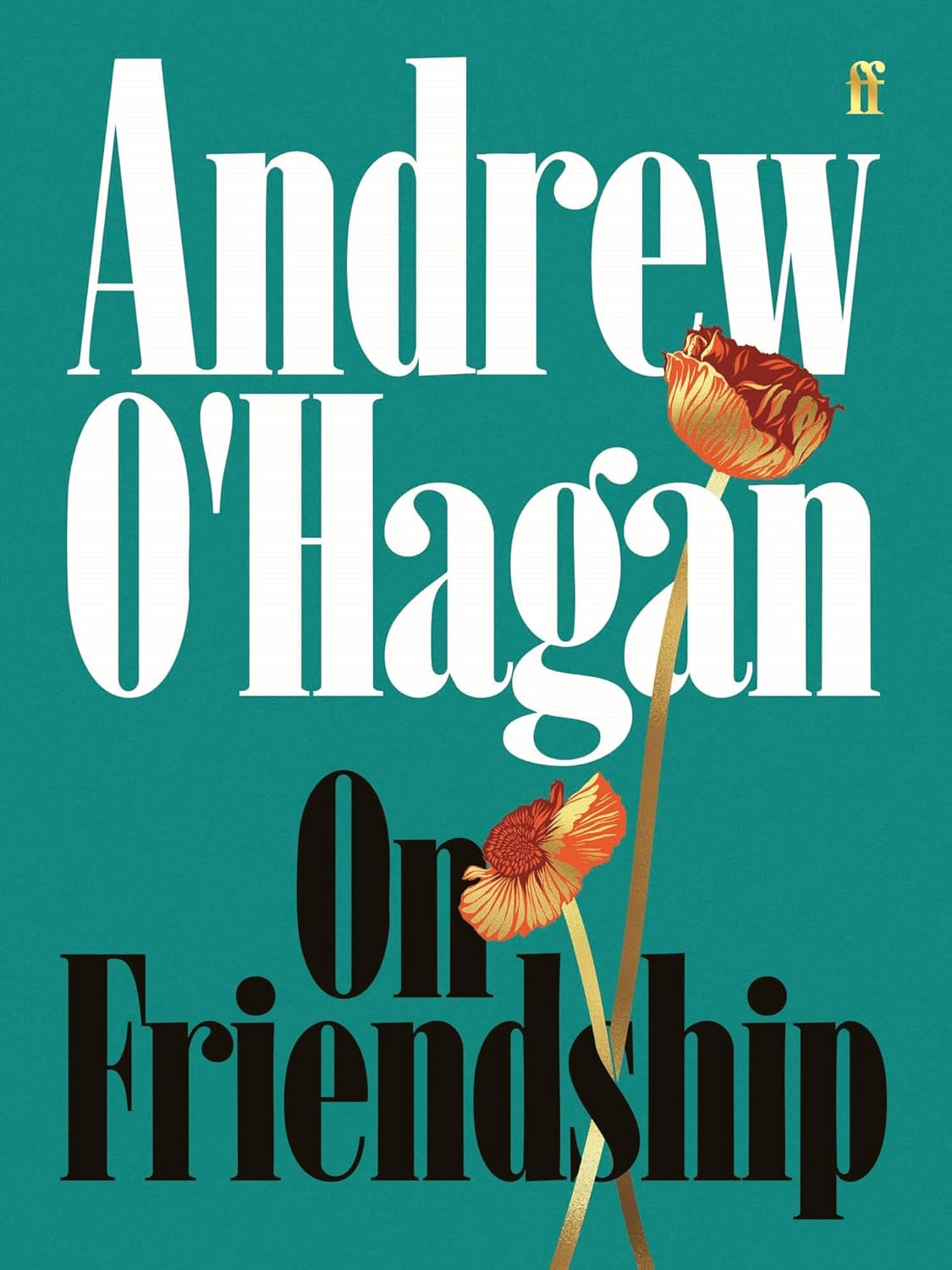
On Friendship by Andrew O’Hagan
Reviewed by Paul Carlucci
About 18 months ago, I got an email from someone I’d lost touch with almost 20 years prior, a friend I met in Goose Bay, Labrador. I was only there for a few months, but we had a great time raucously bonding over loud music, unguarded talks, and mud-soaked CRV rallies deep into the endlessly sprawling wilderness that loomed over town. Now we’ve become fast friends again, building a new connection even as we live provinces apart and haven’t actually seen each other in person. Across rivers, hills, forests, and a gulf, we send pictures, videos, and texts, and we talk on the phone now and then too. It’s like old times, but even older—and better for it.
The richness of this gift is the kind of thing Scottish author and journalist Andrew O’Hagan would appreciate. In his new book, On Friendship, he presents eight short essays on platonic love, exploring amity among children, adults, and even people and other animals. Coming after 2024’s epic and stunning Caledonian Road, this work is a much smaller affair, so short that it sometimes feels unnecessary—and unfortunately, he’s not shy about using the tight space to plug a few of his other novels—but it’s still a memorable read thanks to his keen insights and ruby prose.
In “Boys United,” O’Hagan remembers his first best friend, a troubled but inventive kid with a “mop of chestnut hair and [a] deep fund of jokes.” He traces those early stirrings of loyalty and devotion that were so possessing in our younger years, and he reminds us, without getting nostalgic, just how hard it can be for adults to do what comes so naturally to children and teenagers.
Some of the book’s best lines are in “Losing Friends,” where he writes that “death doesn’t really end a friendship; it sanctifies it. The fact that you won’t see the friend again is a bitter loss, but at another level their vital presence may be guaranteed, a friendship that is now safe from the vagaries of human nature and changeable weather.” He remembers the passing of his friend Keith Martin, and the account has a beauty and pain that his brief connection with Julian Assange simply couldn’t allow; the disgraced whistleblower was only in it for the praise.
If you’re like me, you’ll get a jolt when you read that name: This guy was friends with Julian Assange? The Wikileaks founder is just one of the big personalities O’Hagan mentions, focusing as well on Colm Toíbín and Edna O’Brien, among others. Naturally, as a famous artist and intellectual, O’Hagan keeps notable company. But that success sometimes makes his anecdotes feel out of touch with the so-called friendship recession that’s been cleaving so many less fortunate people apart, particularly men. In fairness, O’Hagan clearly puts a lot of energy into his social life, so class and accomplishment don’t tell the whole story. Still, that he doesn’t really explore the recession seems like an oversight, with one scant mention of “these straitened times for fraternity” in “Boys United” and an overly familiar critique of social media’s ironic toxicity in “‘Friendling.’”
It’s too bad. That balance would’ve made for a longer, more relatable read, even if O’Hagan couldn’t have pulled from his own life to nail it. Personally, as I’ve made my way through the opening salvos of middle age, I’ve accepted that several of my older friendships went toxic long before they finally ended, and others quietly expired due to mutual (maybe even intentional) neglect. But I say that without grief. In fact, not only does it make my recent rekindling such a remarkable experience, it also reminds me to appreciate the healthy bonds that have stayed in bloom—while cautiously keeping space for anything new. Adult friendship, it’s fair to say, is a far more deliberate than instinctual engagement, and O’Hagan’s new book is something to linger over during those deliberations, even if it’s not as substantial as it could be.

About the Author
ANDREW O’HAGAN, a Scottish novelist and essayist, is a winner of the Los Angeles Times Book Prize for Fiction, a three-time nominee for the Booker Prize, the editor-at-large of the London Review of Books, and a contributor to The New Yorker and the New York Review of Books. He lives in London.
About the Reviewer
Paul Carlucci is the author of one novel, The Voyageur, and three story collections, The High-Rise in Fort Fierce, A Plea for Constant Motion, and The Secret Life of Fission. He won the Danuta Gleed Literary Award and has been a finalist for two Ottawa Book Awards and two ReLit Awards. He’s a freelance editor, working with academics and research professionals, hybrid and traditional presses, and aspiring authors.
Book Details
Publisher : Faber & Faber
Publication date : Oct. 9 2025
Edition : Main
Language : English
ISBN-10 : 0571397476
ISBN-13 : 978-0571397471