

On the High Seas by Capt. John W. Froude
A Throwback Thursday review by Robin McGrath

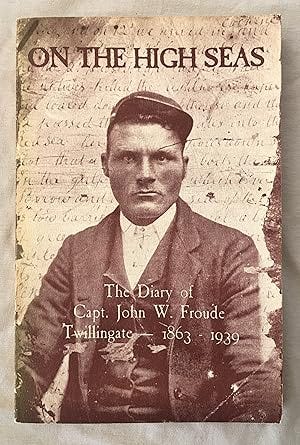
In 1887, at the age of twenty four, a fisherman from Twillingate, Newfoundland, decided that there was no living or future to be had fishing cod, so he signed on as an ocean-going seaman and began to travel around the world. Either because he was lonely or simply because he thought that what he was seeing was worth recording, he began to keep a diary of his international travels. He kept this account of his life, written in an old hard-covered ledger, for eleven years, and then put it away until his death when it was inherited first by one of his sons, then one of his grandsons, and eventually it came to the attention of his great-nephew, Edward Noftle. Noftle brought it to publisher Ivor Jesperson. Almost a century after the author began writing it, and with the help and encouragement of Dr. George Story, Jesperson published the work as On the High Seas: The Diary of Capt. John W. Froude, Twillingate --1863-1939.
I was aware of Capt. Froude's book years ago, in part because I found it referred to often in George Story's Dictionary of Newfoundland English, but it was a book I had put off reading in full, because when I first attempted it, I found it too frustrating. I simply hadn't the patience it required. I knew that Rex Murphy had called it "Newfoundland's Ulysses," but even that wasn't enough to tempt me back when I had children to raise and a living to make. However, I was very glad to find the time for it more than fifty years later.
As described in the Publisher's Note, the text is "an exact transcription of the original diary; it follows the variable spelling, punctuation and capitalization of the original," and "the liniation is also that of the manuscript." In other words, Froude could not spell even his own name consistently, he had little or no use for punctuation, and capital letters were often reserved for the beginnings of each line rather than each sentence, rather than for the names of people, cities or countries.
Second time around, I loved this text almost immediately. The weird spelling, the lack of punctuation, the rapidity of the pace, all of which discouraged me all those years ago, were what I loved about it second time around. Froude's habit of bursting into rhyme with no warning made me laugh, and I particularly liked his combination free verse and rhyme to tell his stories.
It was often a bit of a game for me to try and identify whether what he was writing was original to him or lifted from elsewhere, and despite the spelling I quickly realized that in many places he was quoting from memory. For example, I knew that "From Greenland's icy mountains" was a well-known hymn, and I recognized the line about "men who go down to the sea in ships" which describes sailors seeing the works of the Lord in the deep, including tempestuous winds, high waves and divine deliverance. How could a man like Froude not know that psalm?
I also recognized the 19th century sea song "The Storm," also identified as "The Tradesman's Farewell." "Hark the boatswain harshly bawling--by top sail sheets and halyards stand, / Down top-gallants quick be hauling/ Down our staysails, stand boys stand." There are a few small changes in Froude's version, but they are inconsequential and they fit the scansion and rhyme. Froude is obviously uneducated but he's still pretty good. "Do they miss me at home," probably rings a bell with most of us. The poem was first published in 1844 by the author, Caroline Atherton Mason, but only became well known in 1852 when it was set to music and published by the composer, but without any attribution to Mason. It became popular as a song, and was taken up by soldiers engaged in the American Civil War. The irony is that when I went looking for the lyrics, I found that it had originally been written from the point of view of a homesick girl away at school. I attended residential school and then boarding school for a brief time as a young teen, and I can readily relate to the sentiment, just as Froude did. Many of the phrases I was familiar with were simply common aphorisms adopted by Froude, as we might do ourselves.
I did search for a number of other rhymes that had a familiar ring, including "He learned too late when the sun slipped down / How near he was to the golden crown," which is from a 1920s Edgar Guest poem "Don't Quit," urging persistence when facing hardships; "That's the time to remember the poor," from "The Snow is on the Ground" from 1891; "The Victor is he who can go it alone," from the 19th century poem "The Game of Life " by John Godfrey Saxe; "That's the Time to Remember the Poor," was an anonymous folk song, dating back to 1891; and "In sailing along the river of life, over its waters wide, / We all have to battle with trouble and strife and wait for the turn of the tide," from Harry Clapton, 1867.
No doubt there are many other borrowings tucked away in this journal, but I'm not suggesting Froude intended them to be mistaken for his own compositions. They were probably as familiar to his contemporaries as Beatles lyrics are to those of us who grew up in the 1960s.
“He was clearly not a cold man, but I don't think I'd have wanted him for a husband.”
One rather puzzling aspect of the book for me was the almost complete absence of any reference to Forude's immediate family. Froude mentions at one point that he got married but doesn't say any more than that, not even his wife's name. He eventually refers to his grown son, one of his twelve children, and even then his wife doesn't appear until a few pages from the end, and is still simply an anonymous woman. Froude speaks so warmly of his shipboard friends, naming them and in some cases mourning them. He was clearly not a cold man, but I don't think I'd have wanted him for a husband.
Once Froude has more or less settled back in Newfoundland, his account becomes a bit more pedestrian, though still interesting. The number of boats he sank kept me alert. When he falls back on describing celestial navigation and the use of the compass, I tuned out somewhat, and one can only think he was running short of sea stories. Towards the end of the book, Froude retells many of his adventures and particularly his near misses with death, and my attention began to lag. His poetic impulses come to the fore so he often reverts to rhyme, possibly borrowing phrases from other works, but I think I enjoyed his rougher, free-verse versions more.
Was Froude a good poet? No, but he was a good rhymester in the Newfoundland oral tradition. Particularly in the first half of his journal, he refers to the sea as the briny deep, the broad Atlantic wave, the raging foam, the bounding bellows, rippling waves, blue waters, the bosom of the mighty deep, the proud swelling sea, and (my favourite) like a wild beast roaming over the Patagonian plains. We get much less of this in the later parts of the work. Perhaps he simply realized he didn't have to stretch things quite so much to get our attention.
It has been suggested by some readers that Froude had little education, but he was at school until he was fourteen years old, which in 1877 was pretty advanced for an outport fisherman. More likely, if he were at school today, he would be identified as learning disabled, probably with dysgraphia, a form of dyslexia that affects a person's ability to write thoughts, not his reading capability. Known as Agatha Christie's Learning Disability, for her ability to compose and dictate so many best-selling novels, students today are often provided with a computer, which for some reason bypassed the hand's inability to write accurately. Such a diagnosis now puts dysgraphic authors such as Christie and editor Robert Fulford on an even playing field with otherwise clever and compelling writers.
Finally, I'd just like to add that I think Froude wanted an audience. He was clearly a compelling storyteller, and he kept the diary over a very long period when a great many of his possessions went down with his ships. I'm glad the diary was saved, that his great-nephew salvaged it, and that George Story immediately recognized its value. I'm just sorry I wasn't quite so open to its charms back when I was younger.
About the Reviewer
Robin McGrath was born in Newfoundland. She earned a doctorate from the University of Western Ontario, taught at the University of Alberta, and for 25 years did research in the Canadian Arctic on Inuit Literature and culture before returning home to Newfoundland and Labrador. She now lives in Harbour Main and is a full-time writer. Robin has published 26 books and over 700 articles, reviews, introductions, prefaces, teaching aids, essays, conference proceedings and chapbooks. Her most recent book is Labrador, A Reader's Guide. (2023). She is a columnist for the Northeast Avalon Times and does freelance editing.
Book Details
Publisher: Jesperson Press (Out of print)
Publication date: 1983
Language: English
Print length: 260 pages
ISBN: 0-920502-17-2
What a lovely and well-thought-out review! I like the fact Froude's grand nephew decided to get this work published. These accounts are part of Canadian and world history. It looks like it would be both a satisfying and challenging read. Like the reviewer mentions, it's not Ulysses but like reading the great novel, the reader has to wade through old language, and unfamiliar references, such as poetry long forgotten.
Thank-you for that thoughtful review. What a wonderful window on the past - and what an adventure he had! It is great it has survived. Perhaps he was nicer to his wife and children than what might appear in this account. After all, he is writing about the sea, not home life, so of course he is describing details of his shipmates...it is also that ship life was no doubt more exciting than home life, what with storms and sinkings and exotic places!