

One River: New and Selected Poems by Ricardo Sternberg
A Michael Greenstein Review

Arrivals and Departures
The eponymous poem in Ricardo Sternberg’s “Selected and New Poems” courses through three quatrains to determine whether anything is new or mostly a repetition of earlier endeavours. In other words, Sternberg is concerned with origins, ends, and everything in between. The first sentence of “One River” begins with a parade of monosyllables before branching out somewhat to more syllables in the following lines, as if additional syllables represented life’s accumulations. “This new me is so much like the old me / there’s a chance you didn’t even notice.” What we do notice is a balance of new and old before each me, before switching to the second person pronoun (as if you knew me). The second sentence establishes the rhyme scheme: “Mere passage of time proved no guarantee / when, stubborn, the self refuses change.” Rhyme of me and guarantee is mediated by “mere,” while “change” picks up “chance” and “stubborn” suspends the flow of enjambment with its surrounding caesuras. The self is stubborn from birth and borne along the river of destiny, as it oscillates between an egotistical sublime and run of the mill’s river, all the while bemused and self-effacing.
The second stanza repeats the old-new dichotomy and “like” in a simile to mediate Sternberg’s cosmic and domestic poles, beginning with monosyllables that open out in the rest of the stanza:
I’ve tried my best to learn new tricks,
yet find more comfort in the old groove:
howling at the moon like lunatics
do, mending the heart with needle and string.
That dropped “do” throws tetrameters off balance. The final quatrain begins with an enjambed sentence and ends with a question that shifts the “you” from the beginning of the poem: “Who said you can’t step into the same river twice?” Sidestep and dance step, “One River” ironically interrogates Heraclitus’s river in the experience of once or twice, new and old poems.
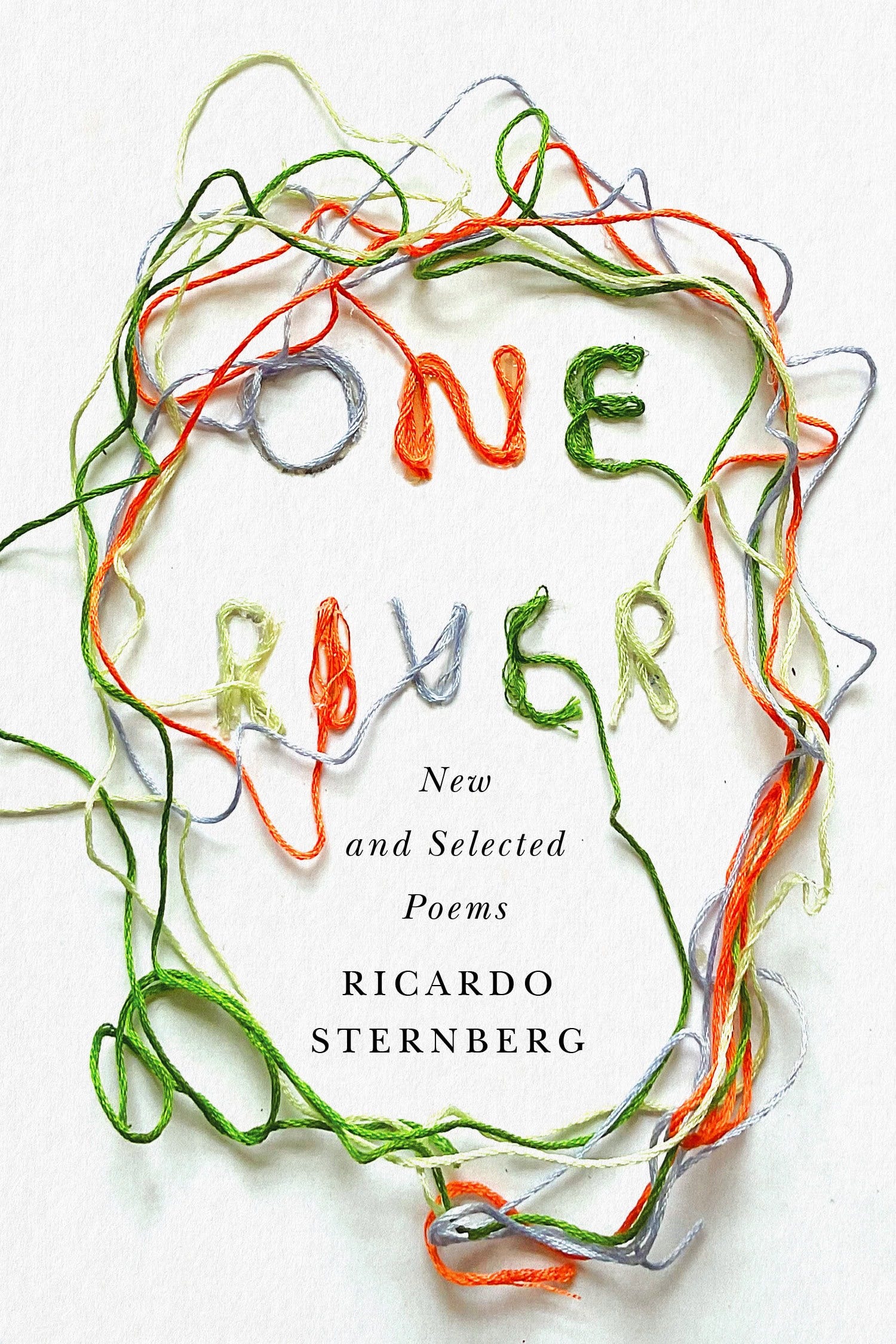
Yet the singular river itself questions the plural colourful rivers swirling on the book’s cover, mending strings braiding states of mind. For “One River” flows into a longer poem, “Rivers,” whose quintain stanzas progress from source to mouth. The poem opens with an epigraph from fifteenth-century Castilian poet Jorge Manrique on the death of his father. Sternberg takes off from those lines:
My father had insisted
he did not want an American funeral,
by which he meant: the cheerfulness
and laughing at anecdotes
the living here tell about the dead.
A colon sits in the stanza’s centre to separate the living and dead.
Rhyming first and last lines, this down-to-earth, matter-of-fact approach continues in the second stanza: “No. He wanted throats constricted, speech impeded, eyes rimmed red.” All those “ed” suffixes reinforce “dead,” and those parallel phrases stamp onomatopoeia of near silence. Eyes rimmed red highlight the poet’s peripheral vision from his unique edge of perception. Alliteration of rimmed red gets extended in the next line – “the room brimming with tears,” where brimming echoes rimmed while preparing for “attending” at the stanza’s finale. Alternating past and present tenses contribute to the river’s grammar, flow, and dream sequence. In the dream the poet places an LP of Edith Piaf under the coffin in the church. In Sternberg’s surrealism, the dream also includes a dead friend David who invites him to drive west to Arizona, which introduces the river motif from Manrique: “Whether this was the same current, / a tributary, or an entirely new dream / didn’t matter, for it carried me / out of sleep.” Carried but not buried, his father is cremated, his ashes taken to the Amazon, upriver to the Paraná. As his ashes mix with the river, “a storm of bright, noisy perroquets” fly to a nearby branch, their noise a kind of rebuff to his father’s desire for quiet. In this tribute and tributary, the poet hopes that their noise follows his father “as he swirled all the way downriver / to the mouth of the Amazon // and into the ocean beyond.” After all the ups and downs, a kind of apotheosis in the oceanic sublime. Mouth of river, poet, and family member converge in the finale.
Sternberg’s verse oscillates between one river and rivers, single precision and multiple meanings, some dance and map of dreams. The final poem in this volume, “Delay,” features yet another of time’s rivers in clipped tercets: “Perhaps a cuff to the head – / think Paul en route to Damascus – / will prove to be his wake-up call.” That call alliterates with cuff and rhymes with Paul in his awakening. The opening “p” pulses through the rest of the poem to underscore the poet’s procrastination: Paul, prove, Proverbial, Prince, prefaces, preludes, and postpone. The two dashes underscore arrested flow in the head cuff which ends up as “cue” in the last stanza. Paul’s route flows to the proverbial river in the second stanza: “Proverbial river, life runs and / runs until it runs dry. / Yet he waits. Defers.” Er sounds project forward: perhaps, proverbial, river, defers, rehearsing, after, first, lingers; while reversals in the middle stanza run in a countercurrent of prefaces, preludes, and rehearsing. That central stanza invokes Hamlet before ending in a question: “Prince of prefaces and preludes, / rehearsing actions he’ll postpone / again. Isn’t now the time?” The final stanzas dramatize inaction and highlight the tension between carpe diem and procrastination, waiting in the wings. The finale’s exclamation – “Begin!” – responds to the middle quintain about time in Sternberg’s rivers of arrivals and departures, and beginnings of belatedness.
Consider another river in “Fishing” with its fluid single stanza. “In otherwise beautiful countryside” stretches syllables which echo wise and side before situating the poet: “I found myself at this fishing hole, / a shallow basin below a bridge / where the quick river slowed / to a sluggish, oily quasi-sludge.” The initial “beautiful” gets undercut by the heavy alliteration of basin below bridge which slows down further in sibilants of slowed, sluggish, sludge, arresting any flow. Bridge over brackish waters and poet share in the experience: If the poet finds himself under the bridge, then the “bridge itself” is “a poster child / for the nation’s decay.” The poet asks, “Why ever did I cast?” and answers “Boredom.” He flicks his line “dead centre” in the middle of the poem where the centre is dead and will not hold, yet he reels in a large trout, “sleek and fully jewelled.” That treasured trout evokes the earlier beauty of the countryside surrounding this dead centre. “That such beauty could emerge / from such a waste of a place / conjured up a spellbound princess.” Because of the industrial decay of the place, the fisherman decides against keeping the trout. “I eased the hook off its lips, / waded into the stream, / releasing that quicksilver / right back into the muck.” In this fable of fish, the poet is prince and principal actor in the midst of pollution.
From his first collection, “The Invention of Honey,” it is evident that Sternberg has dabbled in parables and fables – “A Small Spider,” “Buffalo,” “A Pelican in the Wilderness,” “The Snail,” “Paulito’s Birds,” “Mule,” and “The Ant.” “Some Dance” highlights his choreography of the cosmic and domestic spheres. Sternberg casts his final lines in surprises, epiphanies, and consequential reversals. His swallows return from remote destinations to more familiar terrain “to make right what you first made wrong.” “Ars Longa, Vita Brevis” ends: “best, in short, to call it a day” – a carpe diem against tempus fugit where a spade is a spade in the space of a phrase. In his trajectory, he admits from the start (“The Invention of Honey”) or “as the word engine starts / again at the very start (“Manual”) and concludes in the kitchen where “the music begins / and we begin to dance” (“Some Dance”).

About the Author
Ricardo Sternberg‘s previous books include The Invention of Honey, Map of Dreams, Bamboo Church, and Some Dance. He is also the author of a book on the Brazilian poet Carlos Drummond de Andrade. His poetry has been widely published on both sides of the border in journals such as Descant, The Walrus, The Fiddlehead, The Paris Review, The Nation, Poetry (Chicago) and Ploughshares. He lives in Toronto.
About the Reviewer
Michael Greenstein is a retired professor of English (Université de Sherbrooke). He is the author of Third Solitudes: Tradition and Discontinuity in Jewish-Canadian Literature and has published extensively on Victorian, Canadian, and American Jewish literature.
He has published 250 essays and reviews in books and journals across Canada, the United States, and Europe.
Book Details
Véhicule Press
Publication Date: September 12, 2024
150 pages
7.5 x 5 Inches
ISBN: 9781550656695
 | A guest post by
|
Every poet and poetry lover benefits from Michael Greenstein's close attention, his carefully considered reading.
Thank you, Penn.