
Outspoken: A Journey from Olympic Athlete to Activist by Betty Baxter
Reviewed by Lisa Timpf

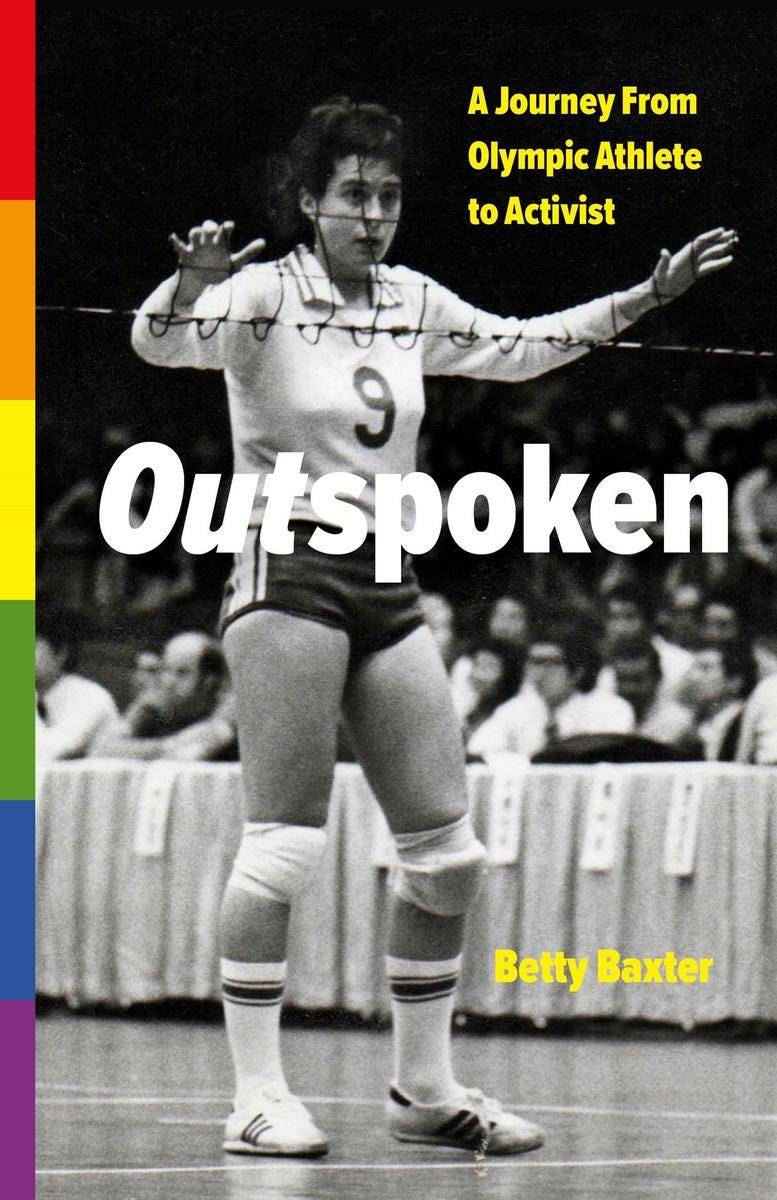
Outspoken: A Journey from Olympic Athlete to Activist shares the life story of Canadian Olympian Betty Baxter. Baxter played for Canada’s national Women’s Volleyball Team for a number of years, and Outspoken conveys the physical and mental demands placed on high-performance athletes in the 1970s. The memoir follows Baxter’s life trajectory, her conflicted relationship with sport, and her work as an activist.
“Baxter provides a vivid sense of both on-the-court and off-the-court experiences, and shares her tribulations, disappointments, and triumphs. An additional nuance on Baxter’s story arose from her need to keep her sexual orientation under wraps.”
Baxter’s love of volleyball developed while she was attending high school in Alberta. After high school, to better position herself to pursue her Olympic dreams, she relocated to British Columbia. There, she played volleyball for a club team while attending the University of British Columbia. Though she struggled initially to balance the demands of school, sports, and a social life, Baxter managed. Issues that arose while playing club volleyball led Baxter to decide to play for UBC instead, and the team won the Canadian Intercollegiate Athletics Union championships twice while Baxter was on the team.
Baxter made the national women’s volleyball team in 1972, and Outspoken describes trips with the national team, including a landmark visit to China in 1973, which was, at that time, just re-opening international relations. Matches in Japan, the 1974 World Championships, training in Cuba, and the Montreal Olympic Games in 1976 are also covered. Baxter includes anecdotes about the team’s experiences during games and travel, occasionally drawing on letters she wrote during that time.
Baxter provides a vivid sense of both on-the-court and off-the-court experiences, and shares her tribulations, disappointments, and triumphs. An additional nuance on Baxter’s story arose from her need to keep her sexual orientation under wraps.
Baxter worked diligently on her strength. Even though she never took performance-enhancing substances, she found herself selected for “random” drug tests more frequently than her teammates, and other athletes, coaches, and members of the public criticized her for being too “masculine,” demonstrating the double standard that exists for female athletes compared to their male counterparts.
Outspoken discusses the post-Olympic letdown, particularly in the 1970s, when many sports organizations lacked year-long plans for their athletes. Though she played in subsequent events for the national team, Baxter was eventually told by the coach that the team would subsequently be trying to develop younger players, effectively ending her national team career.
Baxter served on the National Advisory Council on Fitness and Amateur Sport from 1977-79, and was hired to coach the Canadian women’s volleyball team in 1980. The hiring made headlines, as she was the first woman in that position. Baxter began the job with optimism and ambition, and Outspoken describes her efforts to put the team on the best possible footing.
In January 1982, Baxter was dismissed from her head coaching job because of rumours about her sexual orientation. Baxter was blind sided by the firing, and embittered by the fact that it was driven by prejudicial attitudes rather than performance issues. It took some time to get over it, and Outspoken gives readers a sense of the emotional toll taken. It was not the only occasion on which Baxter’s sexual orientation affected her acceptance within sports circles.
Baxter started the National Coaching School for Women in 1987. She was also a founding member of Canadian Women and Sport (originally the Canadian Association for the Advancement of Women and Sport). Outspoken also details Baxter’s involvement in the Gay Games, first as a participant and later as one of the organizers when the Gay Games III and Cultural Festival was held in Vancouver in 1990.
Olympian Bruce Kidd, Professor Emeritus at University of Toronto, described Outspoken as “one of the best books I have ever read about the helter-skelter creation of the Canadian sports system in the frantic buildup to the 1976 Olympics in Montreal, the state of international sport at the time and the making of a Canadian coach,” calling Baxter’s book “a must for every student of Canadian sport.”
In addition to giving a sense of the physical and emotional demands faced by athletes in high-performance sport, Outspoken is also a first-hand testament to the way societal attitudes put additional pressures on gay athletes. As the Epilogue notes, though there are encouraging signs, the struggle for acceptance is not over, and is facing pushback as the tide of intolerance rises.
Having heard of Baxter years ago while I was taking Physical Education at McMaster University, I was happy for the opportunity to review Outspoken. Baxter’s book offers a behind-the-scenes look at a trailblazing Canadian sports icon and activist.

About the Author
Betty Baxter was born in 1952 in Brooks, Alberta. Prior to turning thirty, she played Olympic volleyball and was one of the rare women to coach the sport internationally. She was a member of the National Advisory Council on Fitness and Amateur Sport for the federal government (1977–79) and a founder of Canadian Women & Sport (1981), and initiated the National Coaching School for Women (1987).
Following her expulsion as Canada’s national coach in 1982, she became an outspoken activist for LGBTQ+ community and human rights. In 1993, she was the first open lesbian to seek federal office in Vancouver Centre, and in 2011 she was elected to her local school board, serving two terms. After many years as an educational and human rights consultant, she is grateful to live, write stories and care for her five horses and three dogs in xwésám (Roberts Creek, BC) on the unceded territory of the shíshálh people.
About the Reviewer
Ontario resident Lisa Timpf writes poetry, book reviews, short stories, and creative nonfiction. Her speculative poetry collections Cats and Dogs in Space (2025) and In Days to Come (2022) are available from Hiraeth Publishing in print and electronic formats. You can find out more about Lisa’s writing projects at http://lisatimpf.blogspot.com/. Lisa is also on Bluesky, @lisatimpf.bsky.social, and her author Facebook page is @lisa.timpf.author.
Book Details
· Publisher: Nightwood Editions
· Publication date: March 10 2026
· Language: English
· Print length: 256 pages
· ISBN-10: 0889715068
· ISBN-13: 978-0889715066
Hi Lisa, this is a thoughtful and powerful review that really honors both Baxter’s athletic achievements and her courage as an activist. You capture the human cost of exclusion in sport while making a strong case for why her story still matters today.